
Ouagadougou, After the Festival Lights
In February 2025, FESPACO garlands hung above the roads between the Cinéastes roundabout, the United Nations roundabout and Place des Femmes. Buses, billboards, radio and television carried the festival through Ouagadougou before the first screening began.
From Place des Cinéastes to a permanent home
Ouagadougou has no fenced-off festival compound. Cinemas, monuments, offices and training rooms sit across the city, while Place des Cinéastes gives film a public address. The 2023 FESPACO programme opened there with a libation for deceased film professionals, followed by a procession to the festival headquarters.
Nearby, the Colonne des Étalons marks the festival’s highest prize. During that same edition, organisers unveiled a statue of Nigerien director Oumarou Ganda beside the column; he had won the first Étalon de Yennenga in 1972. The monument matters because working cinemas, classrooms and archives keep the work around it moving.
FESPACO began here in 1969 as the Premier Festival de cinéma africain de Ouagadougou. A group of film lovers and professionals, including Alimata Salembéré, Louis Tombiano, Hamidou Ouédraogo and Ousmane Sembène, organised its first edition as a non-competitive presentation. They set out to bring films made by Africans, about African realities, to African audiences at a time when colonial control still shaped film production and distribution.
A 1972 decree gave the festival official status, started the competition and introduced the Étalon de Yennenga. The move partly answered the difficulty earlier editions had faced in securing access to privately controlled cinemas. FESPACO became biennial in 1979. The regular return of the festival also left durable addresses in Ouagadougou: MICA, its film and television market, began in 1983; the Cinémathèque africaine followed in 1989; and a permanent headquarters opened in 2005 after decades of shifting premises.
The headquarters stands near the Kadiogo in sector 2. Its 24 offices and meeting room gave the festival its first settled administrative base; in 2023, MICA pavilions, debates and professional meetings filled the site, and the 2025 programme included evening screenings there.
Film cans, photographs and hard drives
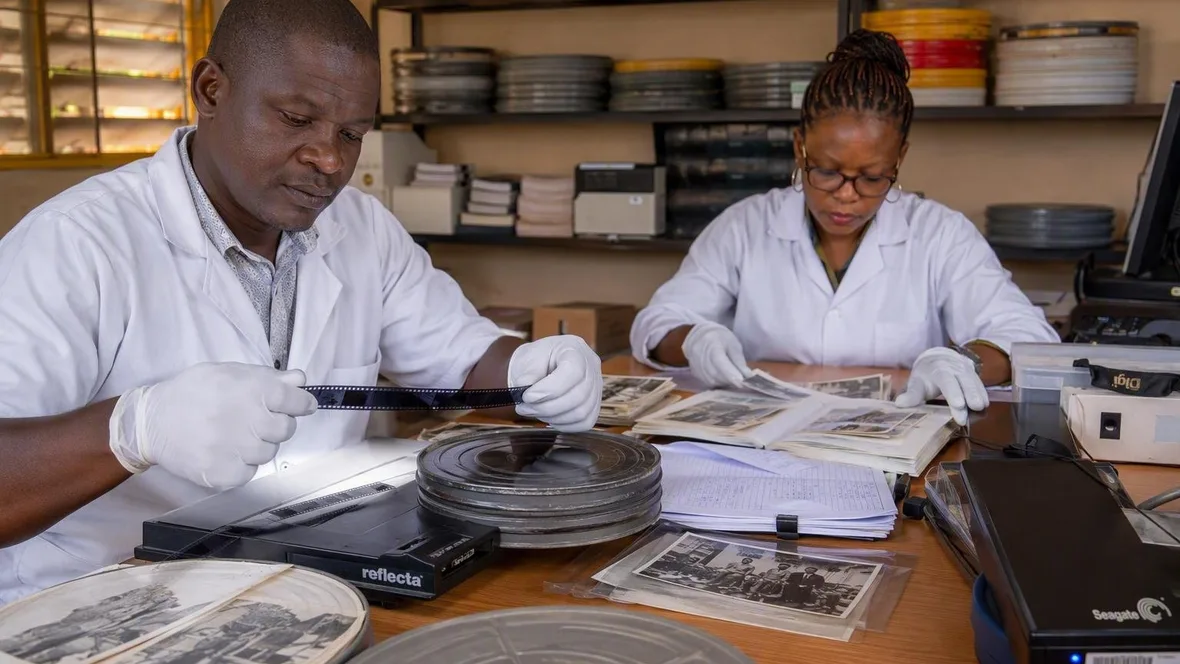
The Cinémathèque africaine de Ouagadougou sits by the headquarters. Founded in 1989, it holds more than 8,000 film and audiovisual works. Its importance lies in the patient work behind that number.
During a 2022 inventory, two teams identified, coded and stored material on celluloid, videotape, discs and hard drives. They also processed posters, photographs and scripts. A 2025 digitisation workshop converted 16 films on 40 reels and catalogued more than 1,200 photographs with captions and classifications. Staff handle reels, check titles and attach names to images between festival editions.
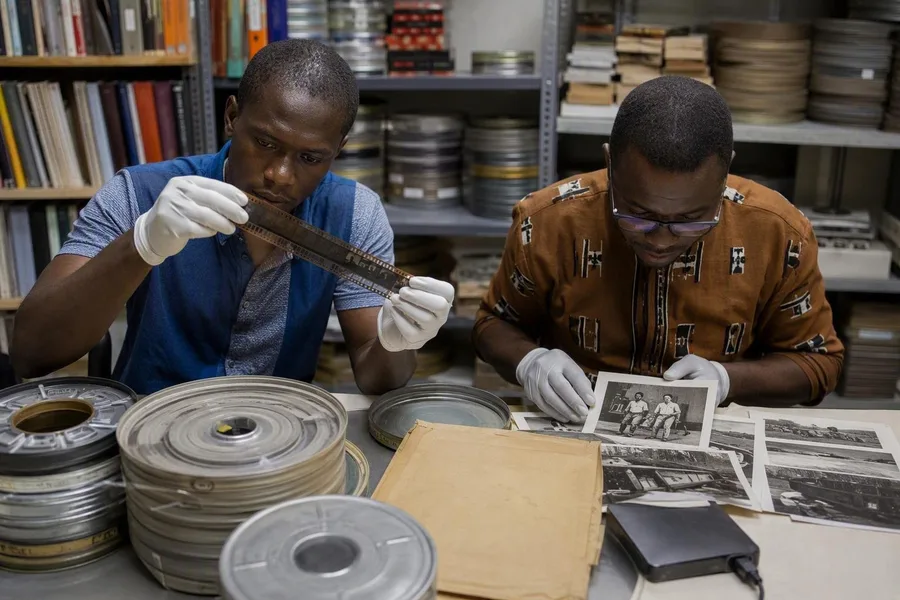 Staff digitise film reels and catalogue photographs at the Cinémathèque africaine de Ouagadougou.
The archive supplies a necessary counterweight to the awards ceremony. A prize recognises a finished film and its director. The cinémathèque keeps the fragile carriers, production papers, still photographs and films that might otherwise become difficult to see.
Screens beyond the biennale
Ciné Burkina remains one of the city’s established screening rooms. During FESPACO 2023, it hosted a commemoration for the Pan-African Federation of Filmmakers and daily FESPACO Classics screenings of restored or historically important films. Before that edition, workers renewed the air conditioning, paint, flooring, stage tiles and sanitary facilities; aluminium doors replaced wooden ones in the toilets. Such repairs make the difference between a ceremonial venue and a usable cinema.
The hall also screens films outside FESPACO. Programmes published for June and July 2026 listed three evening sessions a day, including Burkinabè titles such as Une femme à Kosyam, Les Mendiants VIP de Ouaga and Les Trois Lascars II. Film therefore remains a ticketed evening activity in Ouagadougou, not only a festival occasion or an archival subject.
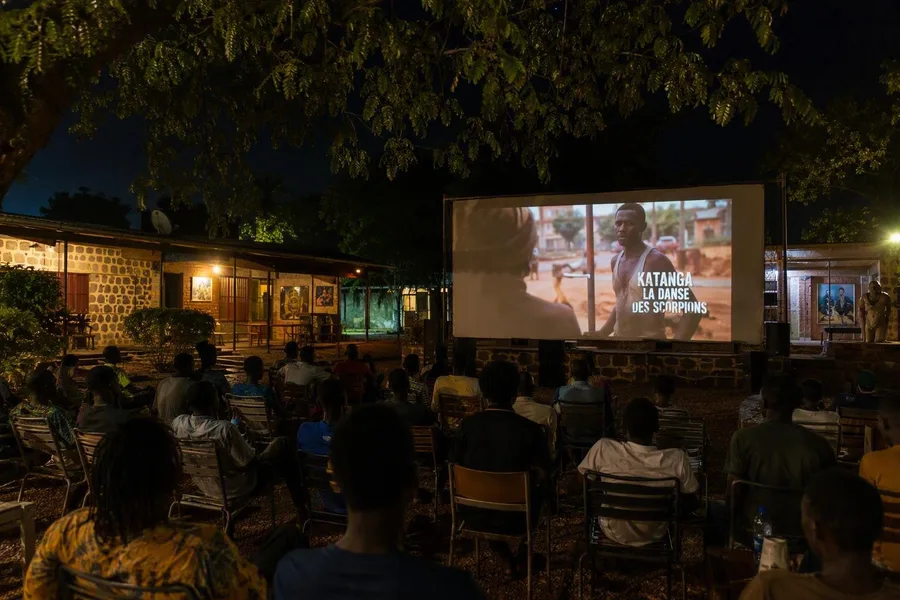 Katanga, la danse des scorpions screens outdoors at the Puma-Rouge grounds in Tanghin.
Other screenings reach neighbourhood grounds. From late October to early December 2025, a European film programme scheduled free outdoor films in Tanghin, Ouidi, Tampouy, Sondogo and Dassasgho. The opening at the Puma-Rouge grounds in Tanghin listed Katanga, la danse des scorpions; later programmes included Apolline Traoré’s Sira.
FESPACO itself used outdoor sites in Saaba, Kossodo, Bassinko, Pazani and Tampouy in 2025. On 25 and 26 February, reports recorded queues at Ciné Burkina, Ciné Neerwaya and the Institut français, while MICA and craft stalls along avenue Kwamé-Nkrumah also drew visitors. That activity belongs to a documented festival week, rather than a permanent picture of the city.
Where new films take shape
Ouagadougou’s film culture also depends on rooms where films are still scripts, rushes or unfinished cuts. Director Gaston Kaboré founded Institut Imagine in 2003, offering professional workshops in writing, directing, production, camera, sound, editing and acting. The institute also runs project coaching, masterclasses and screenings.
Kaboré’s own career links making films to teaching others how to make them. His Buud Yam won FESPACO’s main prize in 1997; at Institut Imagine, he has focused on passing technical skills and film memory to students.
The public film school ISIS-SE offers another fixed base for training. In 2025 it hosted FESPACO’s Fenêtre des écoles, where students from 17 African countries took part in workshops, masterclasses and conferences.
Smaller programmes move projects towards production. Jiguiya Production launched the third intake of Ouaga Tout Court in May 2025, with writing workshops, pitch sessions and technical preparation for short films. Ouaga Stories grew from Ouaga Film Lab, founded in the city in 2016, and now combines script development, mentoring, residencies and support for producers. Nearly 100 projects passed through the earlier lab, and around 20 feature films and documentaries later reached cinemas or television.
A practical note
The Centre culturel du Faso in Ouaga 2000 publishes a weekly cinema programme online and normally schedules films every day except Monday. Ciné Burkina posts short-term listings through its social-media feed, so the latest announcement is more useful than an old festival schedule. During FESPACO, use the official programme: screenings spread across cinemas, cultural centres, the headquarters and temporary venues.
The screen Sankara asked for
Ciné Neerwaya gives this network its most distinctive building. Frank-Alain Kaboré designed and built the cinema in 1986 at the request of President Thomas Sankara, after a lack of suitable halls had threatened FESPACO’s future in Ouagadougou. Its name means “beauty has arrived.” Rounded forms and painted FESPACO figures mark its exterior.
Rodrigue “Rakis” Kaboré, the builder’s son, took over management in 2000 and combined exhibition with distribution and production. Strong attendance for Gaston Kaboré’s Buud Yam led him to seek out more Burkinabè and other African films, distribute them and help finance productions intended for cinemas. The hall built to retain a festival also became a workplace where ticket sales affected what producers could bring to the screen.
Neerwaya remained a major FESPACO venue in 2025. Its original seats still faced the screen in 2021. Behind the curved façade, a thousand-plus-seat hall built for an urgent shortage of screens still holds its rows in the dark, waiting for the projector to start.