One Warm Round of Non at Siab Bazaar
A Samarkand non begins in a clay tandyr long before it reaches the bread stalls at Siab Bazaar. Its stamped centre, thick rim and red-gold crust carry the marks of fast work, fierce heat and a morning market already busy with food.
At three in the morning, a family bakery in Samarkand starts work on its first non of the day. The first fresh loaves are ready around nine.
The work takes place close to the tandyr. This is no roomy modern oven: it rises like a tall clay jar, its inner walls lined with clay that holds intense heat. Uzbek ceramic practice has long included tandyrs alongside pots and other fired wares. Here, the clay has a hard, practical purpose.
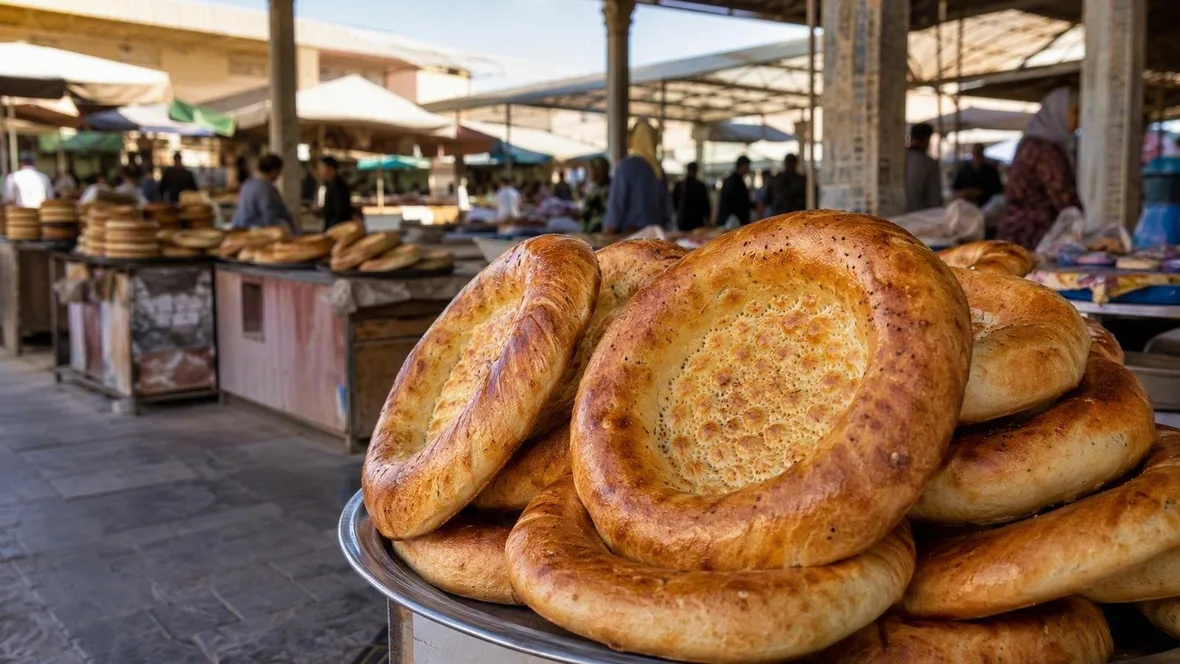
A non begins as a broad, heavy round. Samarkand bread is notably thick, with a raised outer rim and a flatter centre. The baker handles a substantial disc rather than a thin sheet of dough.
Several pairs of hands can divide the work. One worker rolls the dough. Another shapes the round and presses its centre. A third fixes the bread to the oven wall, then removes it when the crust has set.
The chekich leaves the first visible mark. This small wooden stamp carries sharp points; traditional versions use walnut wood and steel needles. The baker presses it firmly into the pale middle of the round, leaving dense dots and lines that may form geometric or floral patterns.
Those pinpricks do more than decorate the loaf. They let steam escape, so the centre stays low while the rim rises thicker around it. The chekich gives each non its familiar face: a patterned, shallow centre enclosed by a full, padded edge. Different bakers and places use different stamps.
Then the soft round goes into the heat. The baker does not slide it onto a tray. With a quick slap, the baker places the dough directly against the tandyr’s glowing curved wall, where it grips the clay.
The oven leaves no room for leisurely movements. One account of a Samarkand bakery shows a baker reaching into the heat in long sleeves, gloves, head covering and a face mask. Those garments belonged to that bakery, but they make clear how close the work comes to the oven mouth.
Fire and clay change the surface quickly. The pale dough takes on a red-gold crust. The stamped middle darkens around its perforations, while the rim keeps its thickness and the interior remains soft.
Samarkand non has a firm crust and a dense, chewy crumb. It is not an airy loaf that collapses when lifted. The bread holds its weight, and its lightly glossy skin catches the first useful light of the day.
Ash waits at the bottom of the tandyr. A loaf that slips from the wall can fall into it; in Samarkand, bread that falls into tandyr ash carries a particular reverence. The baker watches the wall closely and frees each loaf before it drops.
A long pole peels the baked round from the clay. A wooden basket catches it underneath. The loaf passes in a moment from the scorched wall to the pole, from the pole to the basket, then into waiting hands.
By the time fresh non appears at Siab Bazaar, the market has moved into its morning rhythm. Under covered halls, roofs and domes soften the daylight. Outside, longer shadows fall across uneven paving, kerbs and steps.
The bread stalls show the loaves at their most abundant. Sellers stack the large rounds in towers or arrange them on broad metal trays, sometimes while steam still rises from the crusts. The stamped sides face upward.
Each stack repeats the same strong shape: a deep, patterned centre and a swollen rim. Some loaves carry sesame or nigella seeds. All keep the thick, golden profile that makes Samarkand non easy to spot among the market’s colours.
Siab Bazaar sells bread beside dried apricots, raisins, nuts, sweets, spices and tea. Nearby stalls add ripe melons, tomatoes and leafy greens to the morning’s food.
The air holds several smells at once. Fresh bread brings warm flour and crust. Ground spices add a sharper note, while dried fruit gives the covered passages a sweeter edge. Ripe melons sit somewhere between them.
Sound carries across the market as well. Traders and customers bargain and exchange greetings in Uzbek, Tajik and Russian. Porters call as they steer loaded handcarts through the passages, their wheels moving from smooth concrete in the main halls to rougher ground near the outer lanes.
The bread sellers keep their hands on the work. They straighten a stack, settle another round on a tray and turn the patterned face upwards. Buyers compare tomatoes, select sweets and pause at the bread counters for a loaf that needs no further preparation.
Non belongs to the daily food trade here. It is sold with the things that fill Samarkand kitchens and morning tables, rather than set apart as a souvenir.
The large rounds can be carried away in cloth bags, pressed against the body. Their sturdy crust and compact crumb travel better than a delicate loaf, and their weight is immediately apparent in a full bag.
At the table, no knife cuts through the non. Hands break it from the raised edge and share the pieces with tea or use them to pick up other food. The decorated side stays uppermost.
At Siab, another warm round rests on a metal tray. Its centre holds the tiny marks of the chekich. Steam thins over the glossy crust, and the thick rim still gives off heat.
Keep exploring