
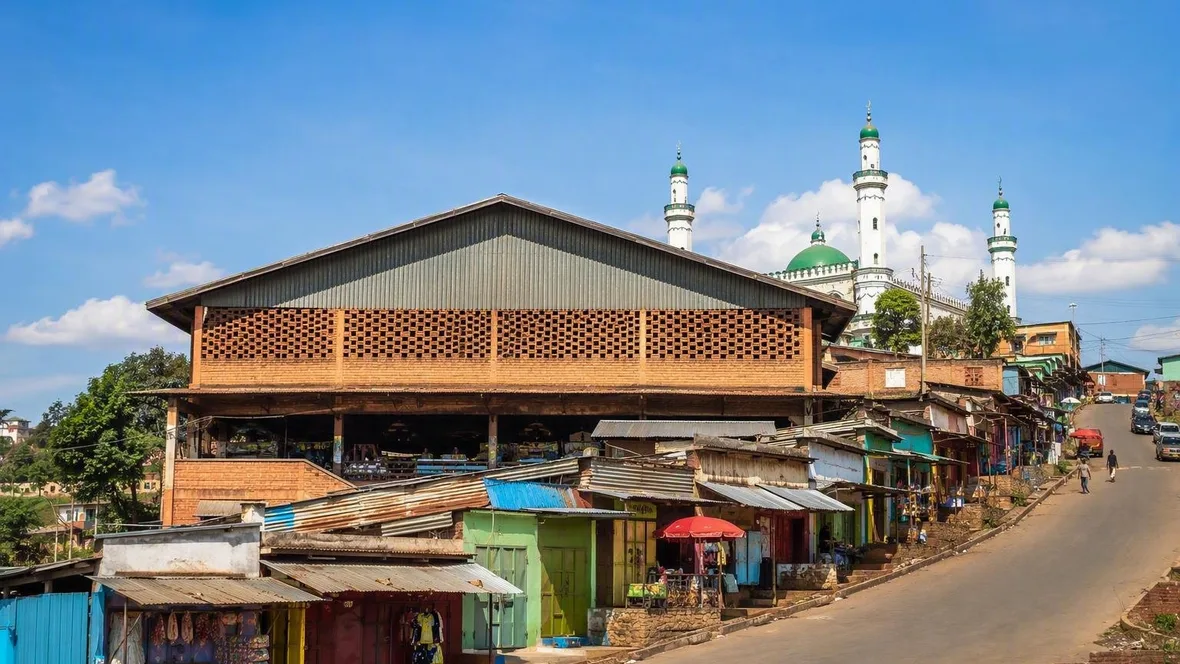
Nyamirambo at Street Level: Markets, Mosques and Makers
Biryogo Market stands where a plateau drops into Nyamirambo’s steep flanks. In its brick-and-corrugated-iron hall, fruit and vegetables fill a central platform, while wooden stalls and narrow passages run around the edges.
Nyamirambo lies southwest of central Kigali, over hills lined mainly with single-storey homes and broken up by denser commercial buildings. Workshops, mosques, market stalls and houses stand close together. The slope shapes the work here. So do the hands that carry food, fabric and second-hand goods through the streets.
Biryogo grew through trade and faith
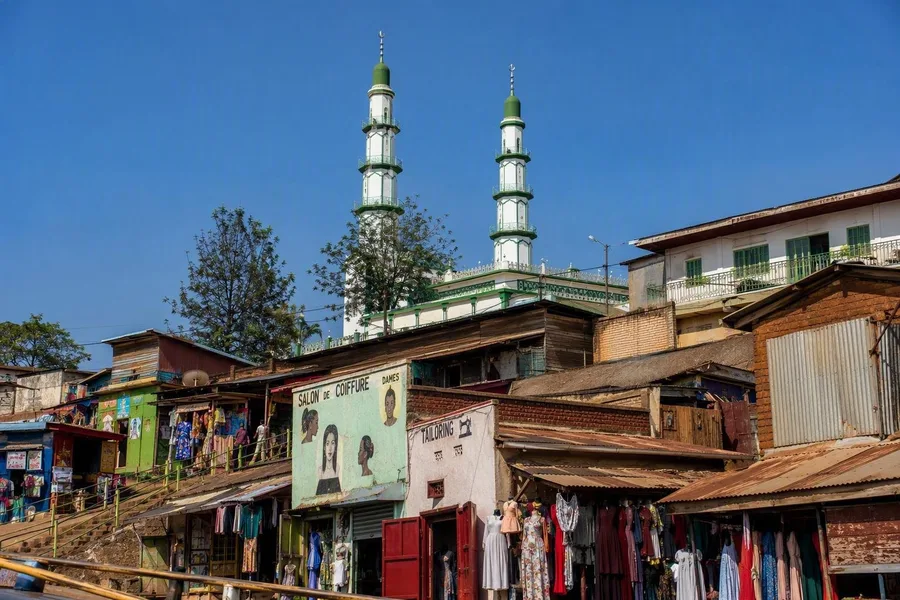 Green-and-white minarets of the Green Mosque rise above Biryogo’s shops and tailors.
Biryogo, one of Nyamirambo’s busiest trading areas, took shape under Belgian colonial rule. Officials used “Swahili” as a broad category for African Muslims, including Rwandans, migrants and converts, then moved this population behind a military camp in 1937. The settlement stood on the southern side of Nyarugenge Hill, separated from Kigali’s European quarter by military land.
That imposed label hid real differences. Early Kigali already drew Swahili-speaking Africans, Afro-Arabs, Omanis and Indians who worked along caravan and trading networks. Muslim merchants later settled around Biryogo, where shops, workshops and religious institutions became closely linked.
The Green Mosque, with green-and-white minarets, stands among tailors, salons and shops. It serves as a place of worship and marks the long presence of Muslim traders in Nyamirambo; businesses in this trading tradition have often stayed open later than elsewhere in Kigali.
Nyamirambo changed again after 1994. Returning Rwandans and newcomers from Congo, Burundi and Uganda added workshops, garages and other small enterprises, while earlier reporting recorded Rwandan, Congolese, Burundian, Ugandan, Tanzanian, Senegalese and Malian traders in the neighbourhood. No single migration produced this mix. Long regional ties and later settlement in the capital built it, business by business.
The market streets climb and tighten
Biryogo has a street grid, but the ground breaks into hills beyond it. The market occupies the edge between the plateau and steeper slopes, set back from a large ring road. In parts of Nyamirambo, tightly spaced buildings and little street greenery leave pedestrians exposed to strong sun.
The market makes that geography practical. Produce sellers use the central platform, manufactured goods fill wooden booths around it, and customers move between product groups along narrow aisles. Commercial streets continue this trade outside the hall.
Textiles form the clearest thread. Traders stack brightly printed kitenge, a waxed cotton fabric, while tailors keep spools of thread and sewing machines in small kiosks. Customers choose cloth, take measurements and commission clothes; Rwandan, Senegalese and Congolese tailors have all worked within this local system of sale and production. Shops around Nyamirambo Market also sell second-hand clothes, used electronics and handmade leather shoes.
A second-hand clothing auction gathers bidders around a platform. Nearby salons, repair businesses and small restaurants extend the trade without changing its scale. These are workplaces and service businesses, not staged displays of neighbourhood life.
Food businesses follow the same compact pattern. Milk bars commonly centre on fresh cow’s milk, served hot and steamed, sometimes with cocoa, honey or tea. Market ingredients supply small restaurants, while whole grilled tilapia with onion and spices, known locally as big fish, appears among the dishes associated with the area.
Nyamirambo’s pedestrian area replaces traffic noise with footfall and conversation, with fresh chapati prepared nearby. Elsewhere, motorbike horns, bargaining and the call to prayer make up documented layers of public sound.
Sewing and study at the Women’s Center
On KN 7 Avenue, the Nyamirambo Women’s Center combines production, teaching and neighbourhood activities. Eighteen women from Nyamirambo founded it in 2007 in response to inequality, discrimination and gender-based violence. Three founders could not read or write, so members first taught one another in homes and local administrative offices.
The centre offers literacy, English, basic computer skills, sewing and handicraft training, as well as hairdressing courses and sessions on health and women’s rights. Its library holds books in Kinyarwanda, English and French, and it runs afternoon activities for children.
The Umutima sewing cooperative, established in 2013, turns training into paid work. Its members cut and stitch kitenge into children’s clothes, accessories and household items; sales support wages, working conditions and the centre’s programmes. The shop and classroom therefore sit on the same practical chain: skills lead to production, and production helps fund more teaching.
Local guides lead walks from the centre to a salon, a tailor, two mosques and a place where cassava leaves are pounded. The walks begin with a short Kinyarwanda lesson. Cooking sessions start with market purchases and use charcoal stoves, while other workshops teach sisal basket weaving. Revenue supports the cooperative, lessons and library.
Across the road, Stitch of Hope makes hand-cut and hand-sewn bags, cushions and jackets, and trains women in sewing. The organisations operate independently, but their addresses place teaching, cloth work and finished products within the same small patch of Biryogo.
Mosques, murals and music
Nyamirambo’s religious history includes difficult memory as well as continuity. During the 1994 genocide against the Tutsi, many Muslims sheltered people in homes and mosques, while research also documents Muslim participation in violence and disagreement over how this period is remembered.
Kurema Kureba Kwiga works with professional Rwandan artists to paint walls and other public surfaces in Nyamirambo. The neighbourhood also contains recording studios, radio stations and small venues where hip-hop and reggae artists work and perform. These places sit alongside the shops and food businesses rather than apart from them.
Practical details
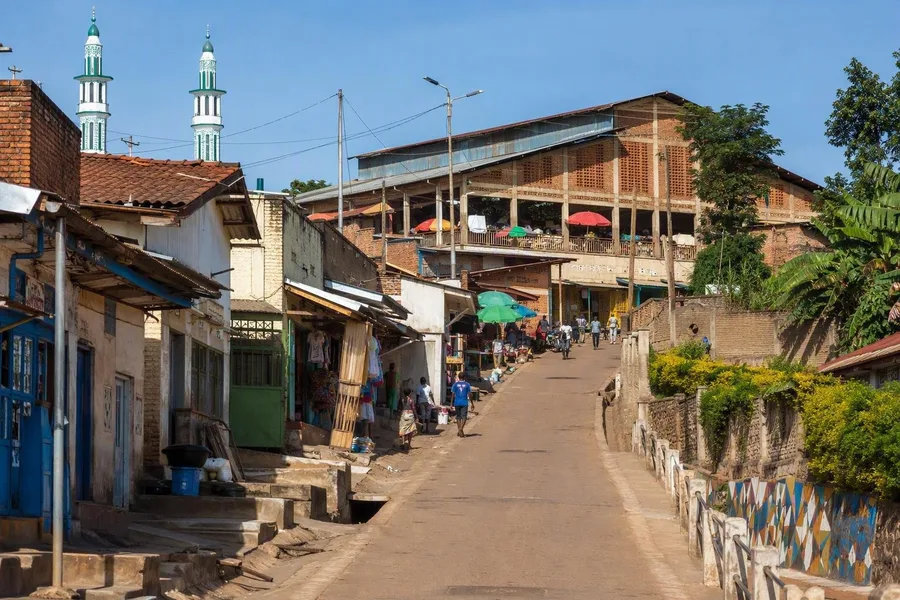 A Biryogo street climbs toward the brick-and-corrugated-iron market hall in Nyamirambo.
Nyamirambo lies about 2 kilometres southwest of central Kigali, and a taxi is the simplest way to reach it. The Nyamirambo Women’s Center stands at House 22, KN 7 Avenue, on the corner with KN 132 Street. It opens Monday to Saturday from 9am to 5pm, except on the final Saturday of each month, when it opens at noon after Umuganda. Walks, cooking sessions and basket workshops require advance contact through the centre.
From the lower streets, Biryogo rises toward the market at the plateau’s edge. The brick market hall comes into view above the climb, with shopfronts pressed along the slope and the Green Mosque’s white-and-green minarets above them.