New Hands in Oamaru’s Old Warehouses
Oamaru’s Victorian Precinct grew beside a working port, not as a historical stage set. Grain and wool once filled its pale limestone warehouses; galleries, studios, a brewery and other small businesses now use their loading spaces and heavy floors.
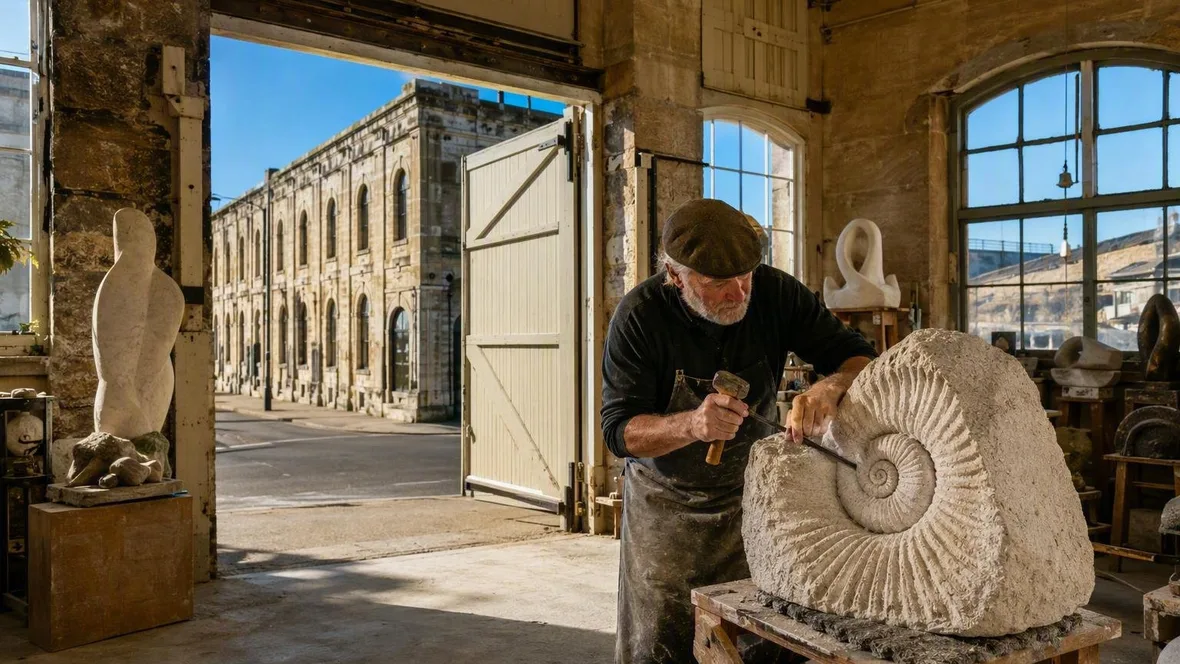
At 1 Humber Street, an 1883 grain elevator now houses Steampunk HQ, where sculptures, film and sound turn Victorian industrial forms into retrofuturist art. It marks the edge of Oamaru’s Victorian Precinct, a compact district of former commercial buildings along Harbour and Tyne Streets.
Most of the warehouses on Harbour Street date from 1870 to 1885. Grain and wool from North Otago paid for their size and their unusually elaborate façades. The buildings still make clear that this was a place of trade on a serious scale, even when a paper-mâché face or a handwoven textile now appears behind a former loading door.
The port built Harbour Street
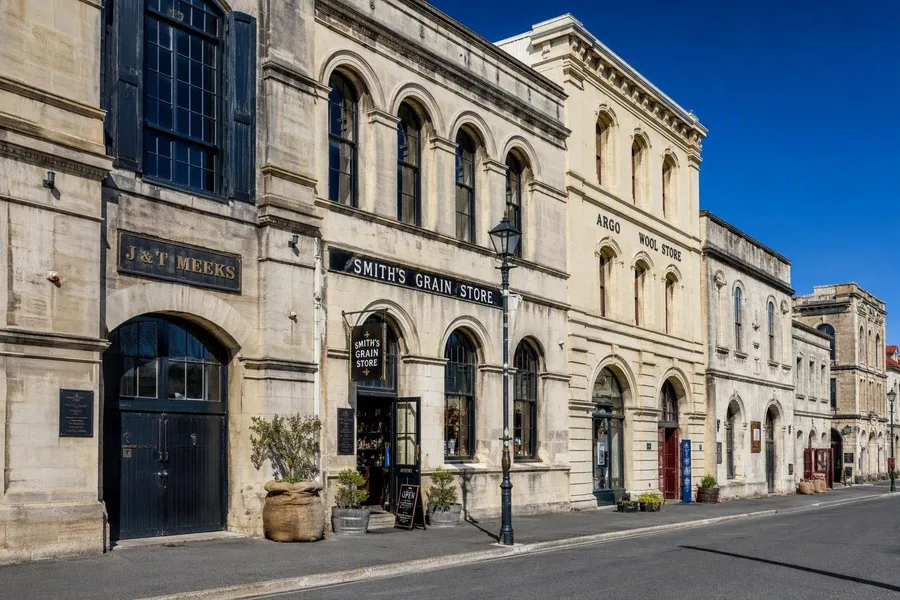 Former grain and wool warehouses line Harbour Street in Oamaru’s Victorian Precinct.
Oamaru’s waterfront was an exposed and hazardous coast until work started on a concrete breakwater in 1872. Macandrew Wharf opened in 1875, after which shipwrecks almost disappeared. The harbour authority divided and leased the land between Tyne Street and the sea. Grain and wool stores rose along Harbour Street, while Tyne Street filled with the banks, offices and shops that served the port.
Produce travelled from North Otago farms by rail to the stores and wharves. Grain and wool went elsewhere in New Zealand and overseas. Refrigerated sheep and lamb meat joined the trade from 1884, and the Elderslie sailed directly between Oamaru and London.
The warehouses handled quantities that explain their bulk. The former Loan and Mercantile warehouse held 100,000 sacks of grain, and water-powered lifts carried sacks between its floors. J & T Meeks Store, built in 1876 for a milling company, held 30,000 sacks. Merchants also spent money on stonework that gave practical stores the manners of Venetian palazzi. Victorian commerce, as usual, liked a respectable front door.
Oamaru stone, cut for commerce
Local Oamaru stone gave builders that flourish. The fine-grained bryozoan limestone is honey-white, soft when quarried and harder later; stonemasons could cut crisp mouldings, reliefs and ornament into it. Repeated pale walls, cornices and window lines give Harbour Street a continuous face, while different heights and details identify the separate warehouses.
Sumpter’s Grain Store carries a rusticated base, arched upper windows, Corinthian pilasters and several styles of keystone. Smith’s Union Grain Store shows the same split between presentation and work: its Tyne Street façade is richly decorated, while its Harbour Street side is plainer and built for loading.
Maude’s Store interrupts the limestone run with rougher local grey stone, visible gables and no parapet. The contrast makes the surrounding honey-white stone more striking. It also shows that the precinct was built lot by lot for businesses with different needs, rather than designed as one tidy architectural set.
Cloth, art and old seed cleaners
At 3 Harbour Street, Crafted: Waitaki Artisan Gallery occupies a preserved Oamaru-stone building. Around 15 local artists show weaving, glasswork, turned wood, basketry, sculpture, painting and textiles. Members staff the collective gallery, so they can explain the materials and making behind the work.
Rod and Sue McLean, who established Crafted, show limited-edition textiles under the name McLean & Co Weavers. Crafted is principally a place to see and buy finished work, rather than a scheduled demonstration workshop. That distinction is worth keeping in mind here: some former stores contain working studios, while others give small makers a public shopfront.
J & T Meeks at 6 Harbour Street has followed the district’s changing trade. After its milling-company years, it held grass-seed cleaning machinery and later served as a wool store. The seed cleaners remain inside as part of a display. Cycle Journeys and the Buggy Robot Gallery now occupy parts of the building. Its broad floors and large openings, once designed for bulk goods, now hold equipment, exhibitions and visitors.
Former warehouses across the precinct now contain galleries, shops, studios, food and drink businesses, and other small enterprises. QR codes in shop windows explain the histories of individual buildings. The old commercial fabric has stayed visible because its large, durable rooms have proved useful for smaller-scale work.
Faces above Smith’s Grain Store
Smith’s Union Grain Store stands at the meeting of Tyne and Harbour Streets. On its upper floor, Donna Demente runs Grainstore Gallery as a studio, salon, collection and museum. Her paintings, detailed masks, papier-mâché busts and faces sit among collected objects and small displays.
The building began as seed storage and then housed Oamaru’s local newspaper for almost 70 years. Grainstore Gallery occupies the Harbour Street side today. The Waitaki Whitestone Geopark and the New Zealand Whisky Collection Cellar Door face Tyne Street. The cellar door offers whisky tasting and sales; the available sources do not support a claim that whisky is distilled in the building.
A little farther along Tyne Street, the former McCarthy’s coal premises now hold six studios or workshops, a small event space, a craft shop and a brewery. Its old yard, arched passage and three differently built bays remain visible. Coal arrived here by rail until the early 1990s. At 10 Harbour Street, Craftwork Brewery occupies a former grain store. The change is plain enough: agricultural goods once moved through these blocks in sacks and wagons; now small businesses make, show, pour and sell from the same robust spaces.
A short walk through the precinct
The precinct covers Harbour and Tyne Streets. Start at 2 Harbour Street, follow Harbour Street, then return along Tyne Street; businesses keep individual hours, so check a particular gallery or studio before setting out. Street parking is available around central Oamaru. Craftwork Brewery takes advance bookings for brewery tours. Ian Andersen’s walk-through sculpture studio runs from 11 Harbour Street to 15 Tyne Street and lists no fixed public hours.
The warehouse at Wansbeck Street
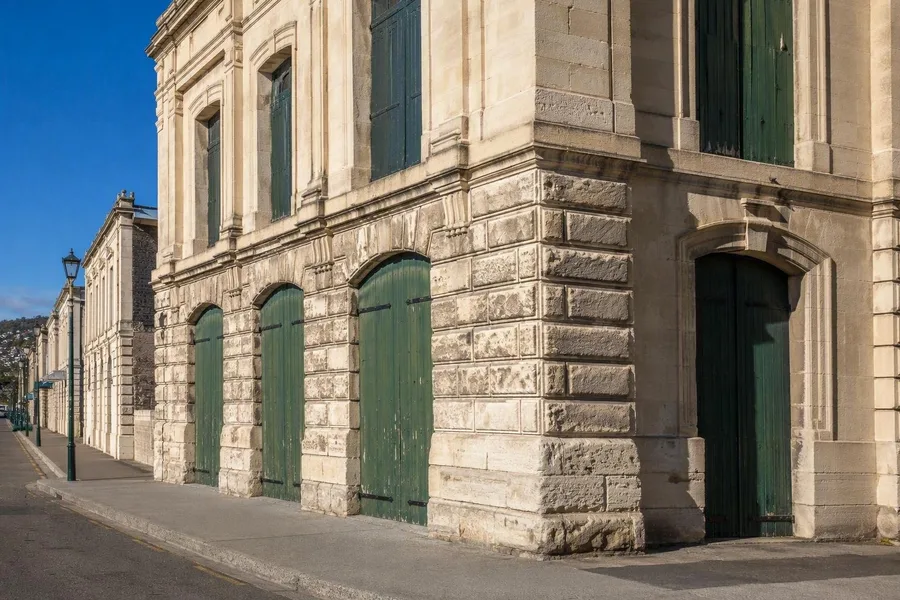 High loading doors frame the former Loan and Mercantile warehouse at Harbour and Wansbeck Streets.
The former Loan and Mercantile warehouse fills the corner of Harbour and Wansbeck Streets with a rusticated ground floor, shallow piers, rope-like stone mouldings and framed loading doors. Inside, cast-iron columns, kauri beams and staircases still show how grain moved through the building.
Oamaru’s port gradually lost traffic to rail connections and the better-equipped ports of Dunedin and Timaru. The last coastal vessel left in 1974. That decline left Harbour and Tyne Streets largely free of later rebuilding, and restoration from the late 1980s brought tenants back into former commercial rooms.
At the corner of Wansbeck Street, the high loading doors still rise above the pavement, their stone frames cut for a warehouse that once sent North Otago’s harvest out across the water.
Keep exploring