
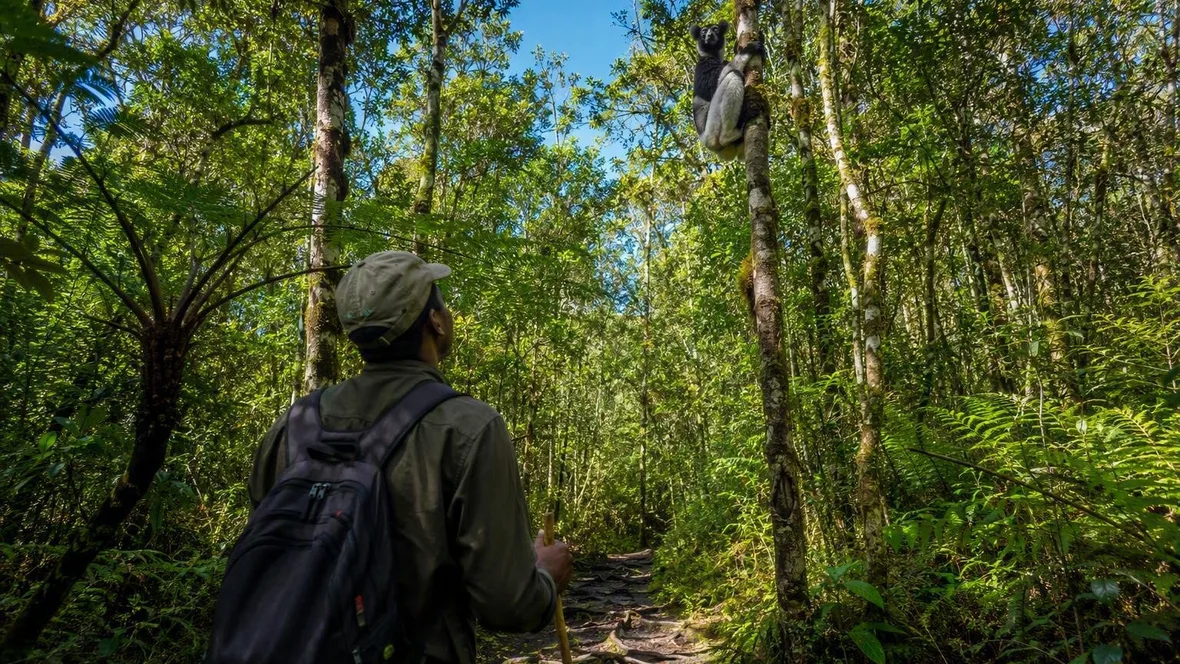
Listening for Indri in the Rainforest of Andasibe
The indri often announces itself before anyone sees it. Around Andasibe, long descending calls travel through a damp canopy that supplies food, routes between trees and the boundaries of a family territory.
A voice above Andasibe
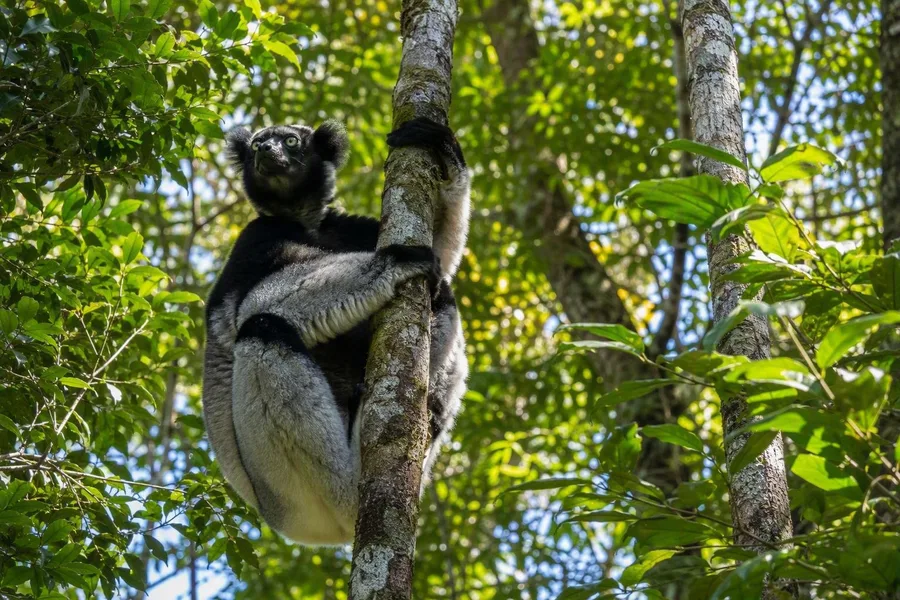 An indri clings to a trunk high in the rainforest around Andasibe.
An indri chorus does not sound like a single animal calling. Rough opening notes give way to long, modulated phrases, and several voices can overlap as the notes rise and fall through the forest. Early morning offers the best chance of hearing it around Andasibe, when indri concentrate much of their singing.
The call marks a family’s place in the forest. Indri usually live in groups of two to six animals, commonly a breeding pair and their young, and each group holds a largely exclusive territory for years. Their songs signal that a patch of forest is occupied, reducing the need for repeated patrols or physical confrontations with neighbouring groups.
The calls also change with the moment. Family members sing while resting, feeding or maintaining social contact, while another song helps animals regroup when foliage blocks their view of one another. At a territorial boundary, the chorus can run longer and become more hectic, with voices crossing as neighbouring families answer. Indri also distinguish familiar neighbours from unfamiliar groups and respond more strongly to strangers.
A local guide can use the direction of a call to search the higher trunks and canopy, rather than leading a group through undergrowth beneath the animals. In this forest, listening often comes first.
The wet forest around Andasibe
Andasibe lies in Madagascar’s eastern rainforest, but its indri do not live in hot lowland forest. Analamazaotra protects moist forest between 900 and 1,050 metres, where hills and plateaus break into ravines, streams and marshy ground. Around 1,400 mm of rain falls each year, with no true dry season, and the vegetation stays green and dense.
A closed canopy stands above mosses, tree ferns, lianas and orchids. In Mantadia, deeper valleys hold rivers and waterfalls. Forest remnants, clearings and wet banks create different small habitats within a short distance. Roots, damp vegetation and streams keep attention close to the path, while the canopy limits long views. An indri may remain audible high in the leaves.
This dense, connected cover supports the animal’s daily life. Indri eat mainly young leaves, with flowers, fruit and seeds added as different plants become available. They also use vertical trunks and overhead branches to move across their territory. The trees provide food, passage and the space through which one family can hear another.
High among the trunks
Indri cling vertically to trunks, climb, then launch themselves towards the next support with powerful leaps. Between these short passages, they rest on branches or remain in one place to feed.
A patient group may see an indri pull a branch closer and pluck young leaves. Another animal may rest nearby or move through the crown. The adult pair forms the core of the family duet, and younger animals can add their voices to the chorus.
Indri feed on parts of many plant species and need varied, connected forest. They are not simply seed dispersers. Feeding research in Mantadia describes them as seed predators because they chew food thoroughly rather than routinely passing intact seeds elsewhere.
A guide can point out food trees or slight movement high above without placing visitors directly beneath the animals. Binoculars help people watch a resting or feeding indri while leaving it free to stay, feed or move away.
Young trees between forest blocks
Forest loss has broken parts of the landscape around Andasibe into remnants separated by farmland and former pasture. Open ground interrupts movement between mature forest stands for an animal that travels through the canopy. Young planting can reconnect some gaps, but it cannot quickly replace the tall, established forest that indri need.
Local work makes this difference visible. Association Mitsinjo, beside Analamazaotra, links guiding and nature tourism with education, monitoring and forest restoration. Its teams collect seeds, raise native trees in nurseries, plant damaged ground and monitor saplings. Some planted species produce fruit that attracts birds, bats and lemurs, which can bring further seeds into a recovering area.
Visitors can see an intact forest edge with a closed canopy, an open plot with eucalyptus, and native planting that has not yet formed overhead cover. Eucalyptus left from charcoal production can hinder native plants in the developing corridor. Small lemurs already use parts of the young connection between Analamazaotra and Andasibe-Mantadia, but older forest remains essential for indri.
Local guides make the forest accessible without sending people off in every direction. They keep groups on established paths, locate animals at a suitable distance and earn income from the living forest around Andasibe.
Watching without pressing closer
Staying on the path means a family need not leave a feeding tree or resting place for visitors. Binoculars or a telephoto lens remove the need to crowd beneath a branch. Feeding, touching or calling to indri interferes with the behaviour people have come to observe.
A guide can also decide when a group should stop. If indri rest or feed, visitors can wait rather than follow every movement through the trees. The animals then choose whether to keep eating, cross the canopy or join a chorus.
Practicalities. Analamazaotra suits visitors who want to look for indri on a shorter forest walk. Mantadia has rougher, hillier trails, rivers and waterfalls, and usually merits a separate visit with suitable transport. Both areas require a recognised local guide, arranged at the entrance or visitor centre. Published opening hours differ, from 06:00–16:00 in local information to 08:00–17:00 in general park information, so confirm an early start through the visitor centre or accommodation. A local listing gives foreign adult admission as 45,000 ariary, excluding the guide fee, but announced tariff changes make it sensible to confirm the current price before arrival. Official park pages do not offer public online booking; tickets and guides can be arranged at the visitor centre.
When another family answers
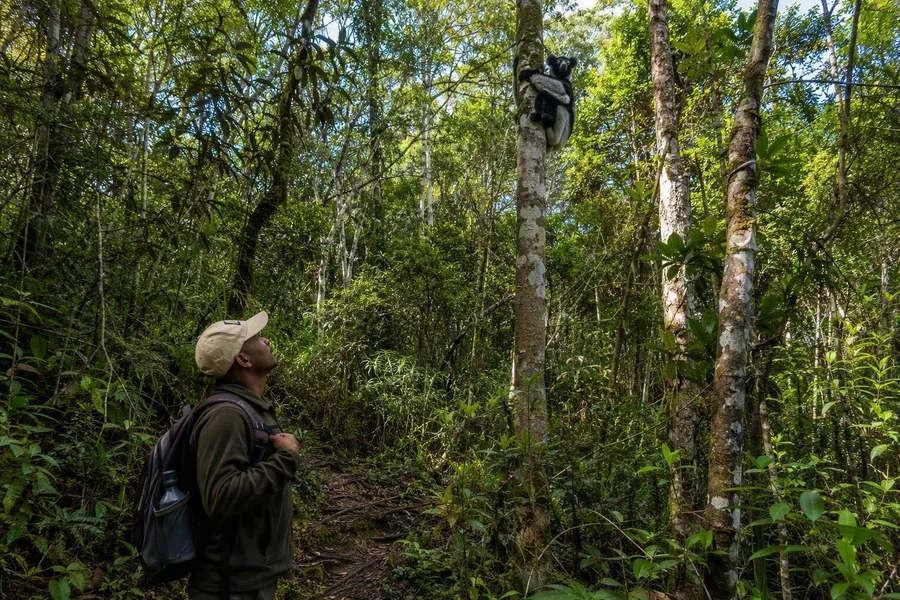 A local guide looks up at an indri high in Andasibe’s forest canopy.
On an early walk, a guide may pause at the first rough notes and turn attention towards the upper trunks. The opening calls lengthen into descending phrases. Several animals overlap, and another family may answer from a separate occupied patch of forest.
Below, the path runs between wet roots, ferns and dense undergrowth. Above, the chorus passes through the closed canopy, where an indri may shift among the leaves.