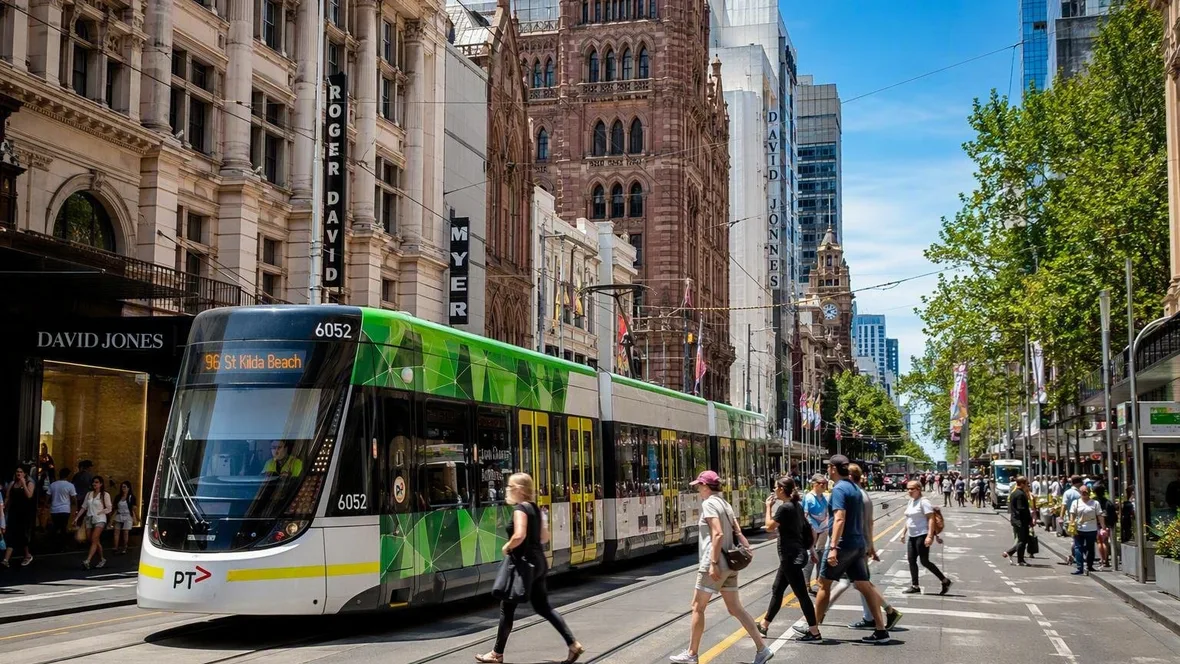
Line 96: East Brunswick to St Kilda by tram
Tram 96 runs from Blyth Street in East Brunswick to Belford Street on Acland Street in St Kilda, linking the inner north, Bourke Street’s retail core and Port Phillip Bay without a change. The full run usually takes about 55 to 60 minutes.
South along Nicholson Street
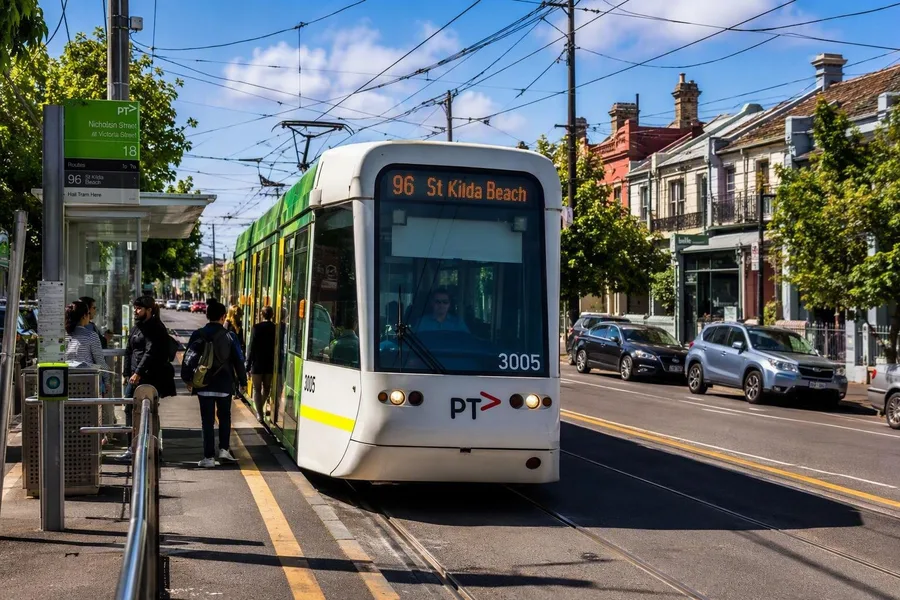 A route 96 tram serves passengers on Nicholson Street in Melbourne’s inner north.
Line 96 begins at Blyth Street in East Brunswick and heads south on Nicholson Street through Brunswick, Carlton North and Fitzroy North. Sydney Road, Brunswick’s better-known shopping strip, sits away from this route. Tram 96 does not run along it.
That small detour matters. Sydney Road explains the working history of the district around the northern end of the line: Brunswick grew from farmland into a manufacturing suburb after the gold rush increased demand for local hardstone and clay. Quarries, brickworks, potteries, textile mills and hosiery factories followed. Sydney Road led towards the goldfields, and shops, hotels, churches and public buildings gathered along it.
Its buildings still show those layers. Narrow Victorian and Edwardian shop buildings stand shoulder to shoulder, with older upper floors above altered shopfronts and long awnings above the pavement. Arabic and Turkish signs appear beneath some nineteenth-century facades, reflecting communities that settled in Brunswick after the Second World War. Cafes, bakeries, repair shops, vintage stores, music venues and a notable cluster of bridal businesses keep the street busy for practical reasons, not just heritage photographs.
Nicholson Street takes a quieter line south. Its stops serve the residential inner-north corridor before the tram reaches Melbourne Museum and Carlton Gardens. The museum stop also provides access towards Carlton and Lygon Street, where cafes draw students, staff and local residents. The same tram carries short neighbourhood trips and longer cross-city journeys; the change of passengers begins long before the CBD.
Near the museum, the 96 continues to Albert Street and Parliament, then turns through Spring Street into Bourke Street. The low-rise residential corridor gives way quickly to Melbourne’s tight central grid.
Bourke Street, track by track
Melbourne laid out Bourke Street in 1837 as an east-west street in the Hoddle Grid. Offices later concentrated towards the western end, shops in the middle, and restaurants, bars and entertainment venues in the east. Line 96 crosses the whole arrangement.
The sharpest shift comes at Bourke Street Mall, between Swanston and Elizabeth streets. Pedestrians and trams share the street, with department stores, smaller shops and arcades immediately beside the tracks. People cross from stops to shopfronts while the tram moves through the middle. Here, the bell earns its keep.
The buildings give the passage weight. The former General Post Office stands at Elizabeth Street, on a site that drew crowds on post days as early as 1841. Nearby, the Royal Arcade leads beneath a high glass roof towards Little Collins and Elizabeth streets. It opened in 1869, and its Gog and Magog figures have struck the hour since 1892. Glass, stone, stucco and shop signs pass the tram windows in quick succession.
The central stops follow closely: Spring, Russell, Swanston, Elizabeth, Queen, William and Spencer streets. Passengers step off for the shops and change at Southern Cross Station, while others use the line for short trips within the centre. The tram does not skirt the retail district. It cuts directly through it.
Farther west, the former headquarters of the Melbourne Tramway & Omnibus Company remains on Bourke Street. The company built this Venetian Gothic office in 1891 after developing horse-tram and cable-tram services across Melbourne. A contemporary tram passing its predecessor’s office is a tidy historical coincidence, though Melbourne is not usually accused of tidiness.
From Southern Cross to the southern suburbs
At Spencer Street, line 96 turns south beside Southern Cross Station. It then passes Batman Park, Casino/MCEC and Whiteman Street towards Southbank. The stops in this stretch connect the railway station, city workplaces and visitor destinations, so boarding and alighting replace the slower foot traffic of the Bourke Street Mall.
South of City Road, the tram leaves street-running track for a separate light-rail alignment. The stop names now mark South Melbourne, Albert Park, the Melbourne Sports and Aquatic Centre and Middle Park. South Melbourne Market, sports facilities and residential streets sit near the route, while passengers staying aboard continue towards St Kilda.
The tram gathers pace. Close shopfronts and cross-street traffic fall away, and longer gaps open between stops. The ride still belongs to inner Melbourne, but Bourke Street’s careful negotiation has ended.
Tickets and timing
For the southbound trip, take a 96 marked St Kilda Beach. A ride from East Brunswick begins outside the Free Tram Zone, so passengers need to touch on with a physical myki or Mobile myki when boarding. A full-fare two-hour myki Money trip currently costs A$2.85; Visa or Mastercard contactless payment is also available at the full fare. Daytime trams generally run every six minutes on weekdays and every 10 minutes at weekends.
Fitzroy Street, Acland Street and the bay
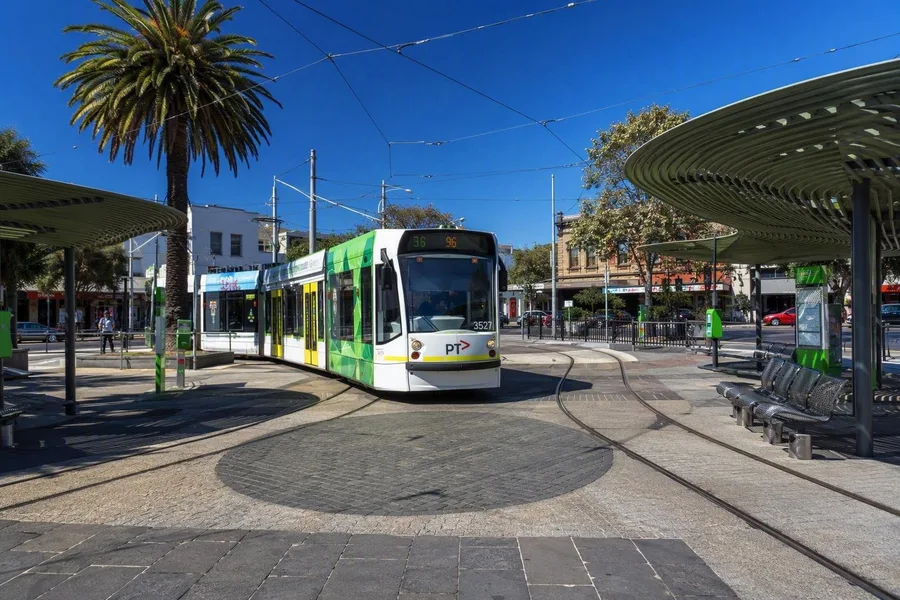 Tram 96 changes ends at the Belford Street terminus on Acland Street.
Line 96 reaches the old St Kilda railway station, follows Fitzroy Street towards The Esplanade, passes Alfred Square, Luna Park and the Palais Theatre, then turns into Acland Street for the terminus at Belford Street.
St Kilda began as a seaside retreat for wealthier Melburnians. The railway arrived in 1857, and a cable tram from 1888 helped turn the suburb into the city’s principal amusement district. The foreshore received a Mediterranean-resort-style makeover in 1906, while Luna Park opened in 1912.
The last section of the route still carries those old entertainments in plain view. Luna Park’s entrance face and towers stand beside the silhouette of the Scenic Railway. Next door, the Palais Theatre faces the foreshore with a broad front, domed towers and a shallow curved roof. The building opened as a cinema in 1927 and has served mainly as a live-music venue since the 1980s.
St Kilda never remained only a resort. Large houses became boarding houses from the 1890s, followed by flats and residential hotels; after the Second World War, cafes, nightlife and Acland Street’s cake shops added further layers to the suburb. Fitzroy Street and Acland Street remain its principal shopping streets, with the Esplanade and beach between them.
The tram finishes in a pedestrian-oriented square on Acland Street rather than beside a conventional turning loop. Bluestone circles run across the ground, rounded seats stand among the shops, and ribbed shelters cover waiting passengers. The tram changes ends here for East Brunswick.
Beyond The Esplanade, the St Kilda Pier curves into Port Phillip Bay in concrete and timber. Stepped seating faces the water and the Melbourne skyline; at the end of the line, rails, shopfronts and overhead wires stop at the broad, open bay.