Levuka, between the wharf and the hills
Beach Street occupies a narrow strip between Levuka’s seawall and Ovalau’s steep volcanic slopes. Fiji’s former capital still carries its nineteenth-century port history, but residents use its shops, schools, churches, market and wharf every day.
Levuka is Fiji’s first colonial capital, but that label can reduce a complicated working town to a row of old façades. The town serves Ovalau and the Lomaiviti islands as a place for trade, public services, education, healthcare and paid work. Its nineteenth-century buildings still frame those ordinary purposes.
Levuka grew from the 1820s beside the iTaukei settlements of Totoga, also called Vitoga, and Nasau. A reef-protected anchorage drew traders in bêche-de-mer, while European beachcombers first settled within or near the existing Fijian community. The colonial town did not arrive as a neat European grid on empty ground. Streets, paths and buildings took shape around older villages, streams and Ovalau’s hard contours.
Beach Street between sea and slope
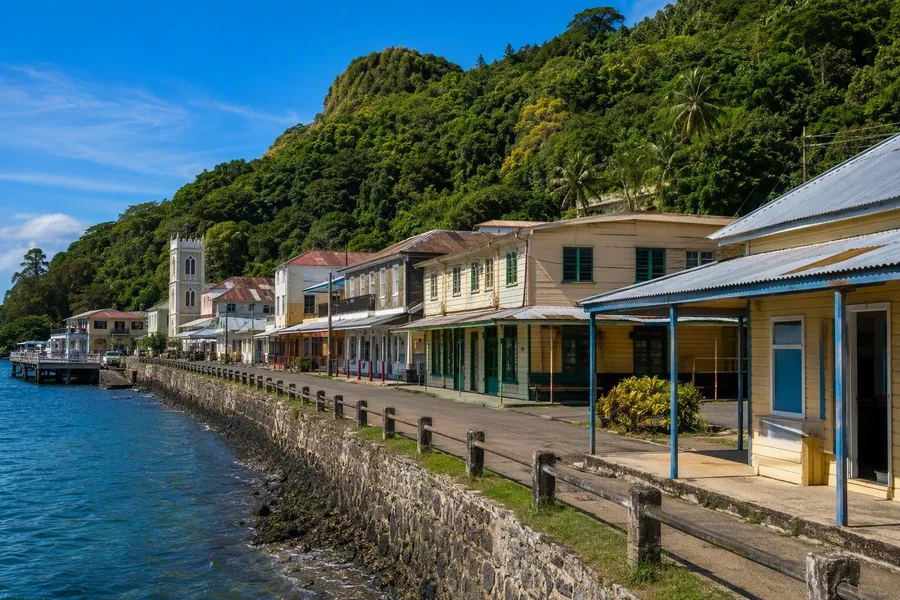 Beach Street’s seawall, low commercial buildings and wooded volcanic slope in Levuka.
Land reclamation created Beach Street, the narrow commercial spine along the coast. The sea and a stone-and-concrete seawall run along one side. Former shops, offices and warehouses stand on the other. Behind them, small streets, alleys, bridges and steps follow streams and climb towards the wooded flanks of Ovalau’s extinct volcano.
The terrain left Levuka little room to spread. Low buildings occupy a slim coastal strip beneath the crater rim, which explains the town’s compact, linear shape. Timber frames, weatherboard or corrugated-metal walls, pitched or hipped roofs, and verandas beneath commercial parapets give the waterfront its restrained material character.
Merchants put shops, warehouses and port facilities beside the water because goods moved directly between vessels, storage sheds and businesses. Houses, churches, schools and government offices took up the limited ground around them. Fijian village sites, commercial buildings and civic institutions sit close together for a simple reason: the shoreline and steep hills offered few other places to build.
After Fiji was ceded to Britain in 1874, Levuka became the colony’s first capital. The short capital period brought a quay, customs facilities, drainage works, the seawall and an enlarged commercial district. The government moved to Suva in 1882. Levuka had too little room for expansion, while reefs, shallows, limited water and drainage, and a harbour exposed to large steamships added practical difficulties; Suva had a deeper, more accessible harbour and closer links to agricultural land on Viti Levu.
Trading houses still have work to do
The Morris Hedstrom building shows how Levuka uses its commercial inheritance. A grocery and textile firm opened its original premises here in 1868. The building now holds the Levuka Community Centre, a small museum, library and visitor information. An old storehouse now provides public services on the same street that once channelled imported goods and export cargo.
The wooden Royal Hotel belongs to the same port economy. Its two storeys have verandas beneath a hipped roof, and its lookout served those watching for ships. It remains Levuka’s last historic hotel.
Nearby, the wooden Sacred Heart Cathedral and rectory date from the 1860s and use Gothic Revival forms. Its separate concrete tower works both as a harbour landmark and a navigational beacon. The Town Hall, built in 1898, still houses the municipal council. Schools and churches have also retained their established educational and religious roles.
These buildings matter because they remain part of the town’s daily geography. The library, council offices, classrooms, shops and places of worship sit within the same short coastal corridor as the old commercial frontages.
The port still moves people and cargo
Levuka lost the government, not the harbour. Copra merchants continued to use warehouses, drying sheds and small rail lines towards the quay after the capital moved. Remnants of those rails remain near the southern port area, alongside customs, postal and warehouse buildings.
Fishing vessels now use the concrete pier to supply the nearby tuna cannery. The PAFCO plant employs hundreds of residents in shift work. Ferries bring passengers and freight from Viti Levu, joining the town to the larger islands through the same waterfront that once handled copra and other export goods.
The waterfront does not preserve a single frozen trading era. Copra sheds and rail remnants explain the shape of the southern port area, while fishing boats, freight and factory work show what the harbour supports now.
Market stalls on an older town site
The covered Levuka Market gives producers and traders from Ovalau and Moturiki a place to sell farm produce, goods and handicrafts. Fixed and temporary stalls serve different vendors, and affordable accommodation supports women sellers travelling from farther away. The market belongs to the island economy, rather than to a performance arranged for visitors.
Nasau Park marks another layer of the town. The sports ground occupies the site of Nasau, one of the iTaukei settlements around which colonial Levuka developed. Along the coast, the Cession Site marks the place where Fiji passed to Britain in 1874. These places correct the familiar colonial shorthand: iTaukei communities stood here before the harbour town grew, and they continued to outnumber European settlers.
Levuka includes iTaukei, Indo-Fijian, Chinese, European and other Pacific communities. Local educational support services also assist pupils and parents from Ovalau and neighbouring islands, extending the town’s role beyond Beach Street. Levuka’s small scale does not make it marginal. Its market, schools, council, churches, port and processing work concentrate functions that surrounding communities use.
Getting to Levuka
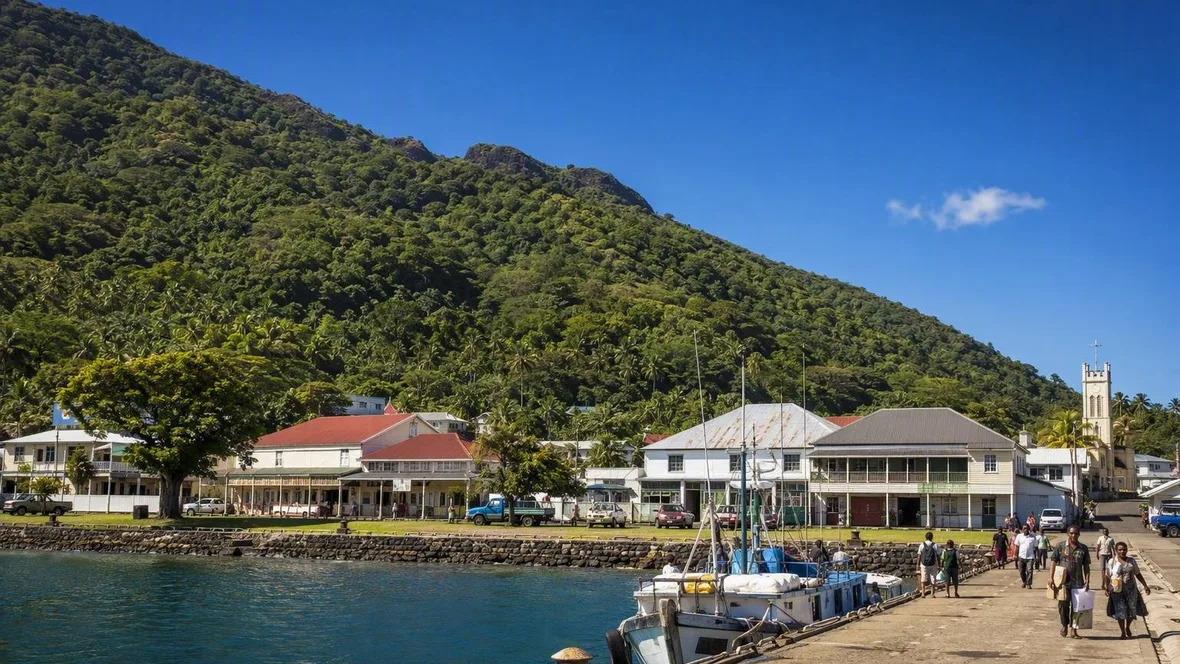
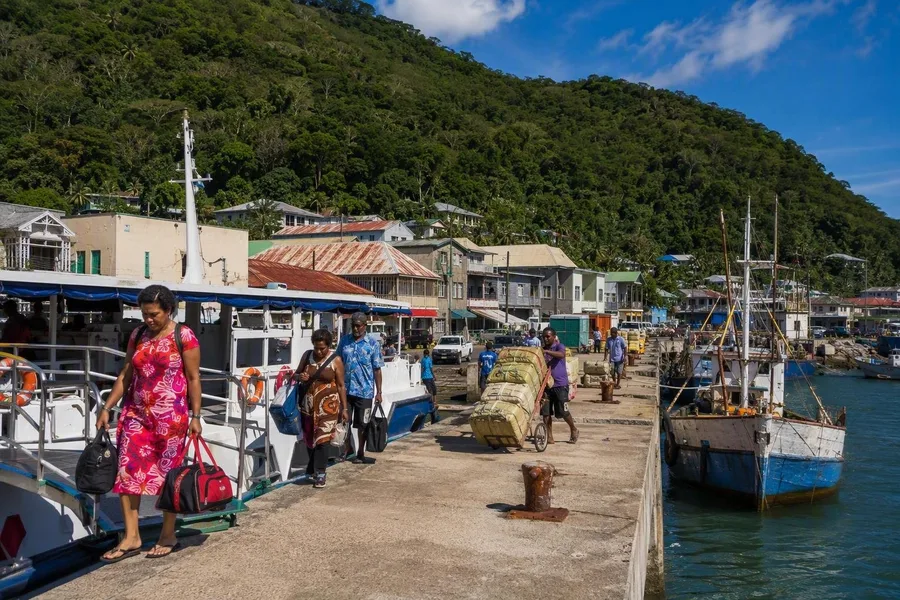 Passengers and freight arrive at Levuka Wharf beside fishing vessels and the concrete pier.
Combined bus-and-ferry services run from Suva via Natovi Landing to Levuka Wharf, with the full trip taking roughly 3½ to 4½ hours. A published one-way fare is around FJ$35; tickets are generally bought through an operator’s agent in Suva or at Ambalal & Sons in Levuka. Confirm departure details shortly before travel, as schedules can change.
At Levuka Wharf, passengers arrive beside fishing vessels and the concrete pier. Beyond the seawall, low timber and corrugated-metal buildings fill the narrow coastal strip, while the dark, wooded volcanic slope rises immediately behind them.
Keep exploring