
How Bonwire’s Weavers Build a Kente Cloth
A Bonwire loom does not produce a broad ceremonial wrapper in one piece. It produces a narrow woven band, built thread by thread by makers who hold the technical and cultural knowledge behind the finished cloth.
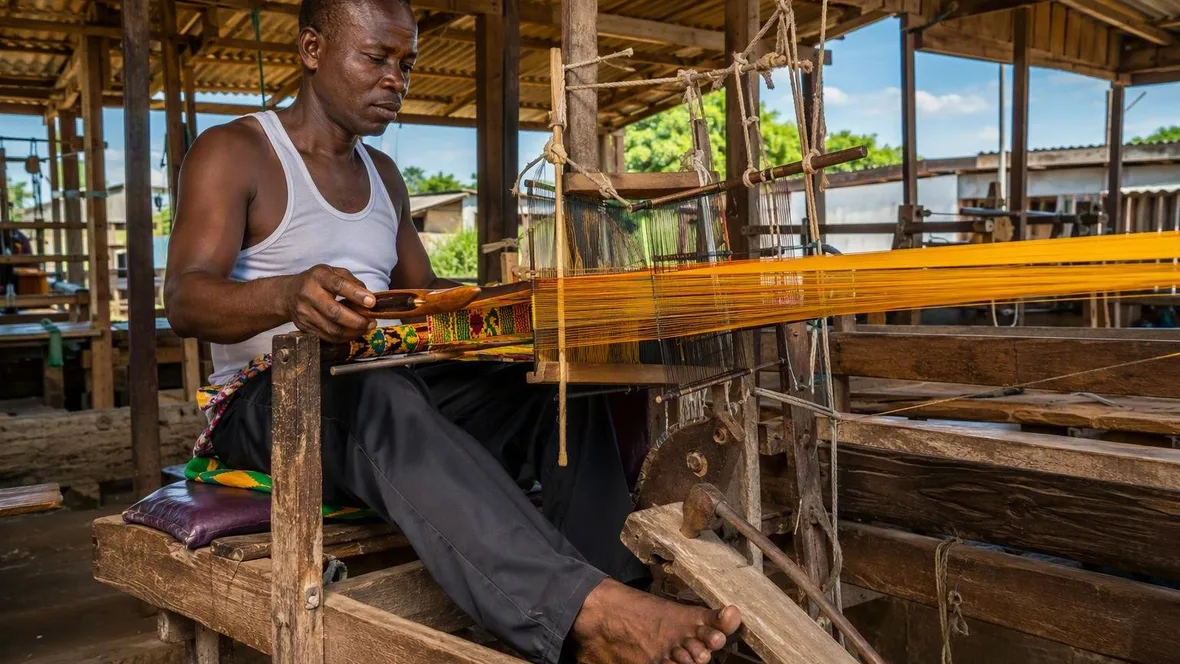
The weaver presses a pedal. A selected set of warp threads rises; a hand sends the shuttle through the opening, and the reed pushes the new weft firmly into place. The feet shift, the opening changes, and the sequence begins again.
That coordination sits at the centre of Asante kente weaving in Bonwire, northeast of Kumasi. The wooden horizontal loom, the Nsadua Kofi, makes bands about ten centimetres wide rather than complete cloths. Makers later sew the long bands edge to edge, creating the large rectangular cloths used at formal occasions.
Bonwire begins with ordered thread
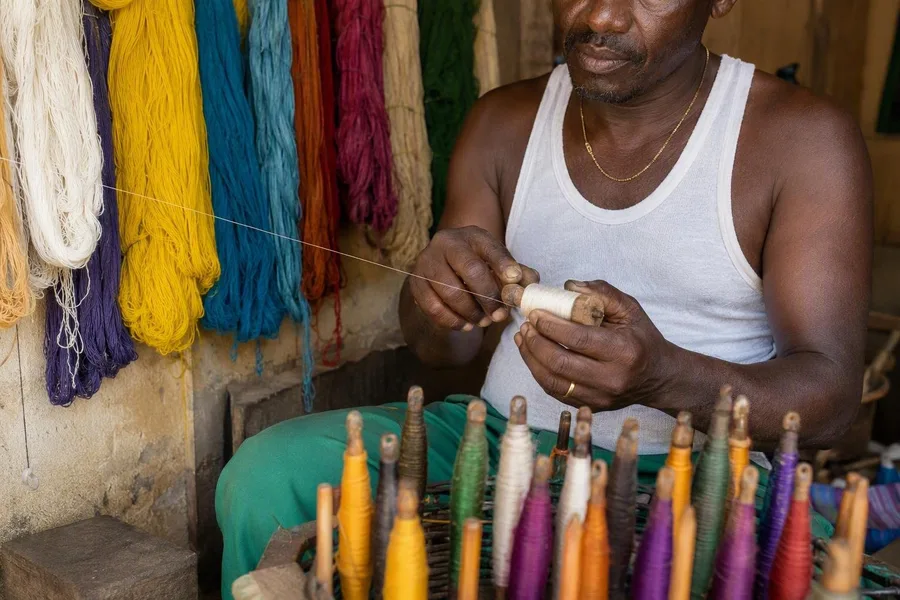 A Bonwire maker winds yarn onto duaduwa bobbins before setting the warp.
Bonwire occupies a particular place in Asante memory. Local tradition identifies it as the home of Kuragu and Ameyaw, hunters who studied the interlaced structure of Ananse the spider’s web and first experimented with raffia. They showed their work to Asantehene Osei Tutu I, according to the account, and the king adopted kente as a royal art.
This is an origin tradition, not proof that weaving appeared from nowhere in one village. Kente drew on older West African textile knowledge and trade networks that brought materials such as silk into the Asante world. Bonwire’s historical weight lies in its Asante development of narrow joined bands, geometric designs and weaving families tied to the royal court.
The work starts well before the shuttle moves. Cotton, silk and rayon arrive in skeins, and makers wind the yarn onto small bobbins called duaduwa. They then set out the warp: the long, parallel threads that determine the length of each band. A warping mill, frame or rows of pegs hold the threads in sequence. Secured crossings preserve that order when the bundle moves to the loom and prevent tangles.
Colour choices begin here. Warp colours form the vertical stripes of the finished band, so an error in the tightly ordered bundle will run through the textile rather than disappear as a minor preparation fault.
Feet separate the threads, hands carry the colour
The weaver spreads the warp through a comb-like divider and puts it under tension on the loom. Each thread passes through a heddle eye and then through the reed; extra warp threads reinforce the two narrow edges. Cords link the heddles to foot pedals. One pedal raises a chosen group of threads and opens a passage for the shuttle.
The shuttle carries the crosswise weft. The reed beats it into the growing cloth.
A plain ground weave can move quickly. A complex motif slows the work as the weaver changes colours, selects groups of warp threads and adds supplementary weft. Triangles, wedges, hourglass forms and dense blocks emerge where those added threads cover parts of the warp. Vertical stripes come from the warp; horizontal bands and geometric figures develop through the weft.
This skill is learned beside other people, often in families or through apprenticeships with master weavers. Learners prepare warp and weft, thread heddles and reeds, set patterns, repair errors, and study the histories and names attached to cloths. Bonwire’s working community includes masters, younger weavers, pattern designers, sellers and apprentices.
A pattern carries a name
Kente is not a fixed code in which each colour has one universal translation. Asante makers and wearers read colour, woven pattern, the name of a whole cloth and the occasion together. A design can refer to a proverb, clan, historical event, person or an exceptional display of skill.
Broad associations still guide many choices. Gold can denote royalty, wealth and spiritual purity; blue peace, harmony and love; black maturity and ancestral power. Green is linked with renewal, growth and fertility, while red can refer to sacrifice and struggle, and white to purity and victory. The maker’s explanation matters because the same colour can sit within a much more specific commission or named design.
Names sharpen those meanings. Adweneasa means that the weaver has exhausted his skills, a description of creativity and technical mastery. Emaa Da, or “it has never happened before,” marks novelty and exceptional achievement. Fathia Fata Nkrumah honours Kwame and Fathia Nkrumah and has been associated with unity across borders. In Bonwire, the design also recalls the saying that one person cannot govern a country alone.
Weavers still name designs after contemporary people and events. That continuing practice makes a direct question more useful than a generic colour chart: the maker can explain the name, material and intended meaning of the particular cloth on the loom.
From court cloth to contemporary wear
Costly silk and intricate patterns once placed kente under royal control. Asante royalty wore it at significant social and sacred occasions, while some designs belonged to the king or senior figures. A named cloth could mark status, political ideas or moral principles.
Kente now appears at weddings, naming ceremonies, graduations, festivals, funerals and presidential inaugurations. Designers also incorporate woven bands into contemporary clothing, and makers produce smaller stoles for newer markets. Ceremonial commissions still begin with choices about the occasion, dimensions, colours and pattern; a wearer’s age, gender and social position may influence them.
Handwoven kente remains materially distinct from printed cloth that imitates its appearance. A woven piece contains the actual crossings, joined strips and design decisions of its maker. A print reproduces the look on a flat surface.
Watching work without turning it into theatre
A workshop visit can show yarn preparation, warping and weaving. Organised demonstrations may include a short attempt at a task when the weaver offers one. The workbench is not a stage, however, and the person at the loom is not part of the scenery.
Visitors should ask before taking photographs of a person, interior, loom or commissioned cloth. They should not touch the shuttle, threads or frame unless the weaver explicitly offers a demonstration. Questions about the maker, yarn, pattern name and intended use recognise the knowledge in the cloth. Direct purchase can also keep the maker’s identity attached to the piece.
Practical: Bonwire lies about 18 kilometres northeast of Kumasi. Taxis and trotros from Kejetia towards Effiduase provide the usual connection. Published hours list 08.00–17.00 for Bonwire and 09.00–17.00 for the weaving centre; arrange a guide, access, photography permission and any weaving demonstration in advance, as work and ceremonies can alter the day’s arrangements.
The bands become a cloth
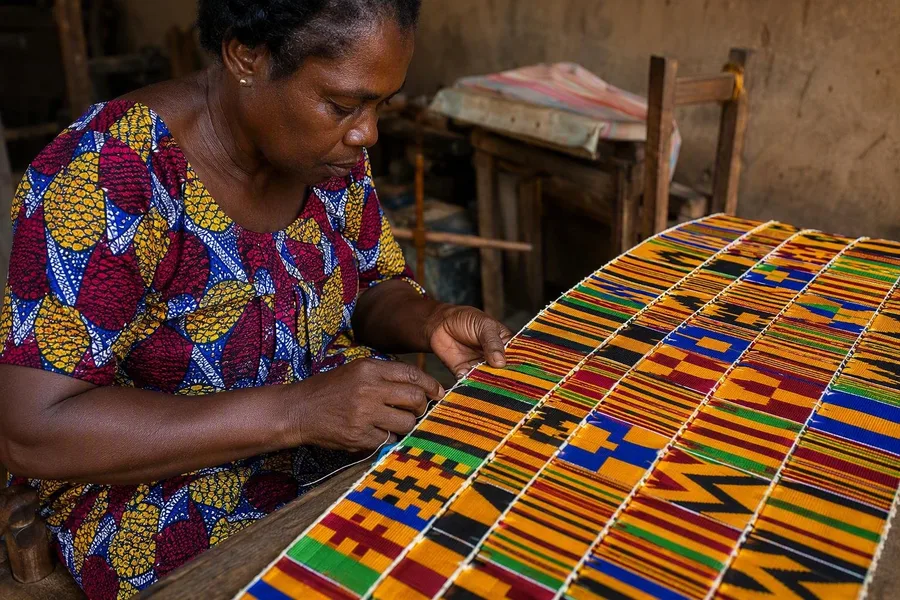 A maker in Bonwire hand-sews narrow kente bands into a broad cloth.
Each band has a beginning border, a repeating central field and an end border. When weaving ends, makers place the strips lengthwise beside one another and sew them together by hand. Colour bars and motif blocks continue across the seams until the separate bands form a broad grid.
At the loom, though, the final physical fact remains narrow and exact: a tightly beaten strip feeds forward from the warp, its lengthwise colour stripes crossed by geometric weft, its edges held firm for the seam that will join it to the next band.