Haida Gwaii Begins at Ḵay Llnagaay
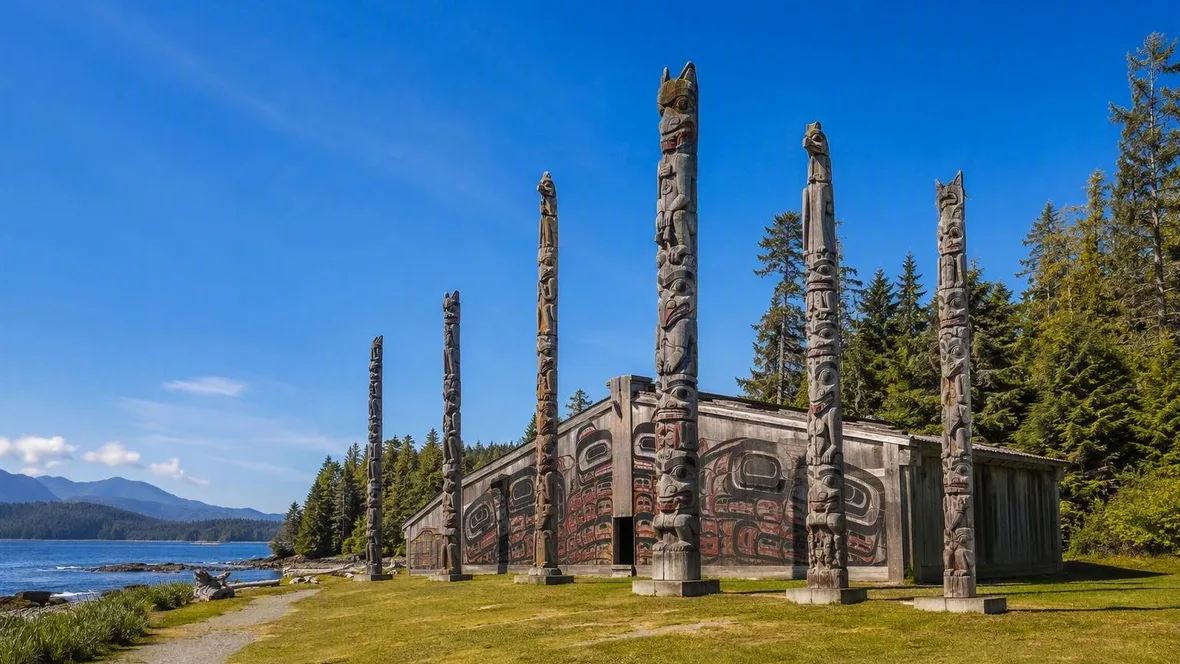
Six monumental poles stand beside the water at Ḵay Llnagaay, each linked to villages and clans whose descendants live in Skidegate today. They make one fact plain: Haida culture belongs to the present, and visitors enter Haida homeland as guests.
Six poles beside the sea
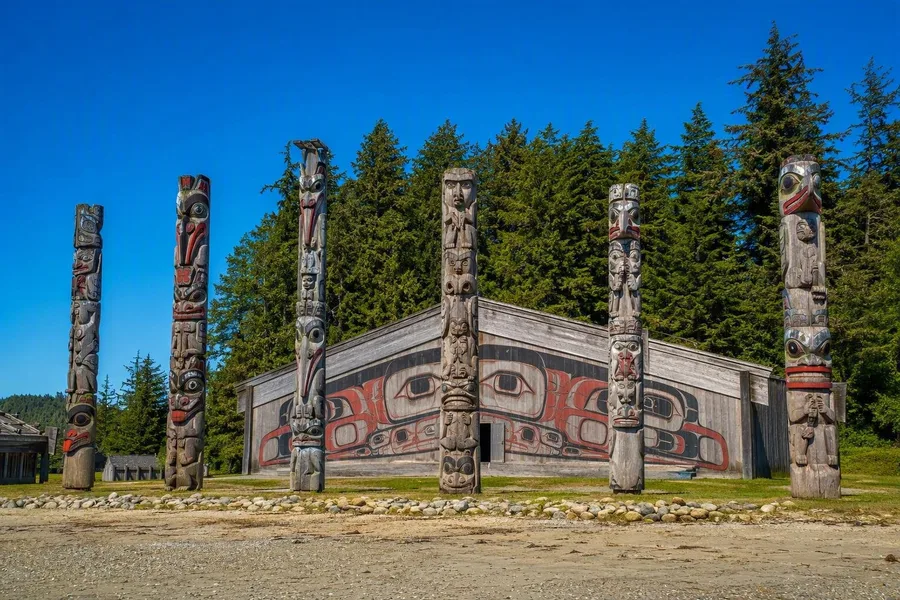 Six monumental poles stand outside the Haida Heritage Centre at Ḵay Llnagaay near Skidegate.
The Haida Heritage Centre stands on the ancestral village site of Ḵay Llnagaay, or Sea-Lion Town, near HlG̱aagilda/Skidegate. Longhouses lined this bay and beach until about two centuries ago; a museum opened here in 1976, and the present centre followed in 2007.
The buildings follow the form of a row of longhouses rather than a conventional museum block. Outside, six poles represent Skidegate, Ts’aahl, Cumshewa, Skedans, SGang Gwaay and Tanu. They connect this shore with villages, clans and families whose histories continue in the community. Seven more poles stand permanently indoors.
The word heritage can suggest something finished and safely stored. That description does not fit Ḵay Llnagaay. The centre brings together galleries, performance and teaching spaces, canoe building and carving, placing historical belongings alongside work that Haida artists make now.
Saahlinda Naay, the “Saving Things House,” holds carved poles, masks, shamanic staffs and finely woven spruce-root baskets, as well as contemporary art and jewellery in gold, silver and argillite. The museum also supports the return of ancestral remains and particular cultural belongings, reconstructs clan genealogies, and helps Haida people enter arts and heritage work. Its collection work reaches far beyond the display case.
Cedar in the workshop
Artists carve monumental poles and canoes in the open Carving House. Markets and music performances also use the space above the curved pebble shore of Second Beach. Nearby, the Canoe House holds LooTaas – Wave Eater, which Bill Reid carved from a single Haida Gwaii tree during renewed work with canoe-building knowledge.
Cedar is not simply a handsome surface here. Haida makers have used red and yellow cedar for house timbers, monumental poles, masks, bentwood boxes, canoes and woven bark; the forest therefore sits directly behind both art and travel by sea. Guided programmes follow spruce roots, cedar bark and wool into baskets, hats, robes and blankets.
Haida art also resists the catch-all label of “Northwest Coast style.” Raven and Eagle family relationships carry histories and rights expressed on house poles, canoes, boxes and masks. Contemporary makers learn from inherited knowledge, then make their own decisions in wood, fibre and metal.
Colonial trade in sea-otter pelts brought major change from the late eighteenth century. Introduced smallpox, measles and tuberculosis then devastated Haida communities; fewer than 600 Haida remained on the islands by the end of the nineteenth century, and survivors from southern villages moved partly to Skidegate. Residential schools intensified that violence by forbidding Haida children to practise their language and culture.
Artistic knowledge still passed between generations. Charles Edenshaw learned through family and apprenticeship, worked in wood, argillite and precious metals, and influenced later generations of artists. At Ḵay Llnagaay, carving tools and woven cedar show continuity through work, not a sentimental return to an untouched past.
From Skidegate to Old Massett
Skidegate and G̲aw Tlagée/Old Massett are the two principal Haida population centres. A drive north across Graham Island links them through contemporary art and language work, not through a string of historical exhibits.
The Skidegate Haida Immersion Program records and teaches X̲aayda Kil. In Old Massett, X̲aad Kíl Née supports the local dialect and its transmission between fluent Elders and younger speakers. Visitors can use local place names carefully and attend programmes offered to the public. Language lessons and an Elder’s knowledge are not services that outsiders can simply request.
In Old Massett, Sarah’s Haida Arts and Jewellery sells work by local Haida jewellers, carvers and weavers, including argillite carving, cedar weaving, jewellery and button blankets. Buying from named makers or licensed outlets matters. Haida art carries intellectual and family knowledge; it is not generic island decoration. The shop at the Heritage Centre works with Haida artists through licensing and royalty arrangements.
Two Haida principles provide a useful footing: Yahguudang, respect for all beings, and Ad Kyaanang, asking permission first. In practice, follow local signs, ask before photographing people or culturally sensitive places, and leave shells, feathers, stones, driftwood and possible artefacts where they lie.
Forest, tide and open coast
Haida Gwaii comprises more than 150 islands across the Hecate Strait from mainland British Columbia. On Graham Island, roads pass communities separated by long stretches of coast and forest rather than folding them into a resort strip.
Rain and mild temperatures sustain coastal rainforest from sea level up the slopes. Western red cedar, hemlock and Sitka spruce grow especially thick in the south, with moss across much of the forest around them. Near the Tlell River, the forest reaches the shore. Farther north, North Beach opens onto a broad Pacific edge.
At low tide, periwinkles, mussels, chitons and crabs appear among seaweed and eelgrass. Tides also affect small boats and kayaks, particularly in the southern archipelago, where currents, storms and local geography can magnify their effects. Sand may look like an easy road, but vehicles damage beach habitats, river crossings and shellfish beds. On foot, open sand gives way to driftwood and then to rainforest.
Gwaii Haanas requires its own plan
Gwaii Haanas lies in the roadless south of the archipelago and is accessible only by boat or floatplane. It is not an automatic add-on after the Heritage Centre, nor a casual drive from Skidegate. Visitors travel with a licensed operator or arrive independently with the skills and equipment for coastal navigation and self-sufficient travel.
Independent visitors need a reservation, paid visitor fees, a valid Trip Permit and the current mandatory online orientation before entering. They must carry the permit and proof of completing the orientation. The orientation covers current closures, emergency procedures, Haida Gwaii Watchmen sites and respectful travel. Those details affect where a boat can land and how visitors can enter sensitive places.
A Haida-owned company such as Haida Style Expeditions works with local Haida storytellers and presents Haida accounts of culture and history on land and water. A licensed operator handles reservations, fees and orientation for guided guests. Either way, the southern islands require a separately booked, weather-dependent journey rather than a spontaneous extension of a day on Graham Island.
Practical details
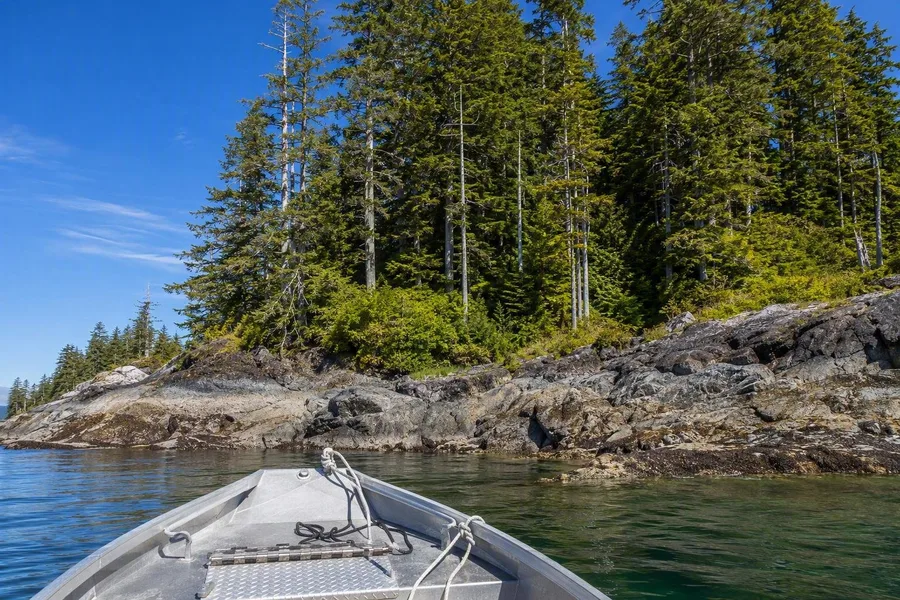 A small boat approaches a rocky Gwaii Haanas shore beneath cedar forest.
Flights connect Vancouver with Sandspit and Masset, while ferries run from Prince Rupert to Skidegate; rental cars, taxis and Eagle Transit serve the dispersed communities. The Haida Heritage Centre opens Tuesday–Saturday from September through April and Monday–Saturday from May through August, 10am–5pm, excluding statutory holidays; adult admission is C$24 before tax, and photography is prohibited in the museum galleries. Book Gwaii Haanas separately. Independent travellers must reserve at least five working days ahead, pay the required fees, complete the online orientation and carry their booking proof and certificate; an appropriate licensed operator can arrange these requirements for a guided trip.
South of the roads, a boat passes between islands, coves and forested slopes before anyone steps ashore. A landing can cross uneven beach stones or slick rock, with cedar forest rising directly behind the tideline.
Keep exploring