Granville Island Still Works for a Living
Fishmongers portion halibut beneath an old lifting crane, glassmakers work near former machine shops, and boat crews haul vessels from False Creek. On Granville Island, Vancouver’s industrial fabric still holds a market, workshops and a working shore together.
Fish, fruit and heavy timber
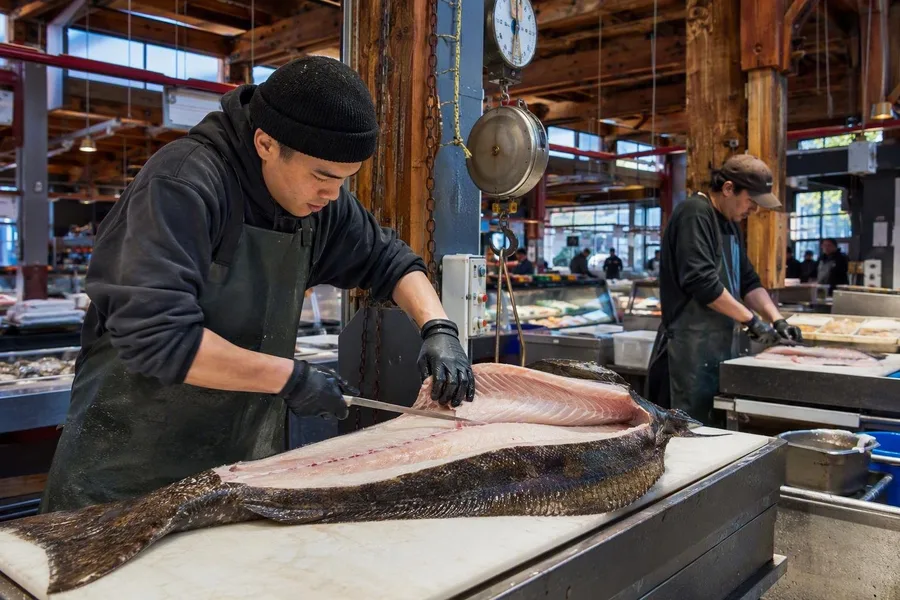 Fishmongers fillet halibut beneath heavy timber in Granville Island Public Market.
Lunch can begin with a fish counter. At Seafood City, staff fillet sea bream and halibut, while Longliner Seafoods sells fresh and smoked local fish. A few steps away, Four Seasons Farm displays British Columbia berries, cherries, peppers and mushrooms. Coast and farmland meet across the same market floor.
The hall makes that proximity more than a pleasant shopping arrangement. Six former industrial buildings were joined to form the Public Market, and several had supplied equipment and materials to forestry, mining and shipping businesses. Heavy timber columns still divide the space. An overhead lifting device remains above stalls of bread, vegetables and prepared food. Workers once moved chains, cables and equipment through these sheds; vendors now cut fish, weigh produce and wrap supper beneath the same beams.
Granville Island was built for handling goods. It is not a natural island and has not been an island since the 1950s. Coast Salish communities fished and gathered food around the original sandbar in False Creek. In 1916, dredged material turned the site into Industrial Island, with wharves, rail links, factories and sheds serving construction, shipping and resource trades.
More than 50 independent food businesses now work in the converted buildings. Lee’s Donuts has made classic doughnuts here since 1979, and its Honey Dip draws a regular line. A Bread Affair bakes without preservatives in small batches. Terra Breads uses local and seasonal ingredients.
The next counters widen the pantry. Benton Brothers cuts cheeses from small producers in Canada and abroad; family-run Zara’s sells fresh pasta, sauces, olives and antipasti; Oyama makes pâtés, salami, ham and sausages. Pad thai, schnitzel and vegetarian pho share the eating area. Salmon, seasonal fruit and regional honey sit beside foods shaped by migration and European deli traditions. The market sells ingredients for dinner as readily as it sells a quick lunch: fish to cook, bread to carry away, cheese cut to order, or maple-candied salmon for later.
Workshops in the old sheds
After the Second World War, road freight displaced some water transport, businesses moved outward, and fires damaged the industrial site. Redevelopment began in the 1970s. The project reused the sheds rather than replacing them with a conventional shopping centre, turning old buildings into studios, theatres, shops, restaurants and community spaces; corrugated-metal walls received vivid colour.
Workshops keep making close to the public. In Railspur Alley, the Net Loft and the Artisan District, jewellers, woodworkers, textile artists, broom makers and glassmakers occupy low industrial buildings. The Net Loft takes its name from a fishing company that dyed and hung nets there.
Vancouver Studio Glass runs as an open studio and gallery, where visitors can watch the team at work. Hammered & Pickled makes rings, necklaces, bracelets and earrings on site; its name refers to hammering and pickling, two silversmithing processes. The workrooms contain more than finished objects on shelves.
The Granville Island Broom Company makes household brooms from untreated broomcorn, a tough sorghum fibre, using Shaker methods. Makers spread, trim and stitch the flat brooms, then fit handles of materials that include poplar, rope and forged iron. The stitching stays visible on the finished broom.
The scale of these spaces comes from their earlier tenants. The B.C. Equipment machine shop, built in 1917, now forms part of the Public Market. Above a parking entrance, the name Canada Chain & Forge remains in place; inside sits a huge chain link left from that industrial past. Pedestrians, cyclists and slow-moving vehicles share the streets rather than using fully separated lanes and pavements. Deliveries, workshop work and visitors therefore remain in the same visible space.
Practical: The Public Market opens daily from 9am to 6pm, though individual businesses may keep different hours; it closes on Mondays in January for maintenance. Bus 50 stops at the entrance, and Aquabus and False Creek Ferries dock near the market. Regular False Creek Ferry services do not require reservations. Paid parking is limited; the stated summer weekend rate between 11am and 6pm is C$6 an hour.
Boats back on dry land
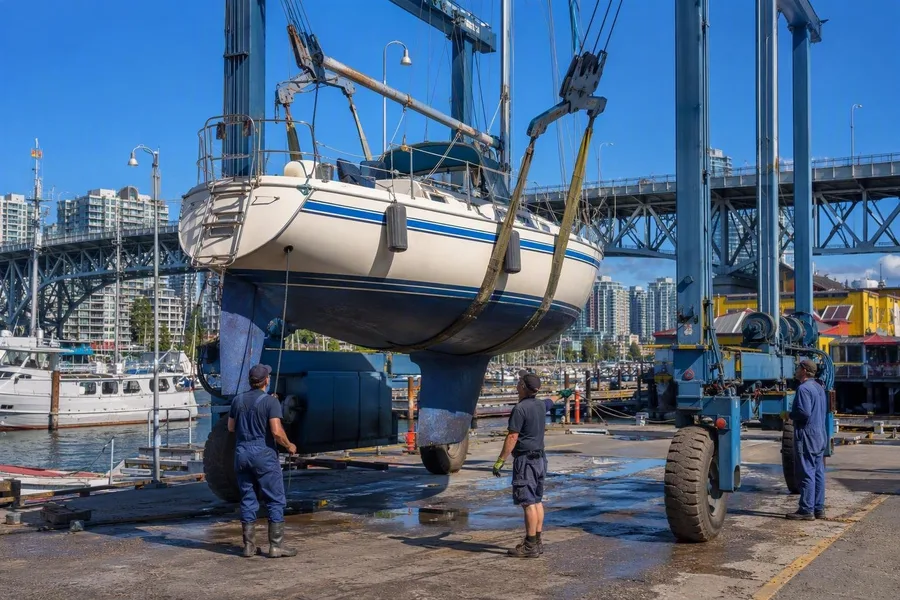 Boatyard crews lift a sailing boat from False Creek for repair at Granville Island.
False Creek remains a workplace beyond the food counters and studios. The Big Red Barn began as a National Machinery Company warehouse and machine shop. It now houses a maritime market and boatyard. The yard lifts sailing boats and motorboats from the water for inspection, hull cleaning and repair. Crews work on engines and rigging, repair fibreglass, and carry out custom fabrication around hulls set temporarily on land.
Heavy industry also remains on the peninsula. A concrete plant has operated here since 1917, and its silos stand beneath the Granville Street Bridge. Shoppers, craftspeople, boat crews and concrete workers use adjoining parts of the same narrow waterfront.
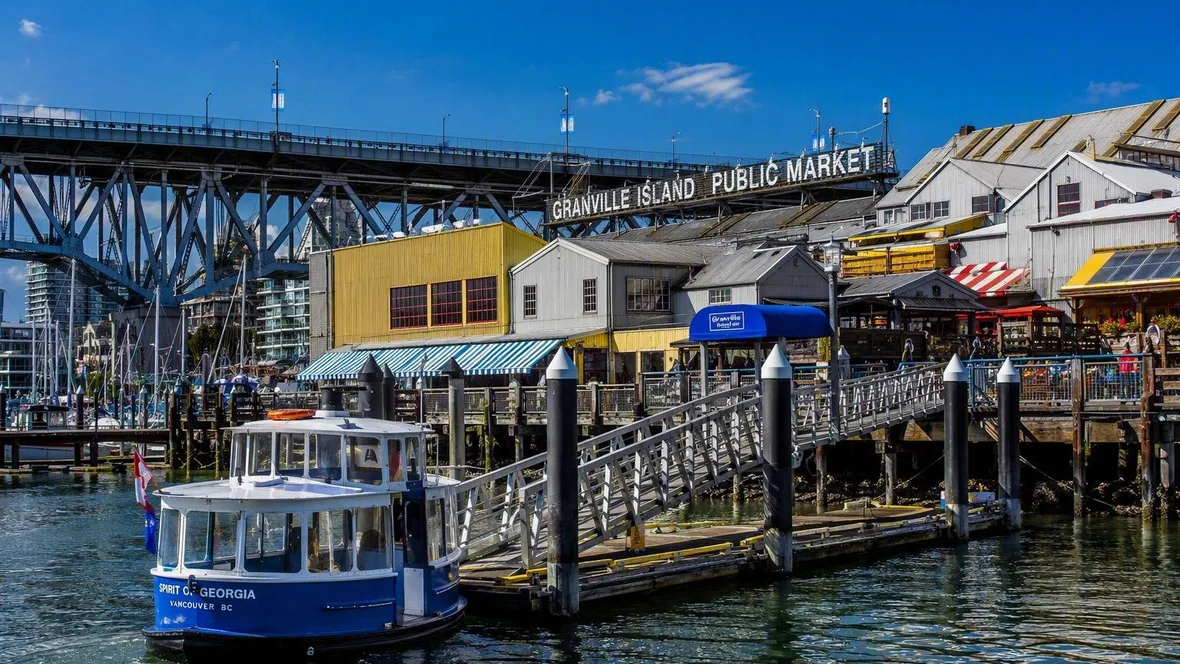
Small passenger ferries pass marina boats, visiting craft and vessels awaiting maintenance. Aquabus docks between the Public Market and the Arts Club Theatre, while False Creek Ferries uses another nearby landing. Behind the market, a ramp connects the fixed shore to a floating dock. Its angle changes with the tidal water.
The present Granville Street Bridge has carried traffic since 1954 and stands high enough for boats to pass beneath it without a movable span. Chain & Forge Plaza sits below the bridge on ground associated with the factory that once made chains there.
At the market dock, a ferry’s bow meets the floating platform. The ramp rises toward old sheds, masts pass below the bridge, and boatyard crews work along the False Creek shore.
Keep exploring