
From Tilène’s Fabric Stalls to a Médina Tailor
Outside Marché Tilène’s covered halls, cloth begins its short, exacting passage through the Médina. A buyer compares colours at a stall, carries a chosen length along Rue 19, then hands it to a tailor who cuts, stitches, presses and finishes it for a particular occasion.
At the market edge
Marché Tilène has a clear physical order. Food traders occupy the middle of the covered market, while jewellers and spice sellers work in its wings. Fabric stalls stand outside the halls, along the market edge and the adjoining streets.
The first decisions happen in the open. Buyers inspect displayed cloth, hold colours beside one another and negotiate with traders before leaving with their purchase in a bag. Late in the afternoon, market talk thickens around the stalls and can drown an ordinary conversation.
The cloth often has a purpose before it leaves Tilène. A customer may choose bazin for a boubou, lace for a dress, or bazin and lace to be patched together in a more contemporary outfit. More formal boubous use damask or bazin with stronger embroidery; simpler versions can remain unembroidered.
These are not off-the-peg purchases. Customers commonly bring their own fabric to a tailor and explain the garment they want. The bag that leaves the market carries a length of cloth, a selected colour and the beginning of an order.
Along Rue 19
Rue 19 offers the most firmly documented link between these two trades. A fabric seller operates at the junction with Avenue Blaise Diagne, while a business making traditional and modern clothes is also registered on Rue 19. The addresses do not make a closed row of textile shops. They sit within the broader Tilène market zone, where fabric trade runs along the outer edge of the halls and into the surrounding streets.
At the workshop, the customer gives the tailor the cloth and describes the chosen model. Before Korité and Tabaski, orders include boubous, women’s dresses and men’s suits that combine European tailoring with African dress.
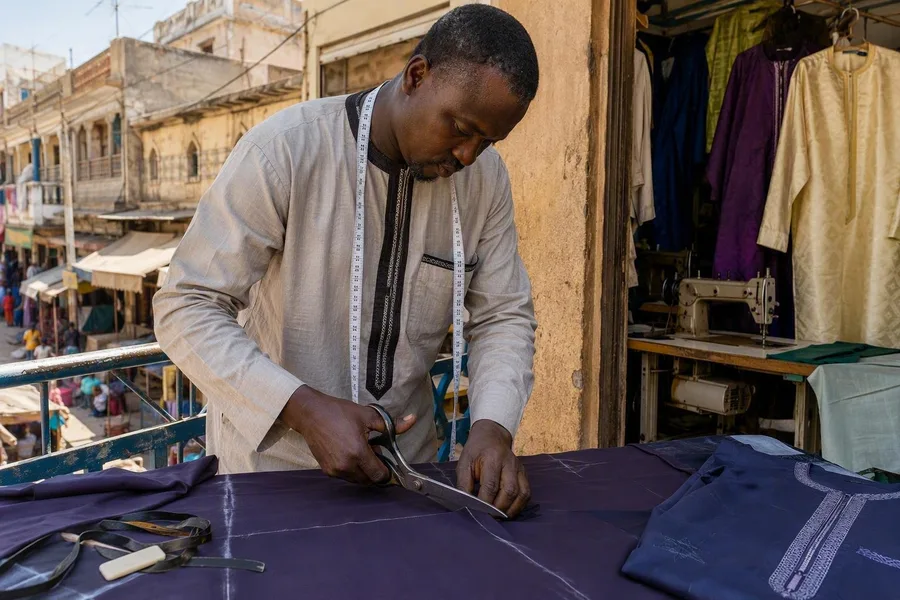 A tailor cuts fabric on a terrace beside a Médina workshop on Rue 19.
The grand boubou shows why cut matters. This ankle-length overrobe has generous sleeves formed as part of the garment, so the tailor needs enough width in the cloth from the start. Men’s versions traditionally have a long V-shaped neckline and sit over matching trousers and a shirt. Women’s versions usually have a rounder neckline and are paired with a pagne and head covering.
The tailor receives more than fabric. The order specifies a form, an occasion and, in many cases, the decoration around the neck and upper body. Boubou embroidery often concentrates in that area, where the garment’s finish is most visible.
Scissors, terrace, street
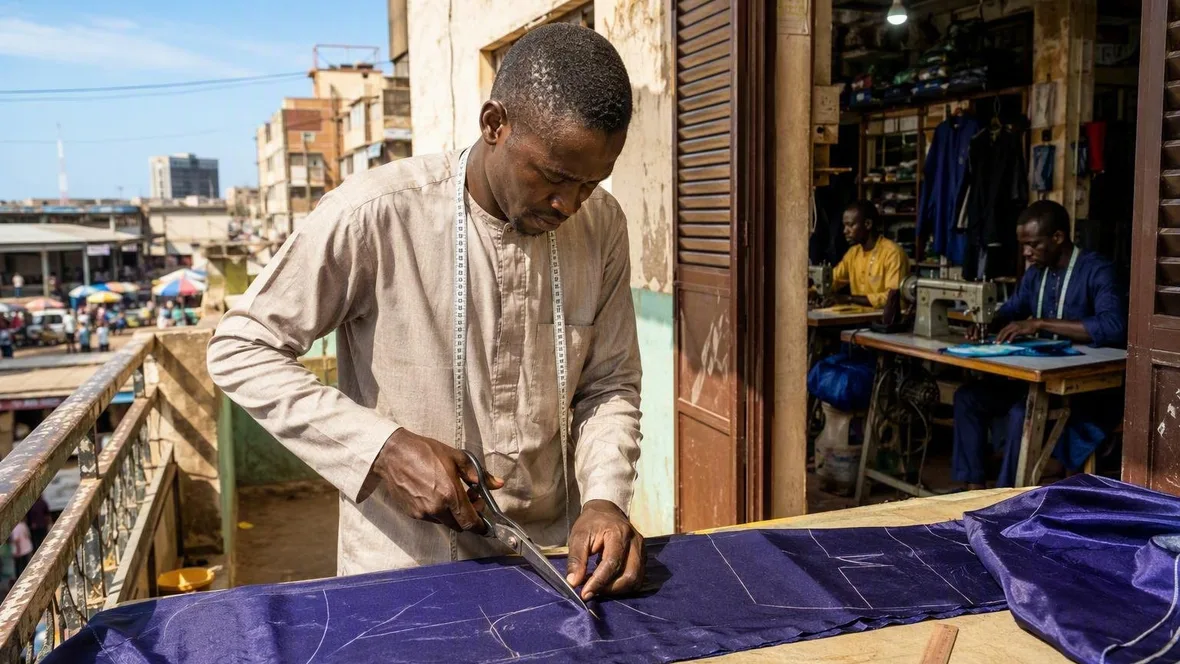
The cut changes the cloth from a whole length into parts with distinct jobs. In a documented Médina workshop, a tailor cuts fabric with scissors on a terrace while other workers sit at sewing machines nearby. The work takes place on a hot, sunny afternoon, close to the street rather than behind a sealed shopfront.
A tailor cuts bazin carefully. Loose sections can lie in a passage or wait on tables before sewing begins. A broad boubou needs panels that preserve its sweep. A closer-fitting modern suit calls for a different outline.
The scissors make their own sharp, metallic sound. Mobile repair tailors elsewhere in Dakar use their clacking blades to signal their presence, so the tool already belongs to the city’s working soundscape. At the terrace, engines pass in the street. Metalworkers hammer nearby, and carpenters saw timber.
The workbench does not stand apart from the pavement. A terrace can hold the cutter near the traffic and trade outside, while machines run within reach of the doorway. Tables and chairs carry pieces that have just been cut, garments still being assembled, and clothes awaiting collection.
Under the needle
The sewing machine takes over once the pieces are ready. Tailors lean forward above their work, guiding cloth beneath the needle. The sustained hum from Médina ateliers can carry beyond an entrance.
The sound holds steady against the street’s broken rhythm. Motors pass. Hammers strike metal. Saws bite through wood. The machines continue their narrower work, joining cut sections one seam at a time.
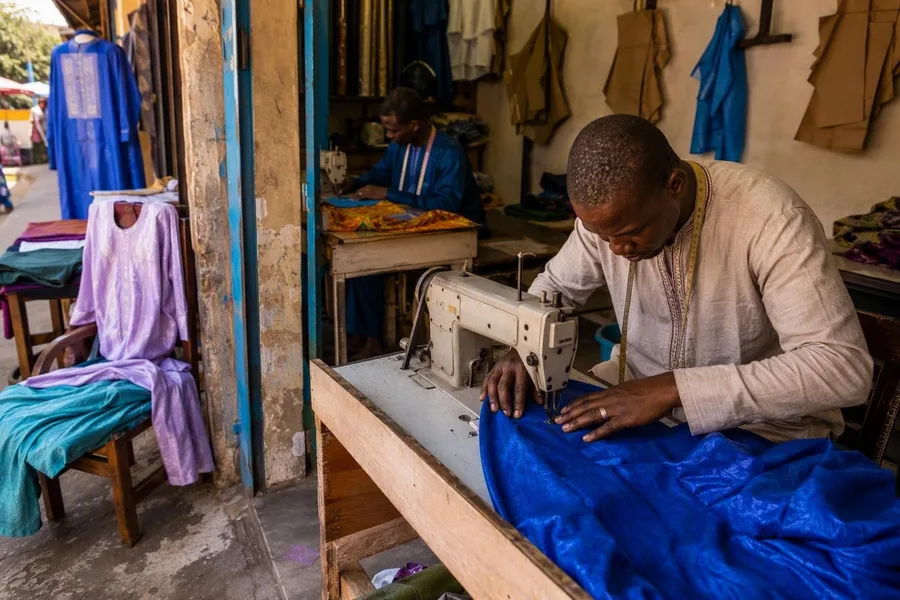 Tailors guide cut fabric beneath sewing-machine needles in a Médina atelier.
A master tailor may direct apprentices while the garments move between machine, table and chair. The arrangement remains visible at the threshold: machines inside, the occasional cutter on the terrace, and finished or nearly finished clothes gathered near the entrance.
For embroidered work, the machine can add decoration around the neckline and chest. Tailors use electric or treadle machines for boubou embroidery, while Médina workshops also apply fil à fil, a thread-by-thread decorative technique used on contemporary outfits.
Before Korité or Tabaski, this sequence quickens. Customers arrive to place orders or collect clothing, and machines can continue deep into the night. The pressure shows at the entrance, where tables and chairs hold stacks of finished garments.
Pressing and the last stitch
Ironing forms a separate part of the work in Médina ateliers. A pressed garment brings order to the seams and panels that have travelled from market stall to worktable.
Near the doorway, boubous, dresses and suits wait on chairs and tables for collection. Some will be worn for Korité or Tabaski. Others have been ordered for a wedding or a naming ceremony, where a starched or embroidered boubou forms part of the dress.
Outside Tilène, the cloth lay among other lengths and colours. Here, a tailor feeds its final edge beneath the needle, and the machine’s hum runs on behind the open doorway.