From the port to Cerro Cordillera, one steep stair at a time
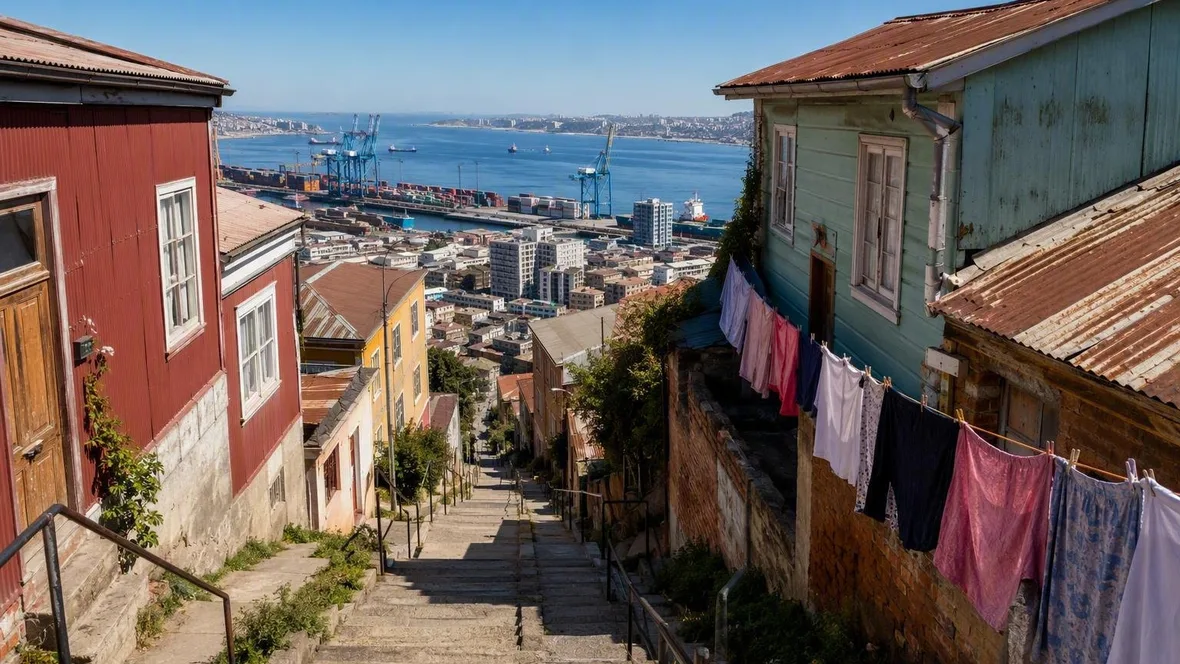
Calle Serrano begins in the working grain of Barrio Puerto. A few minutes uphill, the tiled Escalera Cienfuegos cuts beside Ascensor Cordillera, then releases walkers into the residential streets of Cerro Cordillera.
Calle Serrano runs from the Plaza Echaurren side of Barrio Puerto beneath older buildings that long combined commerce at street level with homes above. The street holds its practical purpose. Panadería Serrano stands at the foot of the climb, a daily landmark before the hill interrupts the flat ground.
Port noise fills this lower stretch. Engines, horns, warning beeps, trucks and freight trains overlap with the knock and scrape of container work; gulls, dogs and voices make a second, less mechanical layer. The sound has weight here because the harbour lies close behind the buildings. Calle Serrano carries traffic, trade and pedestrians under façades built for both business and domestic life.
The lower station of Ascensor Cordillera marks the turn uphill. A mural by the French graphic artist Loro Coirón covers part of the station building. It sits on the structure that serves the route, not on a detached wall selected for inspection. Beside the funicular track, the Escalera Cienfuegos begins its direct climb to Plaza Eleuterio Ramírez.
The stair has 164 steps. Coloured tiles have covered it since 2015. Their colour does not soften the job of the place: this is a narrow, steep pedestrian line between the port street and the houses above. The lift track rises beside it. Walls press close on both sides.
The climb measures only about 60 metres along the funicular’s course, but the average gradient approaches 70 degrees. The figure describes the abruptness of the corridor rather than each individual tread. A person on foot has no broad pavement or gradual bend to dilute the change; the stair goes up, closely following the lift’s route.
Paint appears here as part of the passage. The tiled risers give the stair its colour, while two murals by Giova occupy a small alley opposite. These surfaces belong to a route used for getting home, going down to the port and crossing between street levels. They do not turn the climb into a catalogue of works.
The harbour does not disappear halfway up. Its noise changes shape. Recordings made from Valparaíso’s hills capture ship horns and port machinery at a distance, and the dense slopes can throw sound back across the built ground. On the stair, a horn can arrive alone. So can a dog, a burst of engine noise or the hard strike of industrial work below.
The upper station opens onto Plaza Eleuterio Ramírez. The small expanse of ground breaks the tight vertical corridor, and Calle Castillo restores the ordinary horizontal direction of a street. Across the plaza stands the Castillo San José complex. The original fortification dates to 1692, when it formed part of the harbour’s defence; the present building dates from 1843.
The old fort and the funicular share this compact piece of hill without ceremony. Pedestrians step off the stair. The lift arrives beside them. Calle Castillo takes the route farther inland. The port’s history remains visible in the fort’s position above the bay, while the plaza serves the simpler work of connecting one level of the city to another.
The buildings beyond the plaza show why broad descriptions of a “colourful, crumbling” Valparaíso fail this hill. Casa Massini uses a timber frame with earth and adobillo infill. Its street-facing section has two storeys, while the house continues down the slope in four levels. Repairs there reused timber, sheet metal and earth. The building shows maintenance alongside age, with materials retained because they still form the house.
Espacio Santa Ana uses another combination: stone foundations, brickwork, timber internal walls filled with adobillo, and a roof structure of Oregon pine under zinc sheeting. Wood, earth, brick and metal sit close together in Cerro Cordillera, but each material carries different signs of weather, repair and use. The street does not need picturesque neglect to make those distinctions clear.
A compact practical note: begin at Plaza Echaurren and follow Calle Serrano to the base of the hill; the public street and stair require neither a ticket nor a reservation. Ascensor Cordillera runs between Serrano and Castillo as an alternative to the first steep climb.
Calle Castillo leads towards Purcell and the higher residential fabric. The local soundscape now contains birds, voices and the general hum of the city; the harbour continues below as a thinner field of distant signals. At the Purcell viewpoint, the ground falls away towards the historic quarters and Plaza Sotomayor. From here, the low port streets and the hill’s stairs, paths and subidas show the practical geometry of Valparaíso: routes must climb sharply, then run sideways across the slopes.
Near Castillo, A desalambrar, a mural by un.jotape, stands beside land that residents reclaimed for a community garden after the loss of a heritage building. The painted wall stands next to a working plot rather than a preserved ruin. Its setting gives it a role in the neighbourhood’s current ground-level life.
Beyond Purcell, the route continues into Castillo, Merlet, Villagrán and Sócrates, streets identified with the residential area of Cerro Cordillera. The walk has changed character by then. Serrano dealt in harbour work and shopfronts; the stair solved a brutal change in height; these streets spread across the hill among homes and shared spaces.
Maintenance continues to shape that upper ground. Work on Calle Nº 5 includes repairs to the pavement and stairway, measures for the slope, and rainwater drainage. Such repairs matter plainly on a steep street where water and feet follow the same downward line.
Casa Massini gives the final stretch a physical form: a street-facing block, a courtyard, then a residential wing descending behind it. The building remains collective housing. On Cerro Cordillera, timber, earth, brick and zinc hold their places above the port; repaired steps cut between the houses, and the harbour’s horns reach the residential streets as distant, separate notes.
Keep exploring