From Sanità to Pignasecca, Before Naples Gets Loud
Start low in Sanità, where tuff walls, scooters and early bakery trade fill a tight valley street. Then climb towards Museo, cross Piazza Dante, and descend through Montesanto as separate errands gather into the dense commerce of Pignasecca.
Sanità starts in the valley
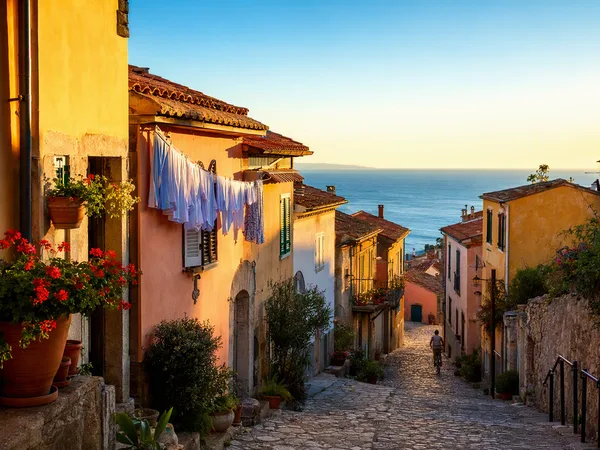
Via della Sanità runs through a low basin beneath Capodimonte. Yellow tuff shows in the slopes and in the rough fabric of the district; plastered façades, iron balcony rails, garage doors and washing lines cut across it at street level.
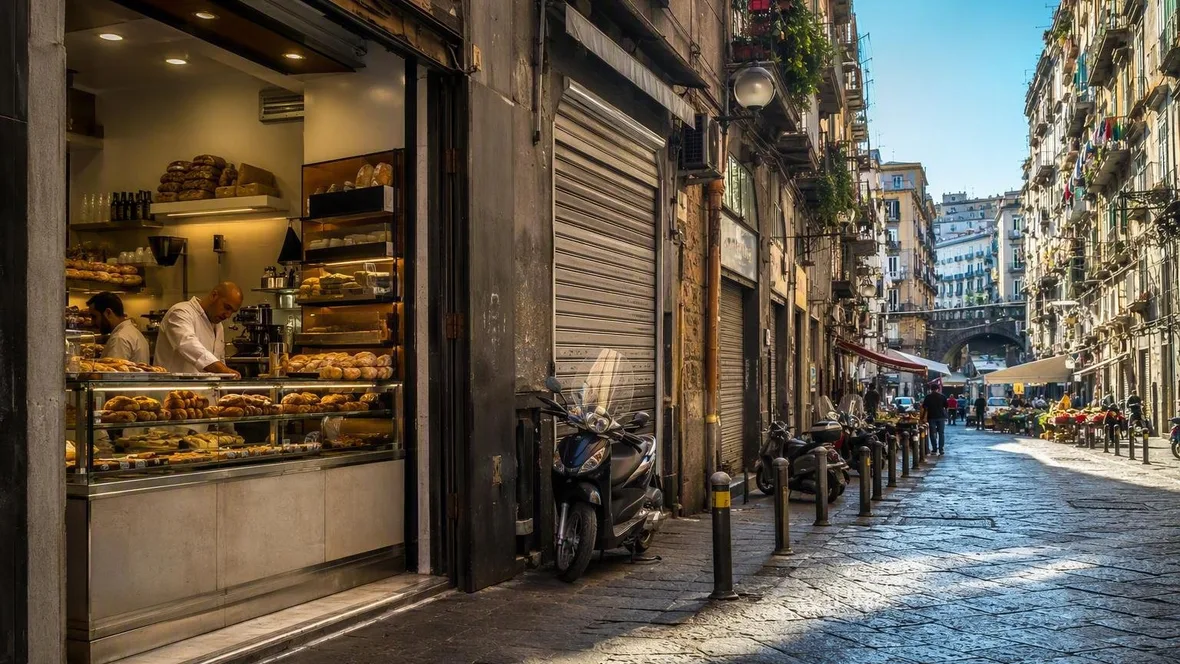
The morning begins in fragments. A scooter takes the narrow carriageway. Voices travel from doorways. A mechanic’s radio plays from a ground-floor garage, while shoppers stop at neighbourhood shops and produce stalls rather than joining a single flow.
Sanità grew into a residential district around its basilica from the seventeenth century, when nobles and middle-class families built palazzi among the older lanes. The architecture still breaks open unexpectedly. Courtyards expose broad stone staircases, including the double flights that give several palazzi their theatrical scale. Palazzo dello Spagnuolo, built in 1738, provides the grandest local example, with two sweeping flights shaped like hawks’ wings.
Those stairs sit behind entrances and above the pavement. The route itself stays on the street. Via della Sanità leads towards Via Santa Teresa degli Scalzi, with the valley’s enclosing buildings close on either side.
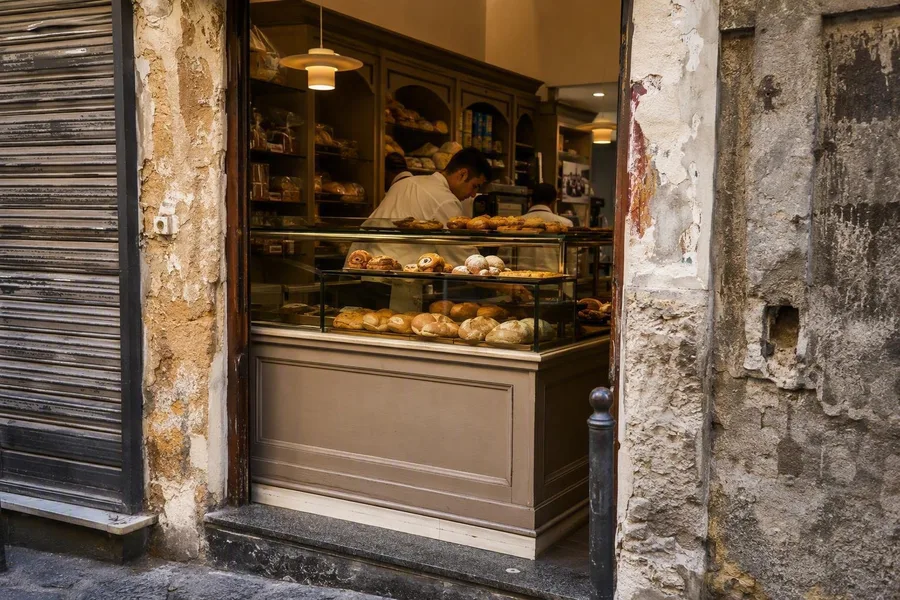
Pasticceria Poppella, on Via Arena della Sanità, opens from 6am every day. Its counter supplies one of the first firm signs of business on this side of the walk: pastry in the display, a lit shopfront, customers stepping back onto the pavement. The district does not wake with a grand flourish. It opens door by door.
Above the roofs, the early nineteenth-century bridge to Capodimonte crosses the district at a height that makes the bowl of Sanità plain to see. Engineers built the viaduct as a faster route to the hill, leaving the older streets below to houses, small businesses, scooters and daily shopping.
Up towards Museo
Via Santa Teresa degli Scalzi takes the route uphill from Sanità towards the historic centre. The rise asks for steady steps, not a dramatic stair climb. Naples has plenty of monumental stairs, but the Scala di Montesanto sits elsewhere, descending from Corso Vittorio Emanuele towards Montesanto; taking it here would turn a short cross-city walk into a detour.
 A view of Sanità starts in the valley.
The climb keeps Sanità’s materials in view. Pitted tuff meets patched plaster. Metal shutters sit below balconies. A garage occupies one entrance, while a butcher, a barber or an ordinary shop may take the next. Work and home share the same dense run of ground floors.
The street begins to open near Piazza Museo. Enclosed lanes and courtyards give way to a wider urban axis through Via Pessina and on towards Piazza Dante. More daylight falls across the paving here. The slope eases, and the sound carries farther: passing engines, steps across the square, voices that no longer stop at the nearest wall.
A quick coffee at Dante
Caffè Mexico stands at Piazza Dante and opens from 6.30am on weekdays, or 7am on Sunday. The café counter provides a brief, practical pause in a walk that has so far moved through scattered local business. Naples treats the standing espresso as a compact affair: coffee at the counter, payment, then back outside.
Piazza Dante gives traffic and pedestrians room that Sanità did not. The space remains busy rather than serene. People cross between the historic centre and the western neighbourhoods, and the open square spreads the morning movement across its broad paving.
Via Tarsia changes the scale again. The road narrows beyond the square and drops towards Montesanto. The descent draws more of the morning into the same direction. Individual errands begin to overlap: shoppers heading downhill, businesses setting out goods, scooters threading through gaps that were never designed for them.
Down to Montesanto
Via Tarsia leads to Via Montesanto and Piazza Montesanto without the need for a stairway. The city has long relied on slopes, ramps and steps to connect its differing levels, but this stretch does its work on a continuous pavement.
Armando Scaturchio, on Via Portamedina, opens daily from 6am. The business combines pasticceria and caffetteria, and its counter and display cases face the street as part of the morning trade. By this point, the route has passed from the first bakery doors in Sanità to a more continuous line of food, coffee and shopping.
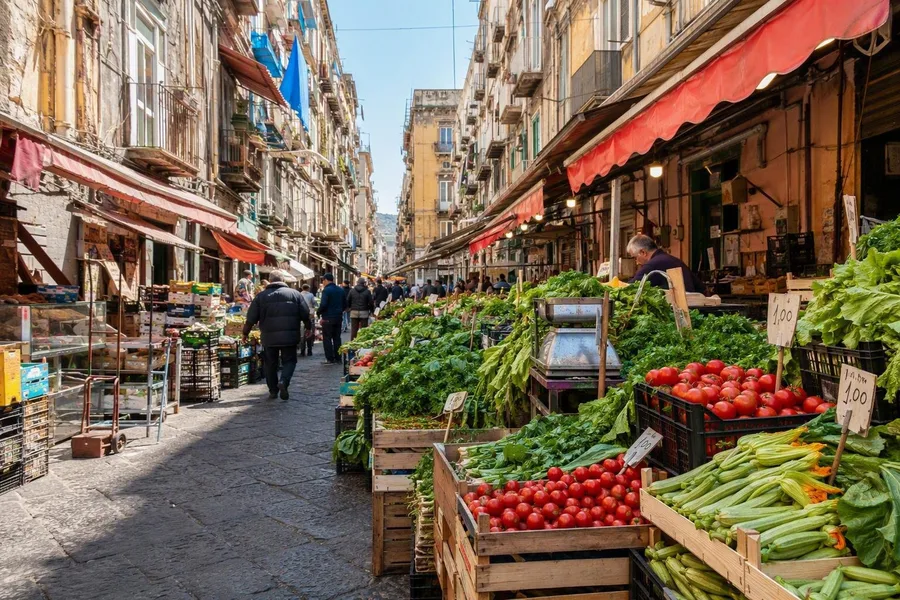 A view of Pignasecca takes the pavement.
The approach tightens near Piazza Montesanto. Footsteps, engines, traders and shoppers occupy the same short stretches of road. Sanità had its own street market and its own calls from sellers, but its activity spread across separate addresses and side streets. Here the traffic gathers before spilling into Pignasecca.
Pignasecca takes the pavement
Via Pignasecca runs uphill from Piazza Montesanto towards Largo Carità. Old shops hold the edges of the road. Market traders take the centre, setting fish, fruit and vegetables beside permanent counters and small food businesses.
The market works from Monday to Saturday in the morning, with stalls established from 8am. Traders fill displays and call prices across the narrowing space. Fish lies on crushed ice. Lemons and vegetables pack the stalls in blocks of colour. Scooters still pass, though every manoeuvre now competes with a shopper, a crate or a market box.
Panificio Coppola Vincenzo, at Via Pignasecca 35, opens from 6.45am from Monday to Saturday. Cornetti and brioche appear in the morning, while bread comes out fresh at several points during the day. The smell and heat of baking no longer belong to one early shopfront. They mix with wet ice, fruit skins, metal trays and the frying pans that begin to sizzle as vendors cook to order.
Pignasecca formed on land that lay outside the old city walls, among gardens and woodland. Sixteenth-century work on Via Toledo turned the area into a route between the centre and the sea. The present street still shows that practical history. Shops anchor the sides. Stalls occupy the open strip. Buyers keep moving through the narrow space between them.
The route ends not with a view but with a transaction. At a bakery counter, a hand closes around a warm paper bag and carries it out into the market crowd.
Keep exploring