
From San Camilo to La Nueva Palomino: Arequipa before lunch
At Mercado San Camilo, the morning arrives on carts: fruit, herbs, bread and fish on ice roll beneath an iron roof. Half an hour uphill in Yanahuara, La Nueva Palomino turns the day’s familiar raw materials into lunch with a river-stone batán, clay chombas and pots set on the concha.
The market before the meal
Mercado San Camilo starts with work. Carts bring in fruit, sacks of herbs, bread and fish laid over ice before the market opens at six; then wheels and footsteps carry through the hall beneath its high metal roof. Daylight reaches the stalls through the iron structure, which was built to bring air and natural light inside. Sillar details break up the metalwork.
Enter from Calle Mercaderes and follow the fresh produce. Papayas sit beside onions, potatoes, white choclo and green habas. Fresh herbs and flowers add bright greens and cut stems to the piles, while dried ají panca, ají amarillo and dried rocoto bring rust, yellow and deep red.
The smell changes from stall to stall. Fresh herbs and vegetables give way to the earthier scent of dried ají panca. A shopper can see the peppers before they become sauce: shrivelled skins, loose seeds and measured portions in the produce aisle.
Deeper in the market, butchers cut beef, pork, chicken and offal to order. Fresh and dried fish lie nearby, and freshwater prawns appear when the season allows. On the Piérola side, vendors arrange fresh and Andean cheeses, butter and cream. Each counter shows a different stage of the same morning: weighing, cutting, wrapping, carrying.
By about ten, the cooking stalls in the market and on its upper floor begin serving soups and daily plates at shared tables. The sound changes with the hour. Carts and chopping continue, but bowls and plates begin to move across counters faster as lunch approaches.
Out into the hard light
The route to La Nueva Palomino begins at San Camilo’s block, bounded by San Camilo, Piérola, Perú and Alto de la Luna. From there, walk northwest through the commercial centre and Plaza de Armas, follow Calle Santa Catalina to Puente Grau, then climb into Yanahuara towards Pasaje Leoncio Prado.
The market gives way to traffic and shopfronts around the centre. Beyond the bridge, Yanahuara has lower sillar houses, broader pavements and quieter residential streets. The filtered light beneath San Camilo’s roof becomes a sharp reflection off pale volcanic stone. The gentle uphill stretch feels exposed in the midday brightness.
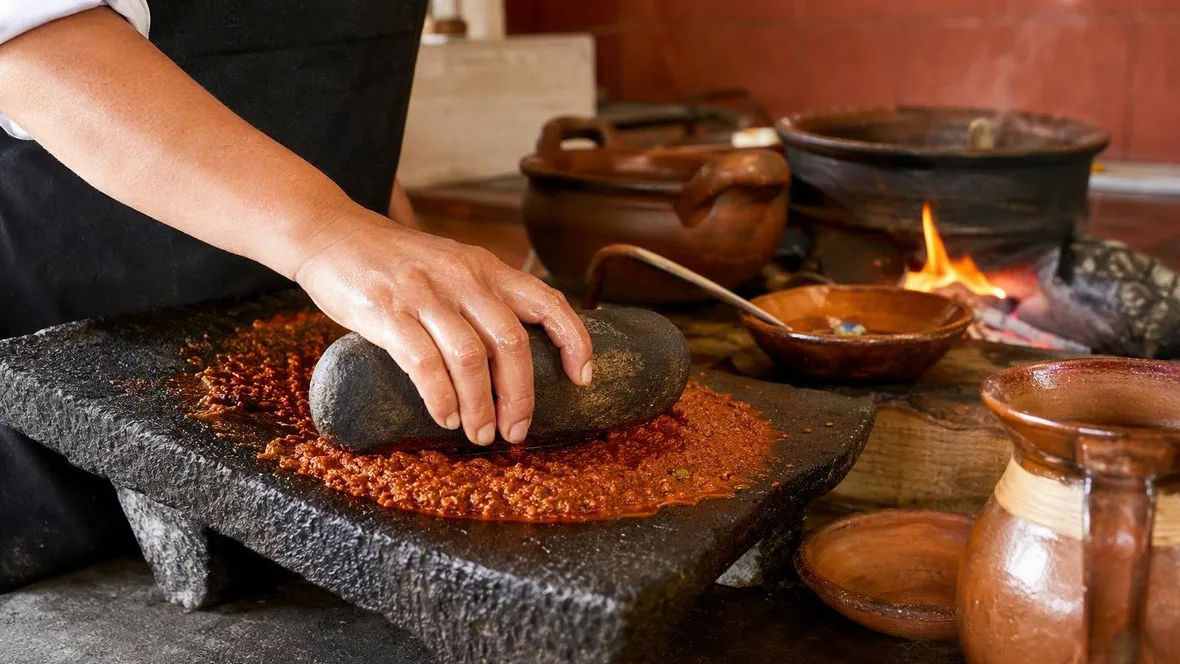
The stone changes purpose at the end of the walk. Sillar lines the streets, but a smooth river stone anchors the kitchen at La Nueva Palomino. Cooks move a curved hand stone back and forth over the heavy batán, grinding ingredients into a paste.
That action gives the market’s dried ajíes a clear continuation without claiming a direct supply chain. San Camilo sells ají panca among its produce and spice stalls. At La Nueva Palomino, cooks grind ají panca into a cream on the batán rather than using a blender. Stone scrapes against stone; freshly ground ají sharpens the air.
Practical details: allow around 30 minutes for the walk from San Camilo to La Nueva Palomino, including a gentle climb into Yanahuara. Mercado San Camilo opens Monday to Saturday from 06:00 to 17:00 and on Sunday until 15:00. La Nueva Palomino, at Leoncio Prado 122, serves lunch daily from 12:00 to 16:30. Reservations are accepted and help at busy lunch periods.
The day’s cooking
La Nueva Palomino begins its lunch preparation early and cooks for that day rather than freezing food in advance. The batán sits at the centre of that work. A cook pushes and draws the curved hand stone across its larger, smooth base until the ingredients become a thick paste.
The same kitchen prepares rocoto relleno, one of the picantería’s established dishes. Rocoto, ají panca and fresh cheese all appear at San Camilo, though the available evidence does not show that this kitchen buys them there. The useful link lies in the visible labour: a pepper at a market stall, an ají paste worked by hand on stone, a dish prepared for the midday table.
A second pot holds chupe de camarones. La Nueva Palomino uses zapallito from Yumina and cheese from Lluta for this prawn soup. San Camilo also sells cheese and, in season, freshwater prawns. The comparison stops there; the market’s counters show the ingredients’ local presence, not the restaurant’s purchasing list.
Chupes and adobos begin their slow cooking from the morning on the traditional concha, described as a wood-fired cooking hearth. The pot gives the kitchen its steady sound: a low simmer beneath the harder scrape of the batán. The preparation depends on repeated hand movements and time at the heat, not on a quick turn through a machine.
Clay, chicha, lunch
Near the kitchen, large handmade clay chombas hold resting, fermenting chicha de güiñapo. These vessels make an older part of Arequipa’s food culture tangible. Picanterías developed from chicherías, places where fermented maize drink accompanied spicy food; during the nineteenth century, fuller meals took over the central role while chicha remained at the table.
La Nueva Palomino keeps that history in working materials rather than in a display case. Ají goes across a stone grinder. Chicha rests in clay. Pots cook from the morning, and diners eat at long tables and benches in open sections of the dining room.
The picantería’s daily lunch has long carried that shared-table custom. A changing soup formed part of the traditional weekly rhythm, and La Nueva Palomino cooks a different chupe each day. Its chupe de camarones comes in portions made for sharing.
At midday, the batán still bears a smear of ají. A brown clay chomba stands close by, and the chupe pot holds its place over the heat of the concha.