
From Market Smoke to Silver Hammers in Kotagede
At Pasar Legi, vegetables lie on cloths beneath an iron roof and smoke from small cooking fires catches the early light. A walk of only a few hundred metres carries the morning from market noise to mosque walls, shared lanes and the dry ring of silverwork in old Kotagede.
Breakfast under the iron roof
Pasar Legi begins with work. Traders lay out vegetables and fruit on cloths, weigh daily purchases and stack rice, eggs, baskets and brooms within easy reach. Customers move through the aisles. Motorcycles pass on the road outside, while butchers chop meat behind their counters and vendors crack open coconuts.
Small fires burn under pots and food carts. Smoke rises through the hard geometry of the iron roof, softening its beams in the morning light. Dry gudeg, made from young jackfruit cooked slowly with spices, brings a deep savoury scent to the market. Traditional sweets sit in banana-leaf parcels nearby; kipo folds sticky rice, grated coconut and palm sugar into one small bite.
Voices carry across the stalls. A cleaver hits a butcher’s block, engines buzz beyond the roofline, and a vendor’s scale knocks lightly as it settles. The market handles breakfast and household supplies before it offers any lesson in history.
Yet the old plan of Kotagede remains close at hand. In the late sixteenth century, this was the first capital of Islamic Mataram, laid out with a royal compound, public square, market and mosque near one another. That compact arrangement still shapes the walk.
Leave Pasar Legi by the street on its western side, follow Jalan Watu Gilang, then turn south toward Masjid Gedhe Mataram. Roughly 100 metres separate the market from the royal grave complex. The loudest calls and engines drop away after the turn. Brick takes over from corrugated stalls and iron beams.
Walls, water and the mosque drum
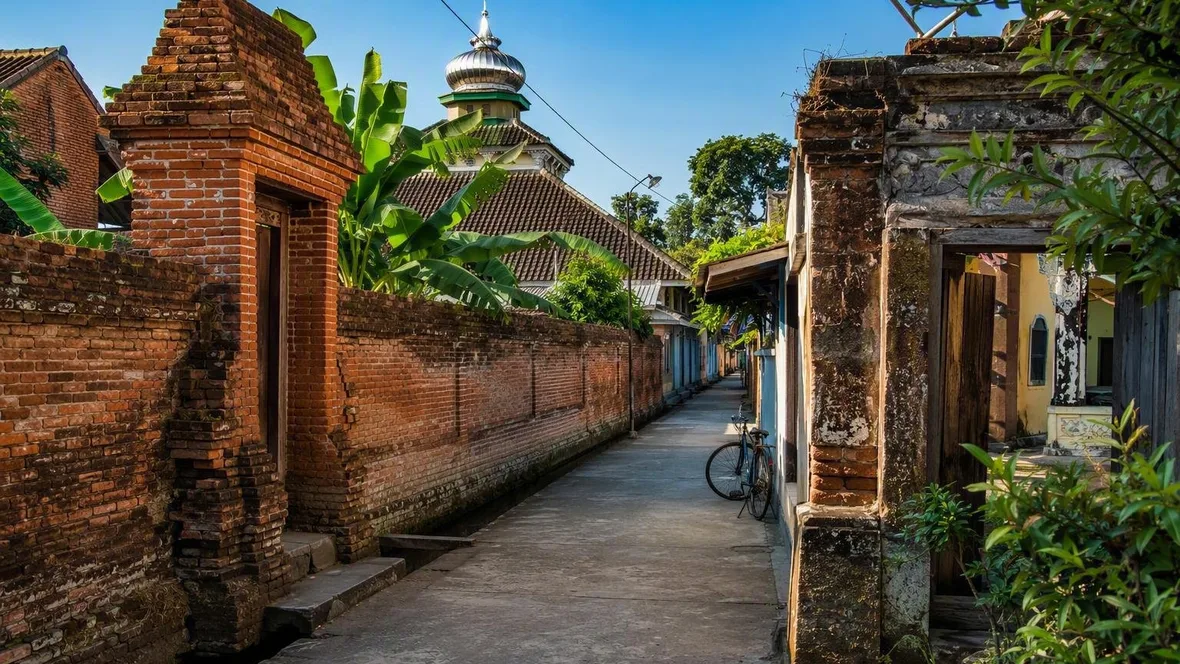
A paduraksa gate marks the entrance to the mosque precinct and its adjoining graves. Unplastered brick walls, built without mortar, divide the mosque, burial ground and bathing area into separate courts. Screen walls and gateways prevent any long, straight view. A visitor passes from one contained space to the next.
The mosque began as a simple langgar, or prayer house, and grew under Panembahan Senopati into Mataram’s royal mosque. The graves of the early Mataram dynasty stand alongside it. Its layered appearance follows that history: Javanese roof forms sit behind brick walls and paduraksa gates that retain forms associated with Hindu-Buddhist temple architecture.
The building shows repair as clearly as age. Older wooden columns stand beside later iron columns beneath a limasan roof, after a fire led builders to replace part of the original wooden support structure. Outside, a narrow wooden bridge crosses a tiled water channel. A ditch around three sides of the front hall once provided water for washing before entry.
Inside, four wooden saka guru posts carry the main roof. Teak boards line the ceiling, barred wooden windows punctuate thick walls, and a white marble floor covers an older white-stone floor that remains preserved underneath. The materials have weight: rough red brick outdoors, dark timber overhead, cool stone underfoot.
The large bedug drum still marks prayer time. Its low beat carries differently from the market’s sharp noises, then fades against the walls.
Between two gates
From the mosque, return toward the former alun-alun and enter Gang Rukunan, also known as Lawang Pethuk or Between Two Gates. Traditional houses stand in east-west rows along this narrow shared passage. Residents formed the lane by giving strips of private land for communal use.
Two gates frame the corridor. House fronts, courtyard walls and doorways stand close together, turning the lane into a slow pedestrian stretch rather than a street for cutting through by vehicle. Small concrete step-benches beside the houses show the seam between domestic space and the shared way.
Many older compounds first appear as high masonry walls. A single regol gate breaks the wall, then a sequence unfolds behind it: an open or partly sheltered front area, an unclosed pendhapa pavilion, enclosed living rooms and, in some compounds, a garden-like longkangan between buildings. Joglo houses hold their inner dalem rooms behind open pavilions. Under the high roofline, a carved wooden bahu dhanyang bracket bears part of the load.
The street remains narrow, but the houses offer small flashes of colour and texture. Some Kalang houses filter daylight through coloured glass, ventilation panels and openings beneath their eaves. Terracotta tiles cover the roofs above zinc awnings. Carved wooden trim, patterned floor tiles, iron window bars and broad overhangs bring shade and detail to the façades.
Use has changed some of these old compounds without erasing their plan. At Ndalem Natan, side wings now serve as guest accommodation, and corridors contain furniture, batik, accessories and handicrafts. The forecourt, rooms and side wings still read as separate spaces.
Nearby Purbayan also sees organised morning bicycle rides, with the quiet mechanical sound of pedals on neighbourhood streets. In Gang Rukunan, feet suit the scale better than wheels.
The sound of worked silver
The lane opens again toward Jalan Kemasan and Jalan Mondorakan. Long courtyard walls give way to linked shopfronts and workshops. Kotagede’s silversmiths were already at work when the town served as Mataram’s capital, and the craft remained after the court moved away.
A window display shows finished pieces. A workbench reveals the more compelling part: silver sheet, thicker wire for an edge and hair-fine strands for filigree. Many workshops use 925 silver. Some set polished bright metal against dark oxidised areas, a contrast that makes a raised line or curled wire stand out.
The visible motions are small and exact. Fine wire curls between tweezers or small pliers, then settles into a frame to make open, lace-like filigree. A small hammer strikes the back of a silver sheet and presses a pattern into relief. At another stage, heat and solder join wire to sheet; a file then removes roughness, and polishing brings back a clean sheen.
The tools do not fill much space: a burner, tweezers, a file, a steel block and a hammer. Their sounds fill it well. A file rasps over silver. Then the hammer meets the steel block in three small, hard notes: ting-ting-ting.