From Kapani’s Fish Stalls to the Thermaic Gulf
Fish lie on ice beneath Kapani’s low metal canopies. Pepper, cinnamon, oregano and saffron rise from open sacks a few steps away. Then the roofs end, the streets widen, and the Thermaic Gulf takes over the view.
Under Kapani’s low roofs
Kapani begins in lanes, not in a grand hall. Menexe and Vlali run through a close mesh of pedestrian streets between Egnatia, Aristotelous, Ermou and Venizelou, with mostly two-storey shop buildings pressed along either side. Metal canopies hang above the walkway. They cut the daylight into narrow, uneven patches.
Open sacks and baskets stand beside the shopfronts. Fish sellers lay their catch on ice; the wet shine of skin and scales catches what light reaches the stalls. Nearby, vendors work with a scoop, weighing pepper, cinnamon, oregano and saffron from sacks or small heaps. The smell of fish holds one corner of the lane. Warm spice follows in the next.
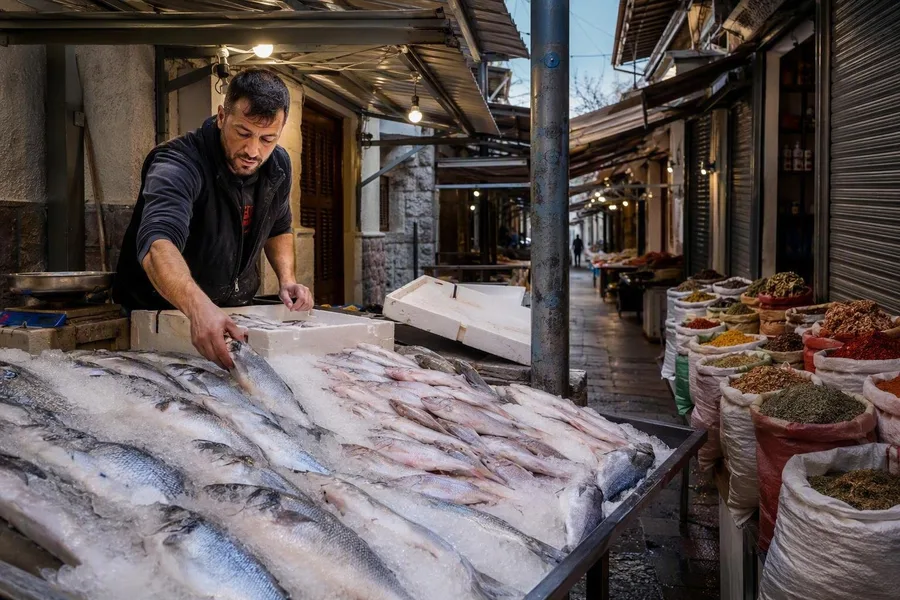 A fish seller arranges fish on ice beneath Kapani’s low metal canopies in Thessaloniki.
Kapani keeps its business in plain sight. A fish seller resets a bed of ice. A hand dips into a spice sack. Crates, baskets and displays leave only a modest strip of pavement between the stalls, so feet and shoulders pass close to the day’s shopping.
Voices carry under the metal covers. Sellers call over produce, customers move between the small shops, and goods travel from counter to street. No one could mistake this for a quiet retail arcade. The market has traded in this compact form for centuries; its name comes from Un Kapan, meaning flour market. That history shows most clearly in the low commercial buildings and covered passages, where trade still sits almost at pavement level.
Practicalities: Kapani’s streets are freely accessible in the central block between Egnatia, Aristotelous, Ermou and Venizelou. Regular hours are Monday, Tuesday and Saturday, 08.00–16.00, and Wednesday to Friday, 08.00–21.00, though individual businesses may keep different hours. Modiano stands around the corner at Ermou 24 and Vasileos Irakleiou 33; its website lists a reopening in September 2026, so check access before going.
The ordered light of Modiano
A short walk south brings Ermou underfoot and Modiano ahead. The distance is slight. The change is not.
Kapani spreads through several imperfect lanes; Modiano holds its market inside one long covered passage, with entrances on Ermou and Vasileos Irakleiou. The building went up between 1922 and 1925, and its restoration left the older structure visible: load-bearing masonry, concrete, steel roof sections and timber pitched roofs. Newer glass fronts and metal security shutters sit alongside them without much fuss.
Inside, the eye catches straighter lines. Small white shop units stand in rows along a pebble-mosaic floor. Marble stairs rise at intervals, metal balustrades edge them, and the steel roof spans above. The materials do not try to resemble one another. Marble stays cool and hard; the mosaic gives the floor its small, stony texture; steel draws thin dark lines against the light.
Daylight enters through horizontal windows and roof lights. It falls from higher up than it does in Kapani, where awnings and low canopies break the sun before it reaches a counter. In Modiano, hard surfaces catch sound as readily as light. Footsteps, voices and tableware gather beneath the roof instead of slipping away down side lanes.
Fish, meat and cheese stalls remain part of the hall, but seating and food businesses share the interior. The older market structure remains easy to read through the newer finish. A person walking from Kapani can still see the practical grammar of commerce here: shutters pulled down after hours, shopfronts opened for the day, goods arranged in a line, and a passage made for people to keep moving.
South to Aristotelous
Leave Modiano by Vasileos Irakleiou and follow the street east to Aristotelous. From there, turn south across Aristotelous Square, cross Mitropoleos and continue to Leoforos Nikis. The route takes only a few blocks. It changes the scale of the city at every turn.
First, the ceiling goes. The metal covers and the hall roof fall behind. Then the pavement broadens, façades stand farther apart, and the light comes from ahead rather than from a gap above a stall. The market noise thins with each block. Voices spread across the square, while traffic begins to make itself heard nearer the seafront.
The walk needs no clever detour. Its pleasures lie in the sequence of surfaces: ice beside fish, loose spice in sacks, pebble mosaic underfoot, marble at the stairs, then ordinary city paving on the way south. A hurried crossing turns these blocks into a shortcut. A slower pace lets each material hold its ground before the next one arrives.
Aristotelous Square puts the gulf at the far end of the street. The buildings still frame the view, but each southward step opens a little more water. At Nikis, Thessaloniki reaches the Thermaic Gulf without a beach or a soft edge. The city meets the water on a built quay, with a flat promenade running directly along the shore.
The hard edge of the water
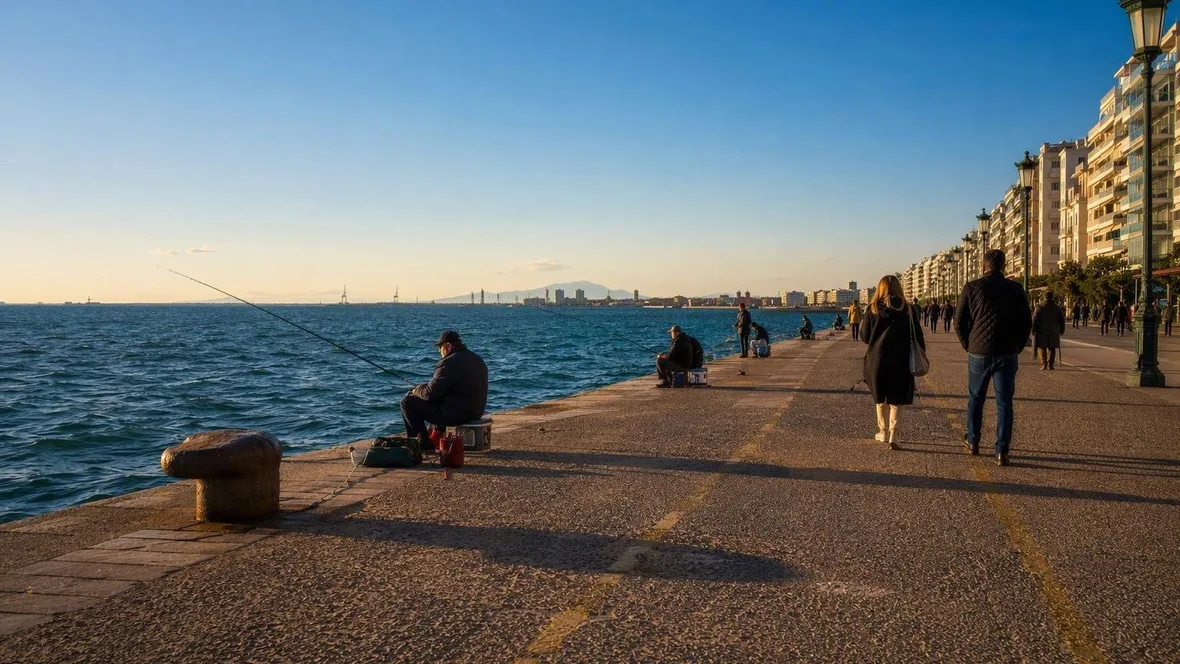
At the waterfront, the market streets sit behind the shoulder. The road runs beside the old promenade towards the White Tower, while the gulf opens across the full width of the view. Traffic continues along Nikis. On the promenade, walkers, runners, fishermen and street musicians occupy more space than they did beneath Kapani’s roofs.
East of the White Tower, Nea Paralia extends for 3.5 kilometres in a narrow strip between land and sea. A broad, light-coloured esplanade follows the water. A strip of hardwood decking marks the edge of the quay. Landward, a tree-lined path runs through shade, with benches, pergolas, planted areas and smaller garden spaces set behind it.
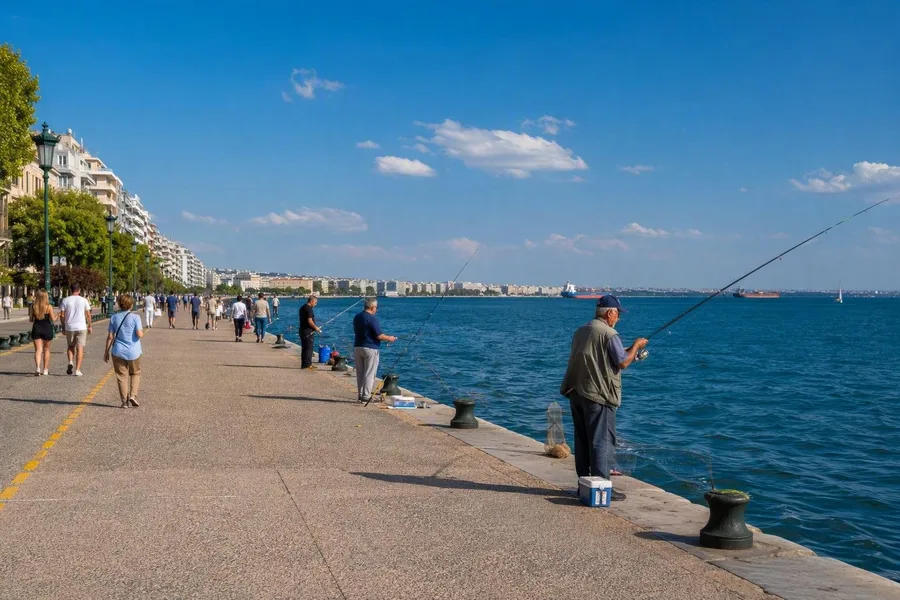 Fishermen stand beside walkers on the built quay along Thessaloniki’s Thermaic Gulf.
The two routes offer a simple choice. The tree-lined side gives shade under the trunks. The waterside path stays open to the sky and horizon, with little between the paving and the gulf. A sea breeze reaches that exposed pavement without obstruction. When northwesterly winds rise, waves can hit the shore edge and carry floating material onto the promenade.
In late afternoon, low western light crosses the water. On clear days, Mount Olympus can appear on the far side of the gulf. The city remains close behind: shop roofs, stone, glass, traffic and the last loose threads of street noise. At the quay, hard pavement stops under the feet, and the light runs on across the water.
Keep exploring