
From Bread Boards to Copper Hammers in Fez
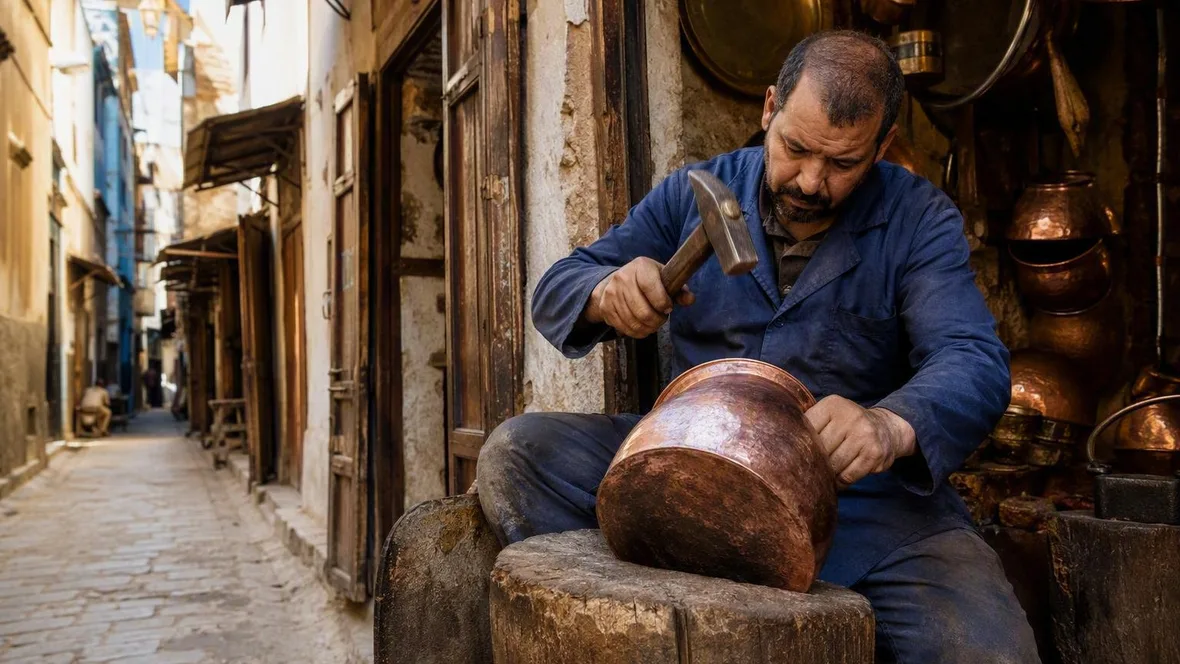
At a neighbourhood ferran, round loaves reach a hot communal oven on wooden boards, under cloth or in other familiar carriers. Downhill beside the Qarawiyyin, coppersmiths work in open-fronted shops, where iron hammers strike copper and brass.
The oven at Four Kouicha
A ferran is more than a bakery counter. Families mix, knead, leave their dough to rise and shape it at home, then bring the rounds to a communal oven for the final bake. The baker handles the heat, the oven space and the order of many households’ loaves.
Ferrane Kouicha lies in the neighbourhood of Talaa Kebira, close to Rue Four Kouicha. A ferran can have a small, plain entrance, but its workroom needs a large baking chamber, storage for fuel, racks or shelves, and long wooden peels for moving bread through the heat. In a wood-fired oven, smoke, ash and the smell of baking bread all come from the same source: the fire that serves nearby homes.
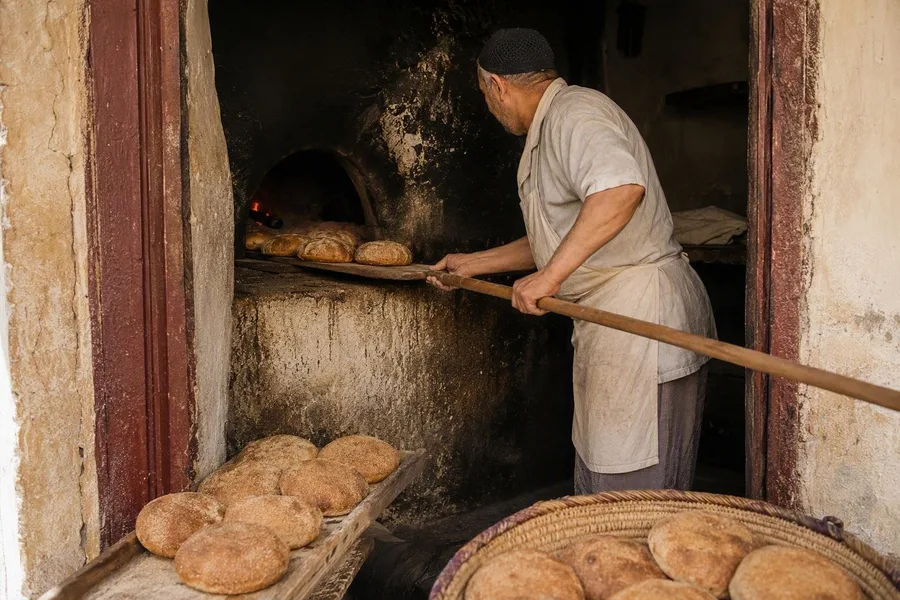 A baker moves household loaves into the communal oven at Ferrane Kouicha near Talaa Kebira.
The dough may arrive on a flat wooden board, or wasla, sometimes under a cloth that protects it from sun and dust. Covered dishes and baskets also carry dough or the baked bread home. These are working objects, not market props. A board holds a household’s bread while it waits its turn; a basket or dish carries the finished rounds back through the lane.
The baker needs a way to tell one set of loaves from another. Cuts, fingertip marks, fork patterns, seeds, a distinctive shape, a cloth or the board itself can identify a household’s dough among many similar rounds. One documented practice in Fez uses a wooden stick to mark dough before a large wooden peel takes the rounds towards the fire.
This exchange gives the narrow street a practical rhythm. Work starts in private kitchens, passes briefly through the public lane, then returns to the household as bread. A neighbour walking past can also take prepared dough to the oven and pay for baking, according to one account from Fez. Communal ovens still operate in the city, though home ovens and commercial bakeries mean that not every household relies on them.
Down Talaa Kebira
From Four Kouicha, Talaa Kebira provides the clearest short line towards the commercial centre of Fez el-Bali. The stone-paved street is pedestrianised, descends with the valley, and links this part of the medina with Souq al-Attarine, the Kissaria and the Qarawiyyin quarter. Many smaller residential derbs end among the houses, so the broader street carries the through traffic.
That division explains the route. Fez el-Bali grew from the ninth century, and much of its urban fabric took shape during the thirteenth and fourteenth centuries. Houses turned inward around patios. Narrow, partly enclosed derbs led to front doors and protected domestic privacy, while public streets made room for shops, services and foot traffic.
The medina’s lanes are too narrow for cars. People move goods on foot, by handcart or with pack animals. Bread boards and covered dishes suit that scale. So do the goods that pass between workshops, shopfronts and homes in spaces where a doorway, a work entrance and a through-route can sit a few steps apart.
The ferran formed part of the residential quarter’s basic provision, alongside facilities such as a water point, mosque and hammam. Its position near homes was practical: large ovens were difficult to fit inside houses, while one hot chamber could finish dough prepared by many families.
Talaa Kebira passes Ain Allou and enters Souq al-Attarine beneath a gate. The gate marks a market threshold rather than a grand change of district. Souq al-Attarine is a covered market passage, and Kissariat al-Kifah branches into a close network of shopping lanes on its southern side. For this compact route, Talaa Kebira remains the useful spine. Near the Attarine medersa, the southward passage beside the Qarawiyyin leads down towards Place Seffarine and the Bou Khrareb valley.
From the market passage to Seffarine
Fez did not put housing, ovens, trade and craft in distant zones. Historical records place these functions close together, while busy public routes and small market nodes concentrated shops and production. That pattern makes the walk from a neighbourhood oven to a metalworking square short, but it does not make the two places interchangeable. The ferran serves a residential need; the workshops at Seffarine make and repair household goods.
The passage south of the Qarawiyyin narrows again before it opens onto Place Seffarine. Hammer blows can carry through the surrounding lanes before the square appears. The sound comes from street-facing workshops, not from a staged display.
Copper work at Place Seffarine
Place Seffarine stands south of the Qarawiyyin mosque. Coppersmiths’ shops open onto this small square, where a large tree stands above the work and the repeated hammering continues through the day.
Metalworkers have worked here since at least the thirteenth century, and Seffarine’s name refers to makers of cauldrons or copperware. The workshops still produce and repair objects. That repair work matters: water vessels, hammam buckets, couscous steamers and large cooking pots arrive as used household goods, while new pieces leave the same small square.
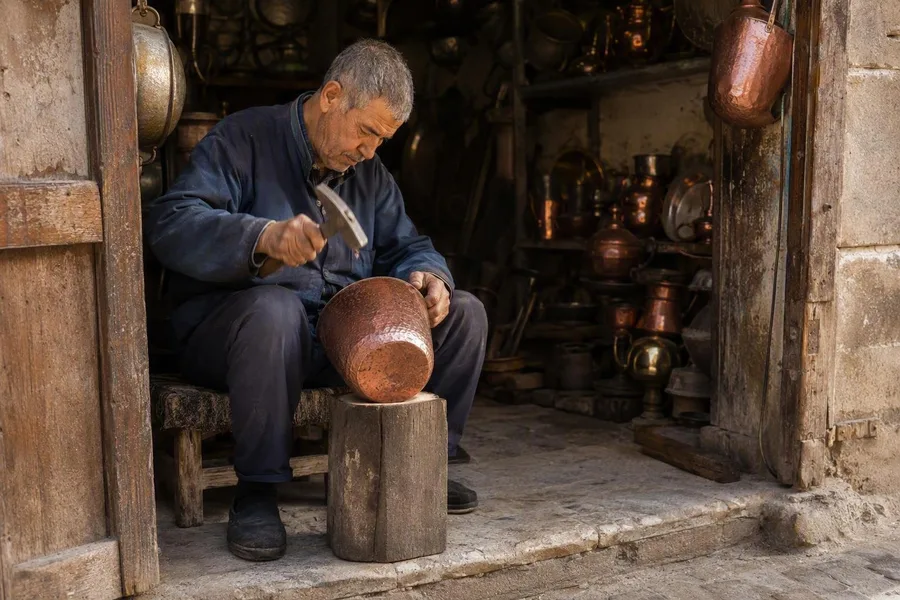 A coppersmith hammers a copper vessel over a wooden block at Place Seffarine.
Raw sheets of metal stand by some doorways. Half-finished pots hang nearby, and finished trays, bowls, kettles, teapots and lanterns fill the fronts of shops. The available accounts document raw metal, sparks and polishing, but not a general haze or layer of metal dust; the visible work gives a more accurate picture.
The rooms are small. Coppersmiths sit on low stools, hold copper or brass against an anvil or shaped support, and strike it by hand with hammers. Chisels or punches, files and polishing tools shape other surfaces, while some work continues further inside the shop. Different specialists may cut, form, solder, punch or polish separate parts of a vessel.
The passage remains part of the workplace. Finished goods hang at its edges, repair items cross the threshold, and pedestrians pass the open fronts while hammer strokes rebound from the walls of the square. At one bench, a coppersmith holds a vessel over a wooden block, turns it between blows, and brings an iron hammer down again.