
From Bolhão Down to Afurada
Fish lies on ice at Mercado do Bolhão as bread warms the air and water slips through the iron grates beneath the stalls. From this busy interior, the route falls through Porto’s granite streets to the Douro, then reaches Afurada, where laundry, charcoal smoke, nets and small boats line the far bank.
The morning starts under iron and stone
Mercado do Bolhão begins the day with work in plain sight. Vendors top up displays of fish, fruit and vegetables; flowers stand in buckets; a knife sharpener still works inside the hall. Fish rests on ice, and early customers arrive with shopping bags tucked into the crook of an arm.
The sellers supply the loudest sound. Calls carry between the counters, particularly around the fish stalls, where customers bargain over their purchases. No music needs to fill the gaps.
Warm bread and fresh flowers soften the sharper nearness of fish. At the end of a task, workers wash the counters, and meltwater and rinse water run across the floor into cast-iron grates around the stalls. The concrete holds damp patches. The market remains a place where someone has another crate to lift.
The building gives the morning its changing light. Metal canopies shade the stalls, while the central court and open galleries admit daylight from above. Granite walls, concrete floors, cast-iron columns and railings give the hall a solid, worked-in weight; timber, slate, tiles and zinc catch the eye in smaller pieces. A metal footbridge crosses between the two levels, with shoppers moving overhead and rows of produce below.
Leave by the eastern exit onto Rua Formosa. The bags, the calls and the wet floor recede behind a granite threshold, but the business of the morning continues on the pavement outside. Bolhão remains a fresh-food market after its restoration.
A slope replaces the market floor
Rua de Sá da Bandeira leads south towards Praça da Batalha. The route begins to lean downhill. Shopfronts take the place of stalls, and the broad interior of the market gives way to stone underfoot and façades close at either side.
From Batalha, Rua de Cimo de Vila and Rua Chã turn towards the Sé quarter. The streets tighten there. Old houses stand shoulder to shoulder above narrow lanes, and shirts, towels and sheets hang from windows or lines overhead.
The neighbourhood keeps its domestic life near the street. Kitchen sounds come through open windows; children play nearby; neighbours talk from doors and sills. A doorway may sit only a few strides from the next corner. A plastic basin, a drying shirt and the scrape of footsteps on stone say more than a polished plaque could manage.
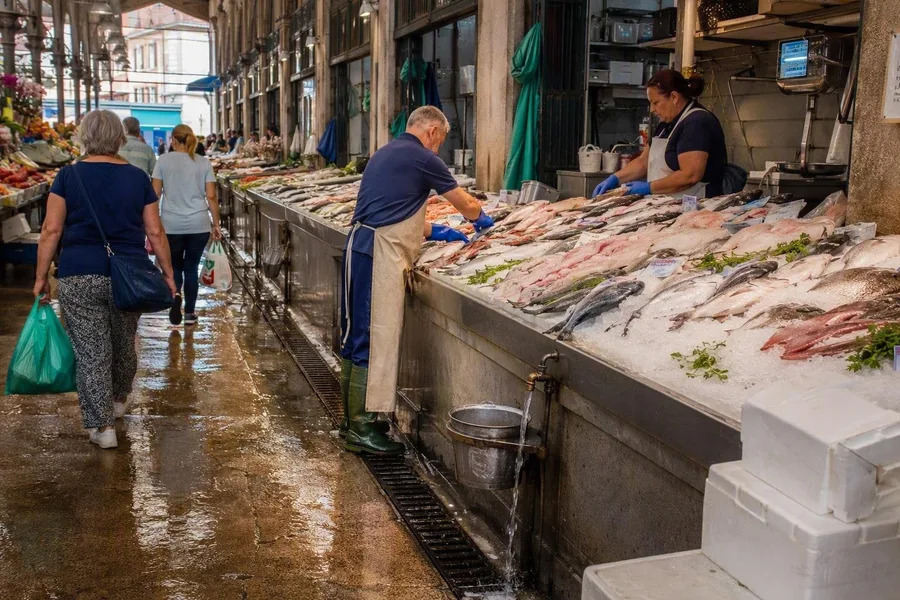 Vendors work beside fish on ice at Mercado do Bolhão in Porto.
Granite governs the descent. Dry paving gives a firm, uneven tread, while rain leaves the polished stone slick. The slope gives each footstep a consequence, which is Porto’s quiet answer to anyone in a hurry.
Behind the cathedral, Largo da Pena Ventosa takes the route further into the old quarter. Tall façades leave thin slices of sky above the lane. Laundry shifts at upper windows, and the sounds of small kitchens and conversations stay close to the walls below.
The long way down
The Escadas dos Guindais carry people from the upper city to Ribeira. The stairway runs long and steep between the high streets and the river, with steady foot traffic on its granite steps. Gaps along the way open towards Ponte Luís I.
At first, the river appears as a pale distance beyond roofs and walls. Then the stairs deliver the body lower, step by step, until the confined lanes begin to loosen. On a damp day, darkened stone holds a sheen; on a dry day, the stairs take the dust and hard light of the afternoon.
At the bottom, Rua da Ribeira Negra connects with Rua da Fonte Taurina and Cais da Ribeira. The Douro now occupies the whole view. Small eateries sit along the quay, while washing lines still break up the stacked façades climbing behind them.
The change is immediate. Porto’s roofs and narrow houses rise above the riverbank in a broad, terracotta-coloured wall, rather than appearing in fragments around the next bend. Voices no longer bounce chiefly between stone walls. Their murmur spreads along the quay with the wider air and the sound of water.
The Douro opens the day out
Wind has room over the river. After the close lanes of the Sé quarter, the open surface of the Douro draws the eye away from the ground and across to the opposite bank.
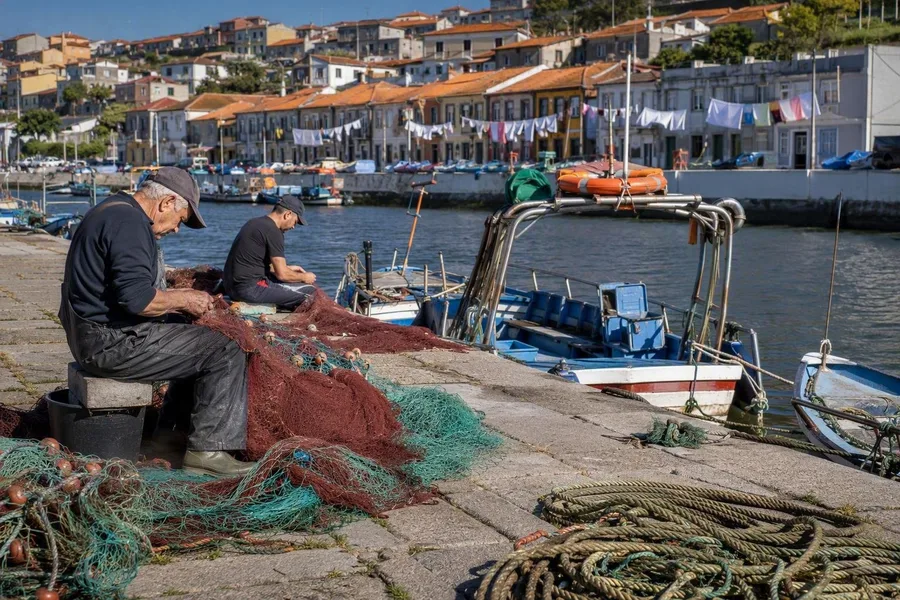 Fishermen mend nets beside small boats and coiled ropes in Afurada’s fishing harbour.
In the afternoon, sunlight reaches the riverside façades. Later, gold and amber settle over ironwork, walls and water, while the bridges turn into darker outlines. Porto remains visible behind the quay as layers of roofs and houses on the slope. Downstream, the large city frontage breaks into lower buildings and more open stretches of bank.
The route continues towards Afurada on the southern, left bank, near the mouth of the Douro. The far side does not present another wall of tall houses. Low streets and houses sit between the quay and the slope in an almost regular grid.
Practical: Mercado do Bolhão opens Monday to Friday from 08.00 to 20.00 and Saturday from 08.00 to 18.00. Entry is free and does not require a reservation; the market closes on Sundays and public holidays.
Afurada at pavement level
Afurada brings the route back to the scale of a doorstep. Low, coloured houses stand much closer to the ground than Porto’s stacked riverfront across the water. Doors open straight onto the pavement. Outside them sit plants, brooms, basins, buckets, tables, benches and chairs, with the ordinary equipment of a household spread into the street.
Charcoal smoke rises from pavement grills where fish cooks near the fish market. The smoke mixes with talk from nearby doors and with the river air. Nothing has been tidied away for display. A broom rests against a wall because it will be used again; a chair waits outside because someone brought it out.
At the public washhouse, women still gather at the tanks. Families use their own drying lines in front of the basins, and soap and bleach cling to hand-washed clothes. Shirts and bright sheets lift above the street in the sun, then settle again when the breeze drops.
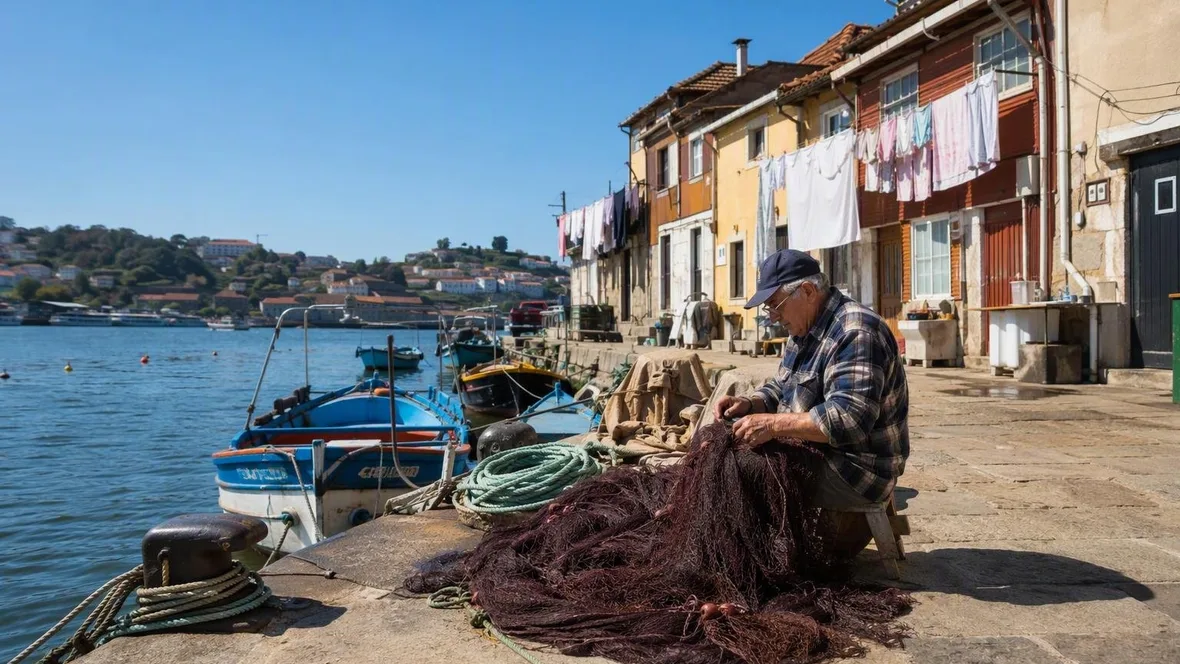
The water remains within a few steps. Fishermen maintain boats and mend nets in the fishing harbour, while ropes and lines run between the quay, Rua da Praia and the working craft beside them. These are tools, not props: coiled rope, a net under repair, a boat held close to the edge.
At the end of Afurada’s compact grid, the pavement meets the quay and stops. Behind it, coloured washing hangs above doors and tanks. Ahead, nets lie beside ropes, small boats press gently against their moorings, and late light stretches across the Douro.