
From Blue Boats to Bread Ovens in Essaouira
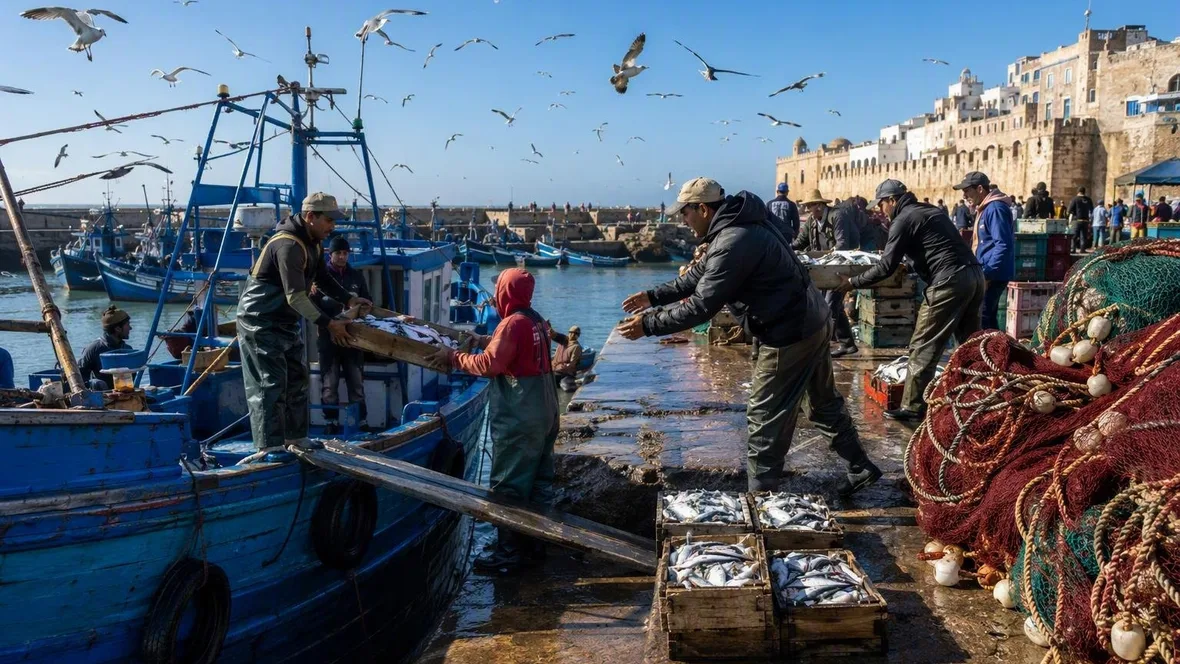
A fishing boat enters Essaouira’s harbour with gulls wheeling above the load. On shore, crates pass from hand to hand towards the fish market, the charcoal grills and, beyond the sea gate, the narrow streets of the medina.
Blue hulls beneath the gulls
The gulls appear first. They circle above a returning fishing boat and cry over the harbour as it heads for the quay.
Small wooden boats lie packed side by side along Essaouira’s waterfront, their hulls painted a hard, clear blue. Larger trawlers berth among them. In the morning, boats arriving, crews unloading and workers repairing nets fill the same narrow strip of stone.
The Atlantic wind crosses the quay without pause. It can make the air feel cooler even under a bright sun. Morning light sharpens the blue paint and picks out damp patches on the stone; later, lower light settles over the hulls and the worn masonry of the fortifications.
A trawler comes alongside. Ropes run from the boat to the quay, hands pull them taut, and the vessel settles against the edge. Sardines wait in crates on deck. More crates rise from the hold.
Crew members pass each box along a narrow plank. Helpers on shore take the weight, lift the crates clear and set them among ice, ropes and other boxes on the quay. The work moves quickly because there is little empty ground between the water and the selling area.
Engines hum. Gulls scream. Carriers step around coils of rope, chipped ice and wet crates. Salt sits in the air with the sharp smell of fish. The ice gives off its own cold, clean smell as workers press it around the catch.
The market starts at the water’s edge
The catch travels only a few steps before the first sale begins. Workers sort fish on the quay, divide it between crates and stack it with ice. Buyers gather beside the landing place, including restaurant owners looking over the day’s fish, while porters and carts thread through the crowd.
The quay serves as both landing ground and market. Fish moves from boat to crate, from crate to auction or stall, without a long trip to a separate market hall. Carts carrying ice pass between the stalls. Sellers arrange fresh fish. Crates remain on boats and pile up on the stone beside them.
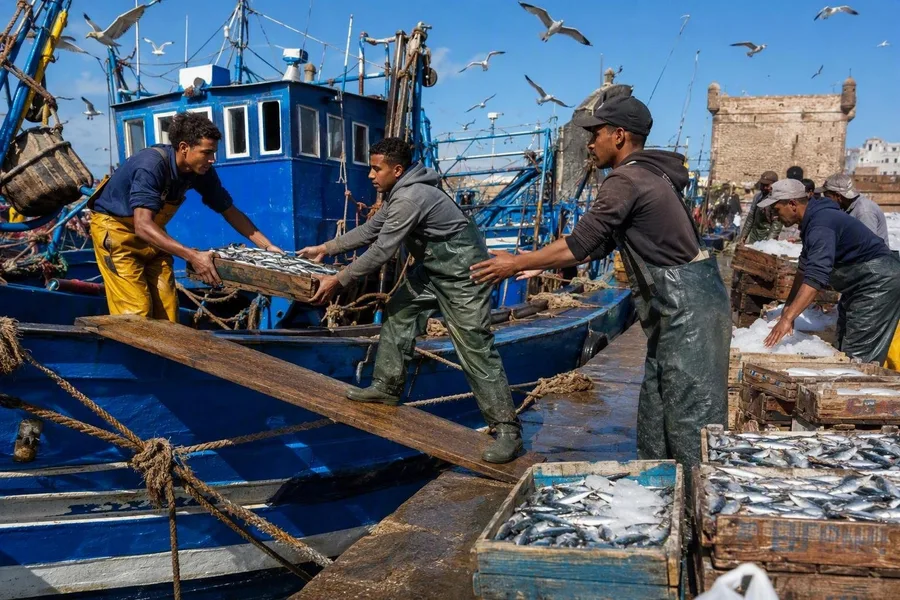 Workers unload sardine crates from a blue trawler onto Essaouira’s harbour quay as gulls circle overhead.
Voices rise around the sales, then disappear beneath the mechanical buzz of engines and the gulls overhead. The birds circle above the cleaning and handling of fish, then dip low over the working space.
Hands carry the scene. They grip crate handles slick with water, pull knots tight, turn fish in the boxes and push ice into the gaps. A hand releases a crate at the end of the plank; another catches it; a carrier takes it inland.
The last crate does not end the work on the boats. Crews bring out the nets, clean them and repair worn or damaged sections before the next trip. Heavy mesh comes ashore in armfuls. Workers pull it into folds and piles, then work along it with their fingers.
The harbour shows fishing in short, repeated actions rather than grand gestures: fastening a rope, hauling a box, shovelling ice, sorting the silver bodies of the catch. Blue paint, wet stone and rough timber frame each task.
Timber, charcoal and the sea gate
Near the slipway, boatbuilders work on wooden hulls. They shape timber, repair damaged sections and seal the seams between planks. Wood chips and curled shavings gather underfoot, close to mooring ropes and fishing gear. The smell of cut timber joins salt and diesel.
The fish keeps moving. Between the harbour and Place Moulay Hassan, open grill stalls display fish and seafood on ice. A customer chooses from the trays; the seller weighs the fish, fixes the price and sets it over charcoal.
Smoke changes the air. The wet, briny smell of the landing place stays close to the water, while grilled sardines send a richer scent across the stalls. A fish can leave a blue boat in a crate and reach a grill in the same harbour quarter.
Porte de la Marine, also known as Bab el-Marsa, stands between the port and the walled city. Its stone arch marks a physical break in the route: behind it lie boats, auction crates and gulls; beyond it, Place Moulay Hassan and the streets of the medina.
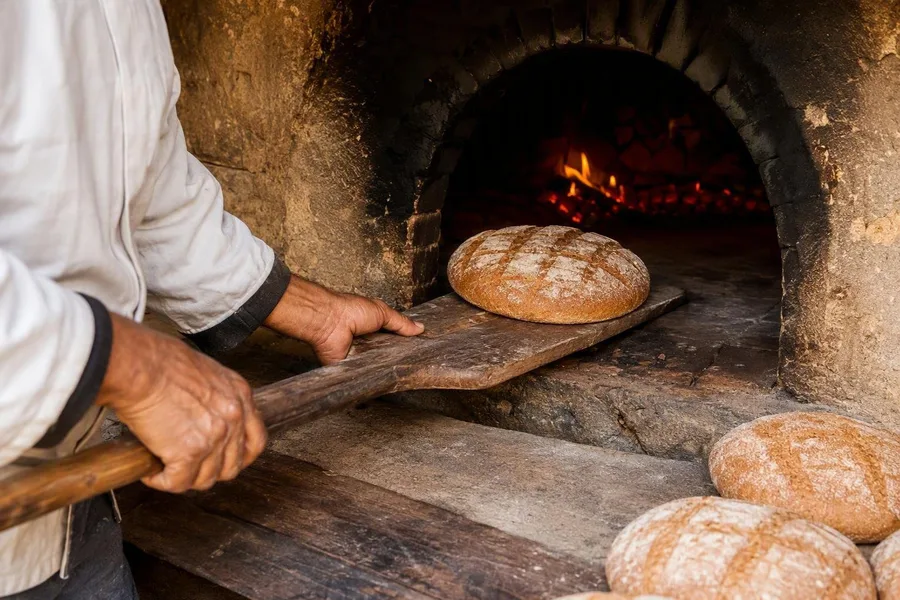 A baker slides a marked loaf into a communal oven just inside Bab Doukkala.
People pass under the arch from the auction towards the square. The engine noise drops behind the wall. Chisels and lathes take its place farther along the streets.
Thuya under the arches
Open wood workshops appear deeper in the medina, especially beneath the arches of Skala de la Ville and along Rue de la Thuya. The workshops use thuya, a reddish-brown wood with twisting grain and a resinous smell.
The work stays visible from the street. Craftspeople cut the wood, carve it, sand it smooth and rub in oil until the grain shows more clearly. Chisels bite into the timber. Lathes turn. Pale shavings fall beside boxes, trays and sections of inlay.
Some pieces pair thuya with lemonwood, ebony, walnut or mother-of-pearl. Light lines and bright fragments sit against the dark, looping grain. At these benches, hands hold chisels rather than ropes, but the work remains just as close to the street.
Open doors show unfinished pieces, tools and worktables. The resin of fresh-cut wood replaces the fish smell from the quay. The harbour remains nearby, though the stone lanes now carry people past carved boxes and trays instead of crates of sardines.
The heat of the ferran
Farther into the old city, just inside Bab Doukkala, cedar gives way to the smell of bread baking. A traditional communal oven, a ferran, receives dough that households have shaped and marked at home, then carried through the streets on wooden boards.
The oven is made of clay and brick and fired with wood. Heat gathers around its mouth. The air close to it smells of warm crust and smoke.
A baker takes a marked loaf from its board. He slides it into the oven with a long wooden peel, turns it towards the fire and reaches for the next loaf.