
From Ballarò to the Sea: A Morning Walk Through Palermo
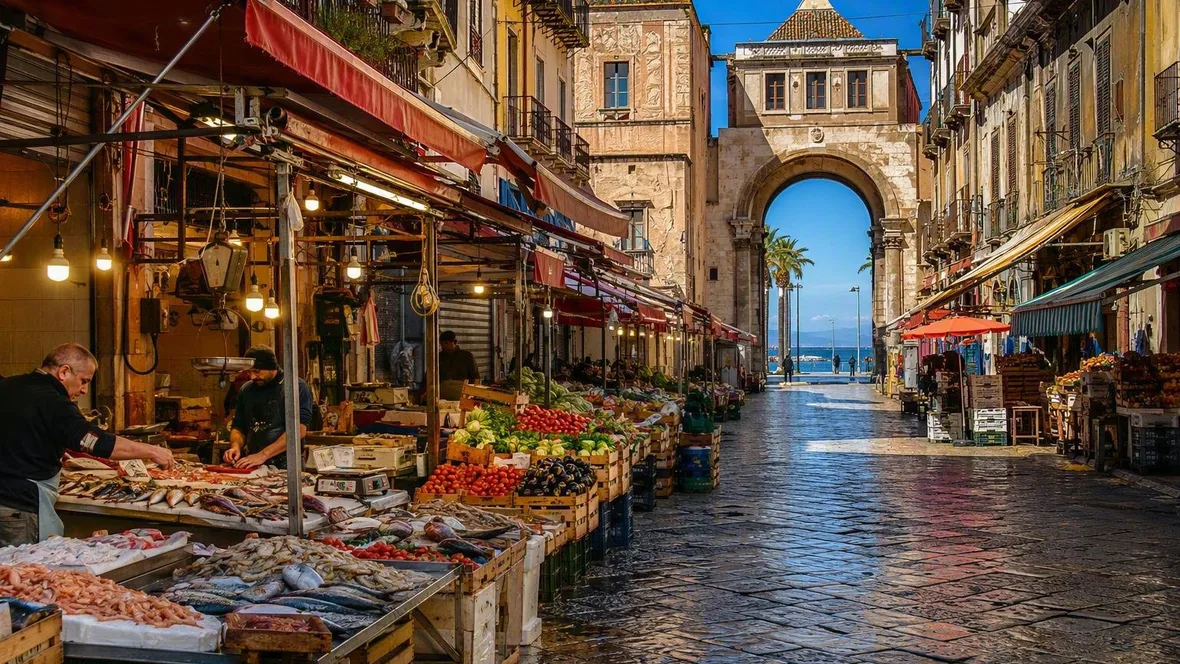
Ballarò starts the morning at close range: sellers’ hands over crates, fish on ice, frying oil and voices ricocheting beneath awnings. A short walk through Palermo then runs east through Quattro Canti and Porta Felice, until the old city’s narrow stone streets give way to grass, wind and water at Foro Italico.
Under the awnings
Ballarò begins as a working street rather than a view. Lamps hang below coloured awnings. Crates press against counters, and counters press into the roadway. Fruit, vegetables, meat and fish fill the spaces between the buildings, leaving a narrow passage for the morning’s steady foot traffic.
The ground asks for attention. Broad old stones lie under boxes, market water and passing shoes; meltwater from fish ice can darken the paving. Nothing here has been arranged for a clean sweep of the eye. A bunch of onions hangs from a hook. A hand shifts tomatoes against lettuce and the deep purple of aubergines. Another hand weighs, wraps, slices or reaches across a counter.
The calls carry above the work. Ballarò’s abbanniata consists of loud, rhythmic cries that sellers use to draw customers towards their goods; one voice can rhyme or rise in pitch before another takes over farther along the street. The sound does not need amplification. It travels under the canvas and between the walls, over the scrape of crates and the clatter of produce being set down.
The market’s colour comes from food before anything else. Garlic and onions hang in bunches. Olives, cheeses, dried tomatoes, herbs and spices sit below them. Local green cauliflower may appear near Thai basil, green beans and green papaya, a practical mixture of nearby produce and goods brought from farther away.
 A view of Under the awnings.
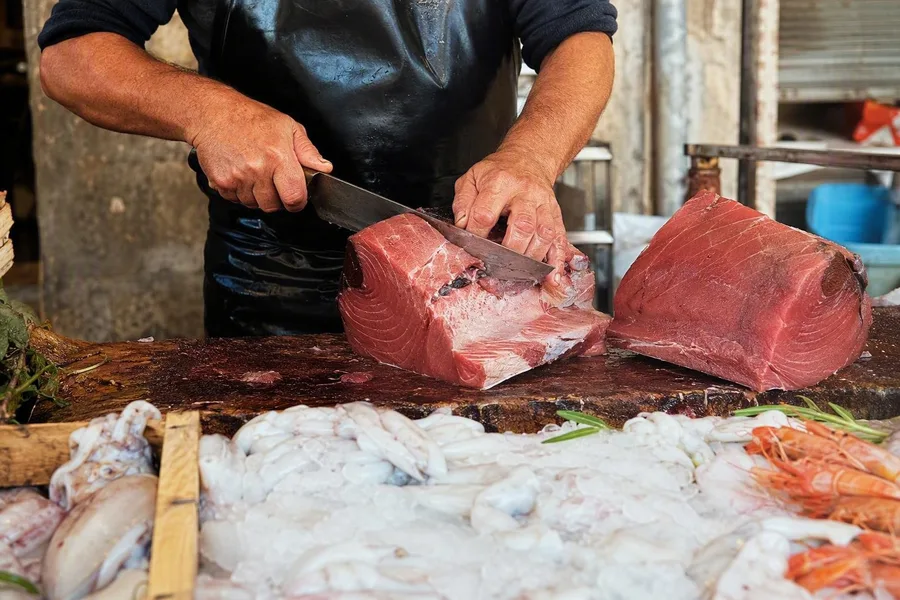
At the fish stalls, red mullet and prawns sit alongside white squid and blue-grey fish. Ice and seaweed frame the displays. Fishmongers cut tuna and swordfish at the counter, while the water from the ice works its way down towards the stones. The smell of the sea arrives here in a more literal form than it will at the waterfront: fish, algae, cold ice and wet paving under an awning.
A view of Under the awnings.
At the fish stalls, red mullet and prawns sit alongside white squid and blue-grey fish. Ice and seaweed frame the displays. Fishmongers cut tuna and swordfish at the counter, while the water from the ice works its way down towards the stones. The smell of the sea arrives here in a more literal form than it will at the waterfront: fish, algae, cold ice and wet paving under an awning.
Then comes heat. Oil hisses at food stalls. Smoke rises from roasted sardines, while fresh bread adds its yeasty scent to the lane. Large trays hold panelle, chickpea fritters often served in sesame bread with potato-and-parsley croquettes known as crocchè or cazzilli. Elsewhere, thick sfincione, arancine and pani cà meusa line the counters. The last of these fills bread with beef lung and spleen cooked in lard, then adds lemon or, sometimes, ricotta or grated cheese.
Braziers and food carts stand among the fruit and meat stalls. Their smoke rises into the same low canopy as the market calls. Ballarò does not separate the day’s groceries from its quick meals. Fish gets cut, vegetables get stacked, bread gets filled, and oil keeps working in its pan.
In summer, warmth can settle early under the awnings, particularly during Palermo’s more humid period from June into early October. The shade still makes a difference. It holds the stronger sunlight at bay for a few more streets.
The market loosens its grip
Via Casa Professa and Via del Ponticello form the short exit from Ballarò towards Via Maqueda. The market does not stop at a clean border. Its voices and awnings remain behind in Via Ballarò and around Piazza Casa Professa, while the number of crates begins to thin ahead.
The first change is physical. The passage opens enough to show a longer stretch of pavement. Shopfronts and façades stay visible instead of disappearing behind stacked fruit or a hanging sheet of canvas. Via Maqueda takes over as a straighter pedestrian axis, with a marked central strip kept clear for authorised traffic and emergency access.
The buildings do not suddenly turn neat. Around Ballarò, low worn houses, votive niches and damaged palazzi still stand close to the market streets. Farther south towards the Kalsa, basalt paving gives way in places to patched asphalt and uneven pavement. Restored façades stand beside unfinished walls. Some damaged buildings remain partly open to the sky, with plants growing among broken floors and masonry.
Above the street, balconies carry the domestic layer of the neighbourhood. Washing can hang between them. Open shutters expose a room here and there at ground level. The route keeps moving, but the stone, repair work and laundry make clear that people live above and beside the old thoroughfares.
The crossroads
Quattro Canti interrupts the long street with a sudden, formal opening. Via Maqueda crosses Via Vittorio Emanuele here, creating an octagonal intersection with four street mouths and four curved façade walls. Fountains sit at street level. Statues occupy niches above them.
The widening changes the light. Sun reaches one façade while another stays in shadow, and the narrow strips of sky from the preceding lanes become a larger patch overhead. Feet no longer need to negotiate the close choreography of boxes and counters. The street still carries people, but it gives them more room.
 A view of Through Porta Felice.
Via Vittorio Emanuele provides the direct line east. Its broad pedestrian space continues towards Porta Felice, with the marked central corridor running through the street. In the clearer summer months, the sun grows harder outside the protection of Ballarò’s awnings and side streets. Palermo’s brightest stretch generally runs from mid-June into early September.
The road holds its course. Stone façades replace the market’s shifting walls of canvas, crates and hanging goods. Pedestrians pass through the old centre on an axis that points towards the sea without yet revealing much of it.
Through Porta Felice
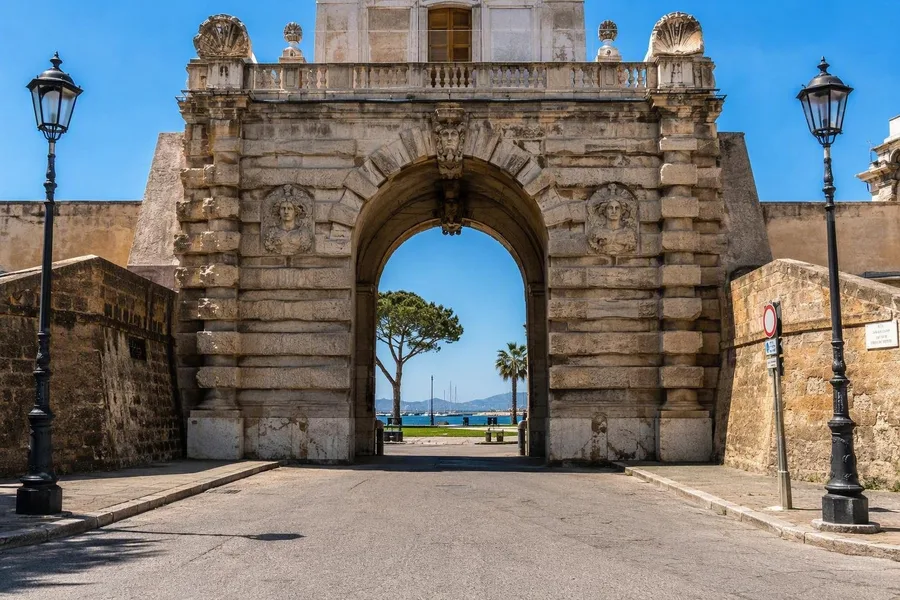
Porta Felice marks the end of that enclosure. Its opening frames sky above the waterfront, where the street’s masonry no longer closes the view. Beyond the gate, grass replaces the dense sequence of paving, walls and storefronts.
Foro Italico runs between La Cala and Villa Giulia as a broad coastal park. A promenade and cycle path follow the open ground. Brightly striped ceramic bollards divide the path from the grass, and bench-like seats face the water. Totems and other coloured elements stand along the central route, but the scale belongs to the gulf rather than to the objects placed beside it.
Morning movement takes a simpler form here. Walkers, runners and cyclists use the flat, largely paved waterfront; early hours are quieter than the later part of the day, though the promenade is not empty. The path allows a longer stride after the small adjustments required by Ballarò’s stones, counters and crowded passages.
Across the gulf, Monte Pellegrino rises along the curve of the coast, with Capo Mongerbino farther away. Low morning light strikes the water more directly than it can reach the protected streets behind Porta Felice. The surface breaks that light into flashes, while the grass and paved path remain fully exposed.
A sea breeze may cross the promenade, depending on the day and season. There are no awnings here, no market roofs and no tall street walls to hold it back. At Foro Italico, the final market calls have fallen behind the gate. Wind moves across the grass, and the water catches the sun in hard white pieces.