
From Bab Souika to Zitouna, by Bread, Brass and Shade
Bab Souika begins with food: chickpea broth, bread, pastry counters and the heat that slips from a bakery doorway. From its old market streets, the walk passes under vaults and beside copper workshops before reaching the tight knot of souks around the Zitouna Mosque.
At Bab Souika, the day starts with bread
The gate that gave Bab Souika its name disappeared in 1861, but the name remains on the square by Halfaouine, between Bab el Khadra and Bab Saadoun. Food shops, pavements and open doors shape this lived-in starting point.
Here, lablabi marks the neighbourhood in the most straightforward way. A clay bowl holds chickpea broth, harissa and cumin. The person eating it crumbles stale bread into the broth, then may add egg, tuna or olive oil. It is plain, hot food, held close to the hand.
Bread carries its own warmth through this part of Tunis. Tabouna names both a round Tunisian loaf and the wood-fired earthen oven traditionally used to bake it. Its thin crust breaks over an airy crumb, with a faint note of wood smoke. Where a bakery works with such an oven, dough is shaped into rounds before loaves go into the fire and come out again. Oven heat can spill through an open doorway onto a street shaded by a high wall.
From square to market lane
Souk el-Halfaouine runs for about 800 metres from the Bab Souika area towards Place Halfaouine. Stalls and customers narrow the way. The route passes from square to lane, then from lane back to square.
Asphalt gives way in places to uneven paving. Feet alter their pace over the stones. Goods at one side and thresholds at the other set the available width, and pedestrians pass close where the lane contracts.
Rue Souki Bel Khir continues past carpenters, shoemakers, pastry sellers and butchers. Food and work share the same run of doorways. A pastry counter fills one entrance; a workbench fills another. Half-raised shutters show shelves, tools or the edge of a counter while the back of the shop remains in shade.
Bab el Khadra creates a more formal pause. The present Green Gate replaced an older arch in 1881. Beyond it, Souk Sidi el Bahri, Rue du Liban and Rue Ahmed Bayram lead towards Hafsia. Broader streets break into small side lanes, while market stands leave narrow channels between their goods and the doors opposite.
The cover of Souk des Granas
A pedestrian lane lined with stands follows Rue Sidi Bou Hadid towards the covered Souk des Granas. Light changes at the roofline. Vaults reduce the open glare to a lower, softer brightness, and upper floors project over nearby alleys to cut the sun.
The medina’s sabats, built-over passages between buildings, add to the shade and help keep streets cooler in summer. A bright strip falls across a threshold. A raised stone interrupts a stride. Behind a partly open door, the interior stays darker than the lane.
Near Rue de la Kasbah, simple eating places finish dishes for waiting customers. Nearby stalls prepare brik, thin pastry filled with egg and fried. Filling, frying and handing over make a quick sequence at the counter, followed by the next order.
A detour for copper
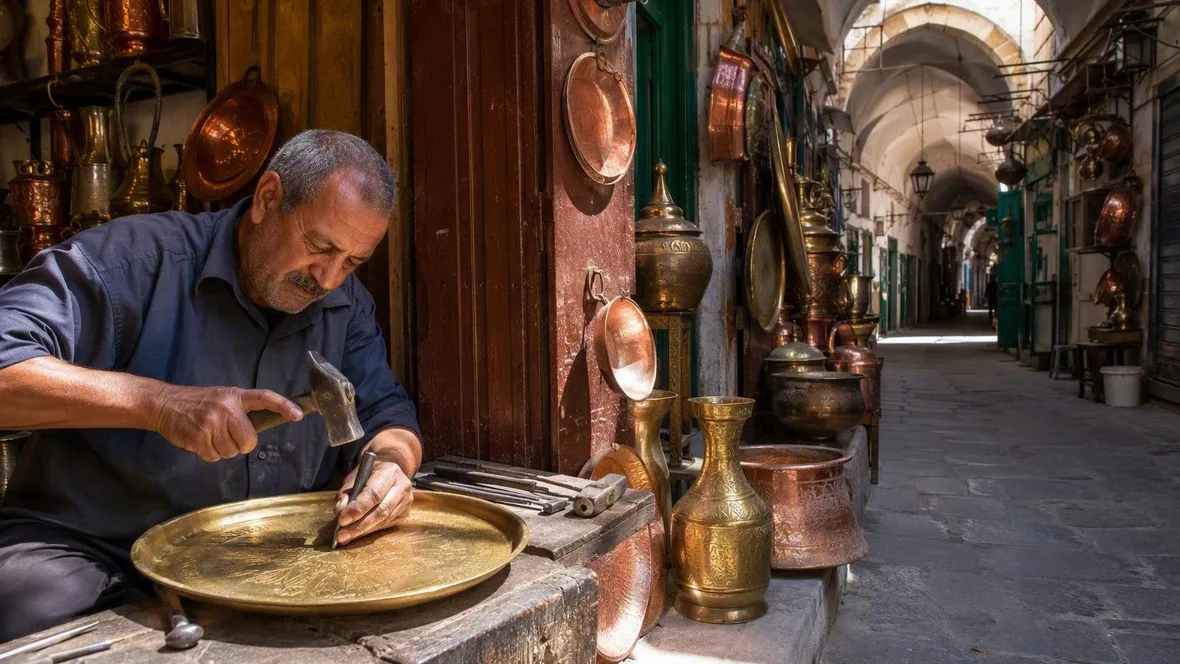
Souk Ennhas, the copperworkers’ souk, lies between Souk El Grana and Rue de la Kasbah. It sits just west of the direct line from Bab Souika to Zitouna. This narrow covered street has volcanic-stone paving and cross-vaults over the shopfronts.
Sound reaches the lane before the displays do. Hammers strike copper and brass. Polishing machines add a harder rasp.
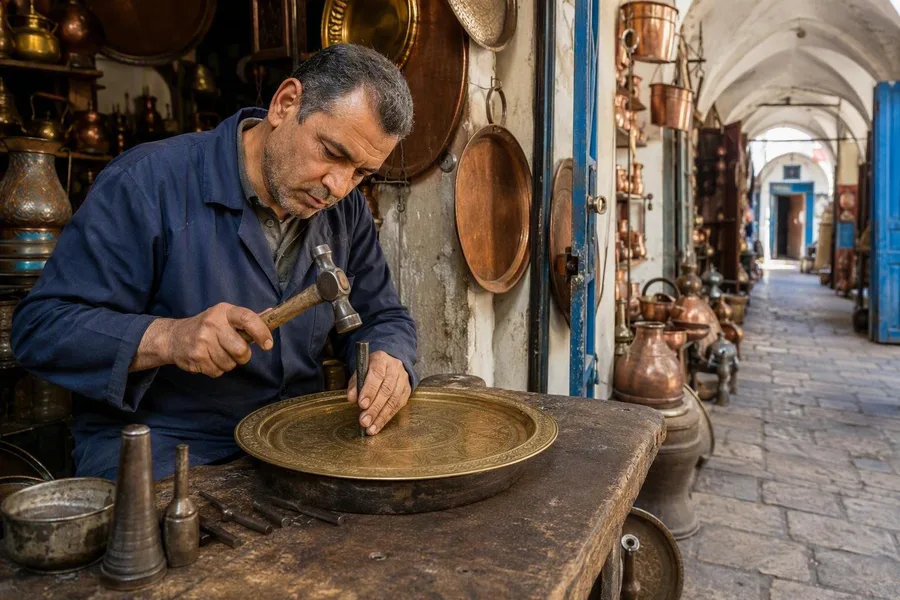 An artisan marks a brass tray in Tunis’s covered Souk Ennhas.
Front rooms hold trays, teapots, mortars, incense burners, candlesticks, lamps, hammam buckets and kitchenware. Copper catches a red glow beside brass and nickel-plated pieces. Some lamps hold coloured sandblasted glass. The displays fill the close street and pick up the thin shafts of light that reach through the vaults.
Some work remains visible from the pavement. A brass tray can rest on a bench while an artisan marks its surface with hammer and burin. Machines now carry out much of the engraving, hammering and polishing in the souk, so a hand at work should not be mistaken for the whole trade. Repair offers a clearer view of daily use: blackened copper pans and bowls are cleaned, polished and retinned until their surfaces regain a pale shine.
These vessels belong in kitchens as much as in shop displays. A used pan enters with the marks of cooking. A restored one leaves bright enough to catch a narrow band of daylight.
The busier street to Zitouna
Rue Sidi Saber leads from the Kasbah axis to Rue ez-Zitouna, one of the medina’s main shopping streets. Shops line both sides. Local customers and visitors bound for the mosque move through the same constricted flow.
Arched passages return near Zitouna. They cut the strong sun into bars of brightness and shade. At the beginning of Rue Souk el Blat, pastry shops sell makroudh with dates and sesame, alongside samsa, zlabia and yoyo. Strong coffee, mint tea and sweet pastries provide brief stops amid the passing trade.
Near the mosque, Souk el Attarine brings spices, scented waters and essential oils into the air. The warm smell of crust and the sharper trace of frying give way to perfume and dried spice under the covered lane.
Practical note
Weekday mornings and early afternoons bring the most reliable shop activity; many stalls pause around Friday midday, and many shutters stay closed on Sundays. Individual opening hours vary, particularly during Ramadan.
At the mosque wall
The streets around the Zitouna Mosque tighten rather than opening onto a broad square. Small cell-like shops line the western wall, while Souk el Attarine follows the north side. Twelve entrances connect the mosque to the surrounding souks, including fifteenth-century stone gateways whose arches lead towards the courtyard.
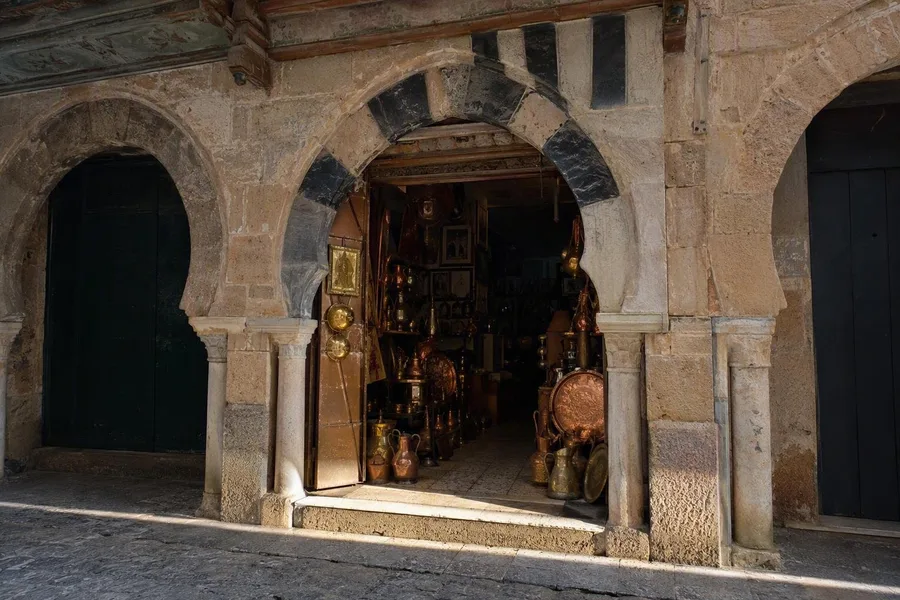 A half-open shop at the Zitouna Mosque’s western wall sits beneath horseshoe arches.
Above the dried-fruit souk, a suspended portico rests on columns beneath horseshoe arches. Painted wooden ceilings lie behind them. Elsewhere, an entrance block alternates red brick with ochre stone, and white marble covers the floor of a small arcaded court by a fountain.
At the western wall, a small shop stands half open beneath the portico. Light reaches its threshold and catches the nearest metal objects. Beyond them, the room falls dark. Above the doorway, horseshoe arches support painted timber across the narrow souk.