
Five Toronto stops, from the CN Tower to a dinosaur’s feet
The CN Tower stands on former railway land beside Lake Ontario, where rail yards, harbour works and reclaimed ground pushed Toronto’s edge into the water. Start high, then take the ferry: the crossing puts the skyline at a useful distance.
The CN Tower puts Toronto on the map
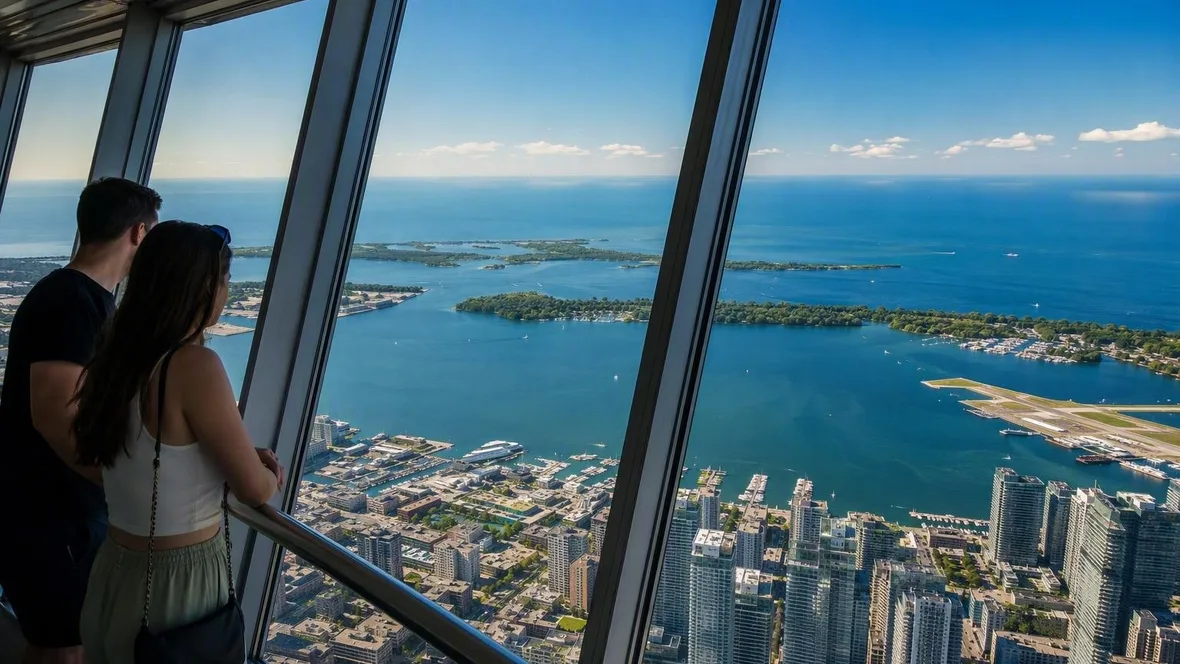
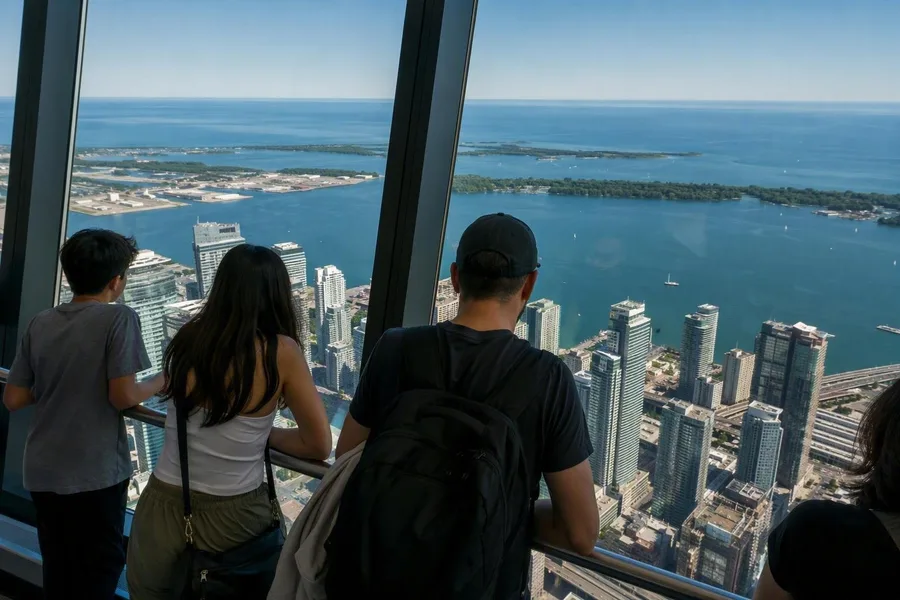 Visitors look across Toronto’s harbour and Lake Ontario from the CN Tower observation level.
The CN Tower began with a practical problem. During Toronto’s high-rise boom in the 1960s, new buildings interfered with radio and television signals, so Canadian National started work on a taller communications tower in 1973. It opened to the public in 1976 and still transmits television and FM radio.
Its shape follows the engineering. Three curved concrete arms rise around a hexagonal core and taper towards the pod, while steel cables inside the concrete allow controlled movement in strong winds. This was infrastructure before it became an icon, a distinction Toronto wears rather well.
Fast lifts carry visitors to the main observation level at 346 metres. High glass walls frame the street grid, harbour and broad surface of Lake Ontario; one level lower, the glass floor places roads and rooftops directly beneath visitors’ shoes. The open terrace exposes visitors to wind and city noise, while the tethered EdgeWalk runs outside around the pod for those who regard an ordinary floor as an unnecessary comfort.
The view explains the ground below. The tower stands on the former Railway Lands, much of it reclaimed from Lake Ontario and later occupied by rail yards. Harbour works between 1912 and 1925 cleared old piers, filled water lots and reshaped the waterfront and eastern Port Lands. Those works moved Toronto’s shore farther into the lake.
Take the ferry to the Toronto Islands
At Jack Layton Ferry Terminal, ferries cross the inner harbour to the Toronto Islands. The tower and downtown high-rises form a single skyline behind the boat.
The islands began as a shifting sand spit. Wind and waves carried material westward from the Scarborough Bluffs until a major storm cut through the strip in 1858, creating the Eastern Gap; later dredging and harbour works kept that channel open. Reclaimed ground, breakwaters and shoreline works have since helped turn unstable sand into fifteen islands with internal waterways.
The northern shore faces the sheltered harbour and downtown. The southern shore looks across open Lake Ontario. Paths, bridges, lagoons and beaches lie between them, alongside two residential communities.
Walking and cycling suit the paved and unpaved paths. Canoes and kayaks enter the quieter lagoons, and a boardwalk follows the lakeshore. Hanlan’s Point and Ward’s Island retain parts of the island group’s natural dune systems, shaped by wind, waves and winter ice. The islands have served Indigenous communities, generations of leisure visitors and permanent residents; Hanlan’s Point also became an important gathering place for Toronto’s queer community.
St. Lawrence Market serves Toronto by the counter
Back on the mainland, St. Lawrence Market replaces the lake horizon with cheese, bread, fish, meat, fruit and prepared food. The district includes South Market, North Market and St. Lawrence Hall around Front Street East. Toronto designated the site as an official market block in 1803, linking farmers from the surrounding region with customers in the growing town.
South Market remains the everyday food hall. Traders occupy two levels with produce, meat, fish, grains, baked goods and dairy products, alongside cooked meals and a smaller selection of non-food stalls. A peameal-bacon sandwich is one local option; fish-and-chips and fresh seafood offer another. Make one circuit before choosing lunch. Indecision here is not a character flaw, merely evidence that breakfast was too small.
The façade carries an older civic role. Part of it dates from 1845, when Toronto’s first City Hall shared the building with the market, council chamber, police station and a cell. The former council chamber now houses the Market Gallery.
On Saturdays, farmers from southern Ontario bring seasonal produce to North Market, continuing a tradition established on this site in 1803. On Sundays, antique dealers take over the hall and surrounding square. Nearby St. Lawrence Hall was built after the great fire of 1849 and hosted concerts, lectures, balls and meetings, including an 1851 gathering of Black communities from Toronto and across the province.
Brick and whisky in the Distillery District
A little farther east, the Distillery District preserves the former Gooderham & Worts complex rather than a modern imitation of an old factory quarter. The business began as a grain mill beside the bay in 1832 and started making whisky from surplus grain five years later. Production ended in 1990.
The buildings still explain how the operation worked. The Stone Distillery, malt houses, kilns, warehouses, workshops and offices handled production, storage and export, while overhead pipes and walkways once moved materials and workers between them. Brick and stone walls, arched windows, chimneys, pitched roofs and decorative masonry give the pedestrian lanes their Victorian character.
Heritage plaques identify original uses and construction dates. Old equipment remains on display too, including milling and distilling machinery, barrel racks, coopers’ tools and a steam pump from 1895. Since the complex reopened as a cultural district in 2003, galleries, studios, theatres, independent shops, cafés and restaurants have occupied the former industrial spaces. The cobbles are historic and sometimes uneven. Not every old feature has improved with age.
Tickets, ferries and opening days
The CN Tower requires a timed ticket; booking ahead helps on popular days, and Union Station is the closest major transit stop. Island ferries run year-round, with seasonal services to Centre Island, Hanlan’s Point and Ward’s Island; an online ticket gives access to a separate queue, though boarding still depends on capacity. St. Lawrence Market has no general admission, closes on Mondays and holds its farmers’ market on Saturdays. The Distillery District also has no general entrance charge, although performances and events can require tickets. The Royal Ontario Museum usually opens Tuesday to Sunday, uses date-based ticket prices and currently directs visitors to the Weston Entrance on Queen’s Park because the Crystal entrance on Bloor Street is closed for works.
The Royal Ontario Museum ends on a larger scale
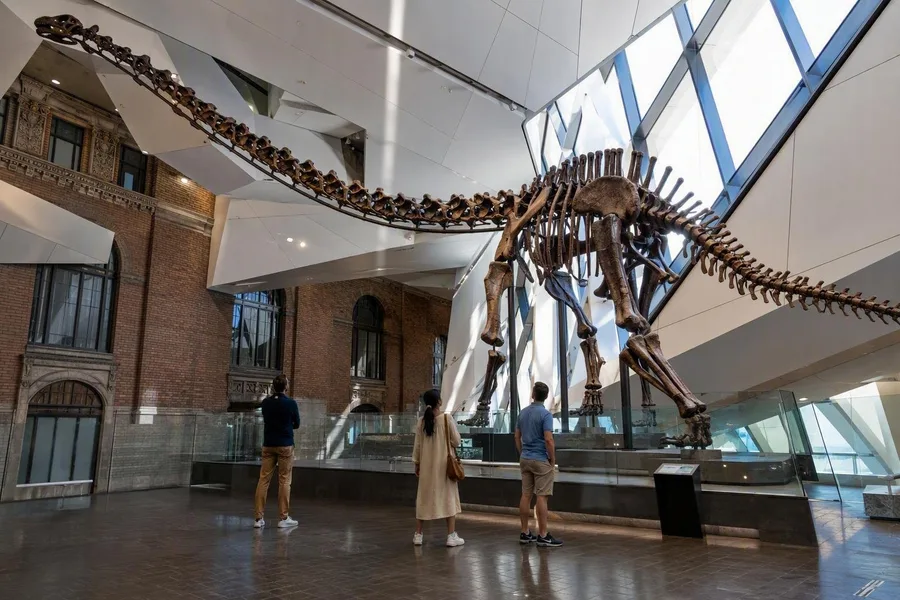 Visitors stand beneath the towering Futalognkosaurus in the Royal Ontario Museum’s Currelly Gallery.
The Royal Ontario Museum opened in 1914, but its sharpest street frontage arrived in 2007. Daniel Libeskind designed the Michael Lee-Chin Crystal as five intersecting, self-supporting prisms, clad in glass and brushed aluminium and connected to the historic building only by bridges. Its angled walls meet the older museum’s masonry without pretending the two buildings belong to the same era.
Inside, the collections span art, cultural history and the natural world. A first visit works best with a short list. The dinosaur galleries bring together life from land, sea and air during the Jurassic and Cretaceous periods, including a T. rex, the large Barosaurus known as Gordo and original skeletons from fossil fields in Alberta.
The Daphne Cockwell Gallery dedicated to First Peoples Art & Culture presents more than a thousand works and objects concerning travel, daily life, spirituality and contemporary art, with Indigenous languages, music and performance in multimedia spaces. The older Rotunda offers a different scale: its dome contains more than a million pieces of Venetian glass in gold, rust, bronze, red, blue and turquoise.
Maps are available in the Currelly Gallery, near the huge Futalognkosaurus. Its raised skeleton stands above the gallery floor, a long-necked presence beneath the museum’s glass and aluminium angles.