
Copper, Bread and River Water in Sarajevo
Low winter light falls across the Sebilj and the cobbles of Baščaršija before the old bazaar reaches full volume. A short walk passes copper workshops, bakery doors and coffee pots before it ends beside the narrow, fast-moving Miljacka.
The wooden Sebilj stands at the centre of Baščaršija, its dark timber set against an open square. Cobbled lanes run away from it in several directions, toward mosques, hans, covered markets and the close-packed shopfronts of the old trading quarter. The fountain dates from 1753. It is the last surviving public Ottoman fountain of its kind in Sarajevo.
A cold morning leaves plenty of space around it. Many shutters stay down early, and the sound of footsteps carries farther over the stones before cafés, workshops and food counters begin their later-morning business. Low light catches the edges of wooden balconies, the uneven faces of paving blocks and a few copper vessels behind glass. In icy weather, the narrow lanes can turn slick. The sensible walker watches the stones rather than the skyline.
Smoke hangs lightly in the colder air. Some of it comes from bakery ovens; some comes from coffee roasting, and the two smells meet in the small streets. Fresh bread brings a softer, yeasty note. Roasted coffee smells darker and more bitter, the kind of scent that lingers beside a closed door and then disappears around the next corner.
The layout explains the density. Ottoman Sarajevo placed homes in mahala neighbourhoods on the slopes while merchants and craftspeople worked in the čaršija below. Shops and workshops still stand shoulder to shoulder here, with doors opening straight onto the pavement. Street names preserve the trades that once filled them.
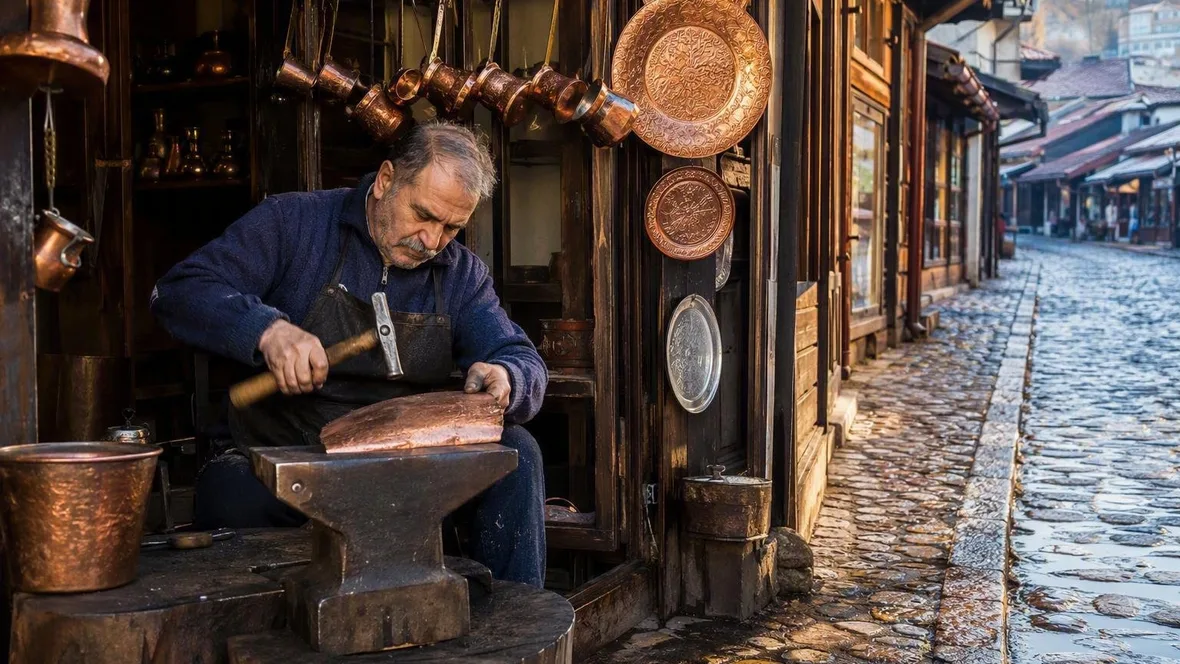
From the Sebilj, Kazandžiluk runs east, then turns sharply south toward Bravadžiluk. The lane narrows quickly. Shop openings show thin copper sheets, anvils, hanging džezve and shelves of trays, bowls and small cups. The view stays close: a window, a workbench, a brass-coloured curve catching a strip of pale sun.
The hammers announce the street before the objects do. Small steel heads strike thin copper in hard, regular taps, sometimes from more than one open workshop at a time. A coppersmith works beside an anvil. Another hand may guide a small chisel across a coffee pot while finished pieces wait in the doorway. The metal sometimes gives off a faint scorched smell.
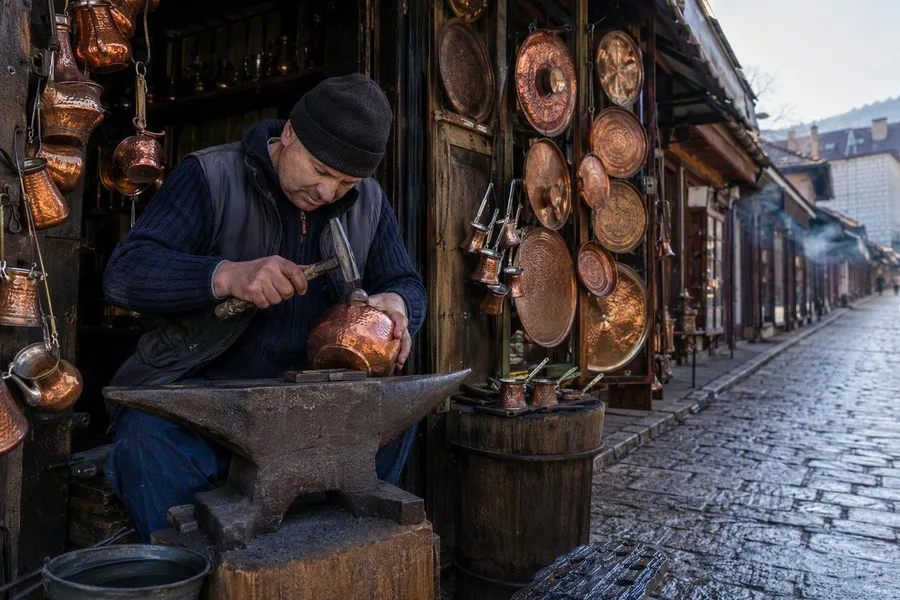 A coppersmith hammers copper beside an anvil in Sarajevo’s Kazandžiluk street.
Kazandžiluk means the street of coppersmiths. Many streets in Baščaršija now keep only the names of their former trades, but this one still contains workshops where copperware is made and sold. The old name remains practical. It saves everyone a great deal of guesswork.
Morning light works well on copper. It picks out the small dents left by hammer blows and turns the rounded sides of a džezva from dull brown to gold for a moment. The work stays part of the street rather than a performance arranged for it. A hammer lifts. A hammer falls. The shopfront frames the sound.
At Bravadžiluk, the sharp ring of metal gives way to food. The name recalls locksmiths, while the street now holds familiar places for pita and other straightforward dishes. Bakery smoke slips into the lane, followed by the smell of somun, rolls and pastries. Paper bags leave bakery counters warm and quickly acquire darker patches where the bread presses against them.
Pekara Imaret lies behind a passage near the clock tower, with the modest frontage of a working bakery rather than a grand restaurant. Somun, loaves and kifla make up its daily display. Pekara Poričanin has belonged to the quarter’s bakery life since 1923 and remains closely associated with round somun. These are not ornamental loaves. They are bought, bagged and carried away down the wet stones.
Coffee adds its own percussion. In traditional roasteries, workers roast beans, pound them in a heavy stone dibek with a metal rod and sieve the coffee afterward; the dull repeated thud can reach the street before the roasted aroma does. The sound lacks the brightness of the copper hammers. It lands lower, with more weight.
In a coffeehouse, Bosnian coffee arrives as a small arrangement: a copper džezva, a handleless fildžan, a glass of water and a sugar cube. The coffee stays in the pot while the grounds settle, then pours slowly into the cup. Copper has travelled only a few lanes from the workshop wall to the table. Heat has darkened the pot’s base; its narrow handle keeps a hand away from the flame’s work.
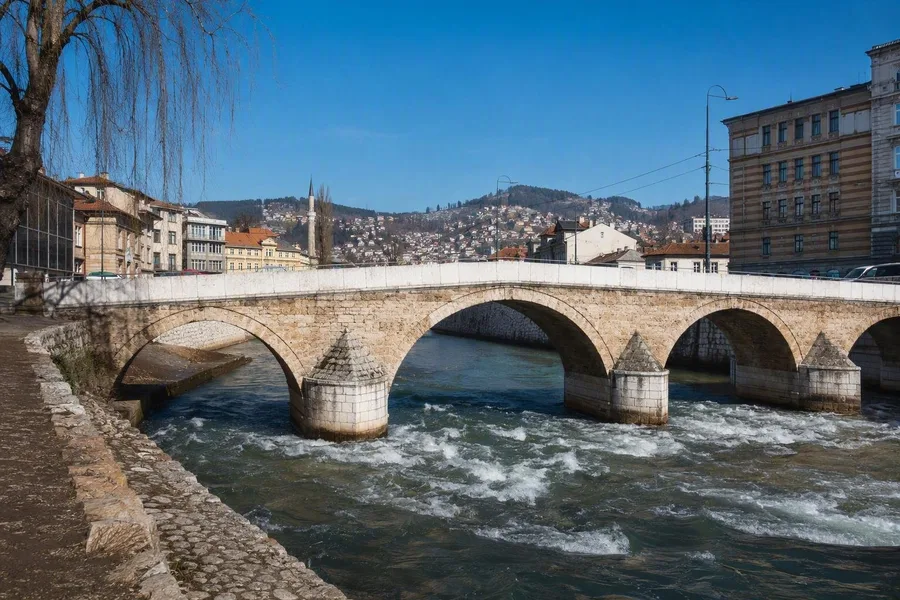 Water rushes beneath the four limestone arches of Sarajevo’s Šeher-Ćehaja Bridge.
West of Bravadžiluk, the Gazi Husrev-beg Mosque brings larger stone forms into the bazaar. Its complex includes a madrasa, library, clock tower and covered bezistan. These buildings formed part of the commercial life around them. The foundation that supported the mosque also funded institutions and trading spaces used by worshippers, merchants and travellers.
Near Morića Han, a square stone courtyard and central fountain sit behind the tight retail streets. The han now serves coffee, but its enclosed form still shows the practical needs of a trading district: walls, rooms and shelter gathered around a shared yard. Beyond it, Sarači continues the pattern of occupational names. The street recalls saddle makers, as Kazandžiluk recalls coppersmiths and Bravadžiluk locksmiths.
The paving along Sarači carries the route toward the brass line marked Sarajevo Meeting of Cultures. To the east, the bazaar remains low, tight and irregular. To the west, Ferhadija spreads into a broader Austro-Hungarian street. Fires, especially the fire of 1879, damaged Baščaršija; later rebuilding added new construction and planning while retaining older streets and structures. The change shows underfoot and at eye level. Close shopfronts give way to wider façades. The cobbles lead into a different scale of street.
For the river, turn back toward the eastern edge of Baščaršija. The Miljacka runs below the market quarter as a narrow urban current between embankments, not a grand promenade river. At the Latin Bridge, pale stone arches hold the road above the water. Winter wet makes the bridge deck slippery, and years of foot traffic have smoothed parts of the paving.
Upstream, Vijećnica stands beyond the bazaar with striped sandstone, horseshoe arches and carved relief over its entrance. Its large façade makes a brisk contrast with the timber, copper and low shopfronts behind it. Closer to Baščaršija, the Šeher-Ćehaja Bridge crosses the water on four visible limestone arches. Low parapets run along its sides, while pointed piers face the current upstream.
People use the bridge as an ordinary crossing. Traffic passes along the embankment. Shoes click and slide lightly on damp stone. Then, beneath the harder sounds above, water strikes the limestone piers and rushes under the four arches.