By Train from Winnipeg to the Hudson Bay Coast
VIA Rail leaves Winnipeg around midday and reaches Churchill two nights later, after roughly 45 hours and 1,697 kilometres of prairie, boreal forest, muskeg and tundra. The final stop stands on Hudson Bay, in a town with no road connection to southern Manitoba.
Across the prairie from Winnipeg
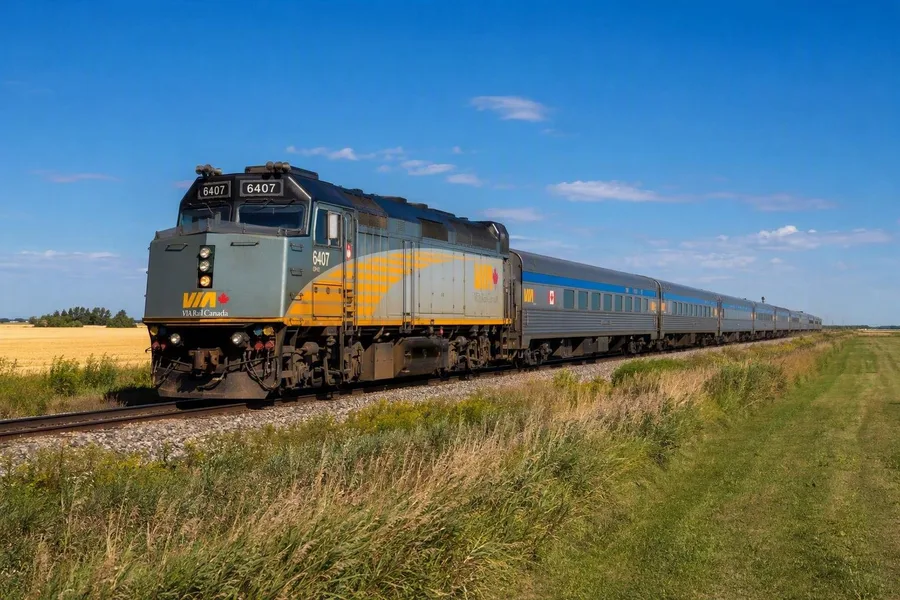 A VIA Rail train crosses cultivated fields near Portage la Prairie, Manitoba.
The northbound train starts among the flat agricultural land around Portage la Prairie. It continues through Dauphin, crosses a short stretch of Saskatchewan and reaches The Pas, where the Pasquia and Saskatchewan rivers meet.
At first, this is recognisably Prairie country: cultivated fields, level ground and towns connected by road. Then the long route begins to show its purpose. The railway was conceived in the late nineteenth century as a route for Prairie grain bound for Europe, and Churchill became its terminus because of its deep harbour on Hudson Bay.
The line reached Churchill in 1929. The first grain shipment left the port in 1931. Railway construction shaped the present town: workers set out Churchill’s streets from the station, and the building handled passengers, freight and railway staff.
The grain trade no longer explains every carriage or box of supplies on the train. The railway now also carries people and freight to communities that have few other practical ways to travel.
Beyond The Pas
North of The Pas, lakes, rivers and wet woodland become more frequent beside the track. The line passes Wabowden, set between three lakes, then Thicket Portage and Thompson on the Burntwood River. Black spruce, pine, white birch and tamarack replace the wheat fields.
The smaller stops make the railway’s daily role clear. Thicket Portage has no all-season road, and residents take the train to Thompson for shops and services. Pikwitonei and Ilford also have limited land access. Groceries, parcels and supplies travel on the same line as passengers.
Thompson is the largest break in the journey. After it, the timetable lists Sipiwesk, Pikwitonei, Ilford and Gillam, places that sit far apart across northern Manitoba. North of Gillam, the railway is Churchill’s only year-round land connection.
That fact became painfully concrete after flooding damaged the track in 2017. Churchill lost rail service and could only be reached by air; food, fuel and other necessities cost more, while visits to family and necessary trips became unaffordable for many residents. The line carries more than holidaymakers north. It helps keep ordinary errands, deliveries and visits possible.
Where the forest thins
Past Thompson, the boreal forest starts to break apart. Permafrost leaves some trees leaning; farther north, they grow lower and stand farther apart. Open muskeg, a waterlogged peatland, spreads beside the railway. Near Churchill, almost treeless subarctic tundra takes over.
This gradual change marks the approach to Hudson Bay. Churchill lies where the Churchill River enters the bay, at the meeting point of boreal forest, tundra and sea.
People have used this coast for thousands of years. Pre-Dorset communities hunted caribou in summer and ringed seals in winter, while Cree, Dene and Inuit maintained trading networks before European fur traders arrived. At the river mouth, the stone Prince of Wales Fort records the strategic value of this sheltered access to Hudson Bay.
Churchill at the end of the rails
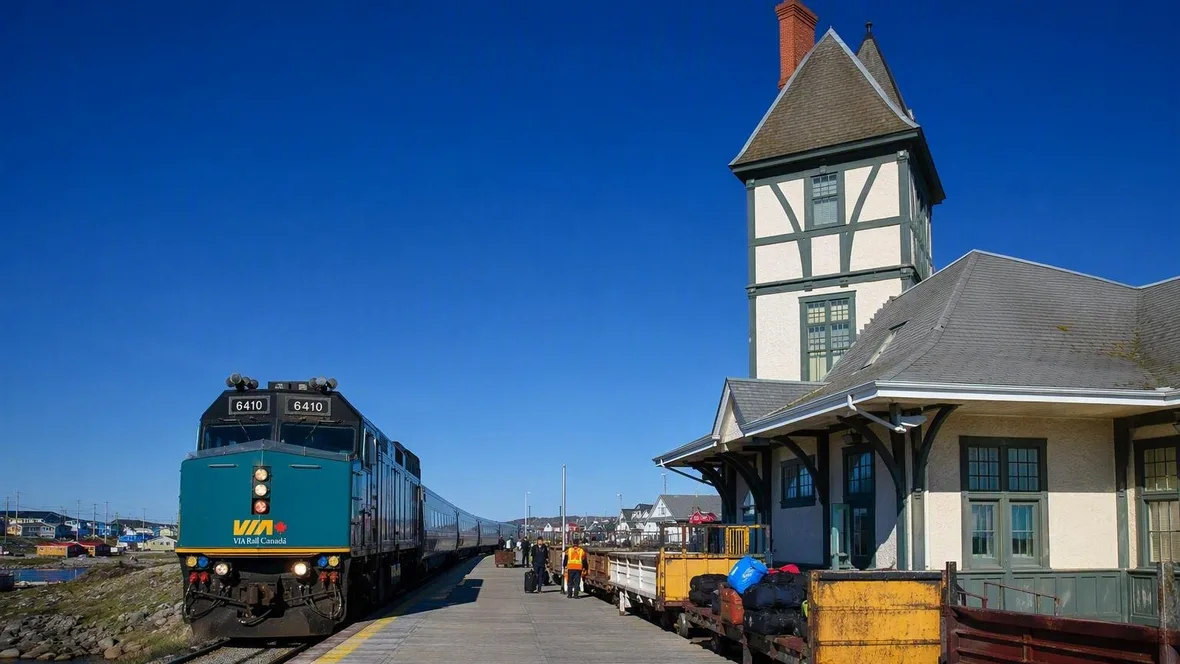
The train terminates at Churchill’s historic station, with its high tower and platform built for passengers, freight and railway crews. The town spreads from this point across low, open coastal ground near the river mouth.
Churchill remains both a railway town and a port town. Trains bring residents, visitors and freight. During the ice-free season, ships carry grain, fuel, construction materials and supplies, including goods that continue north to Nunavut.
The harbour works only when Hudson Bay is open. Ships generally arrive and depart from about mid-July to early November; winter ice closes the port, while the railway remains the fixed land route and aircraft provide another link from the south.
Since 2018, a partnership of 41 northern and Indigenous communities, including 29 First Nations, has owned the railway and port. That ownership sits behind a visible pattern at the station: people get off, freight moves onward, and a coastal town without a southern road receives what it needs by rail, air and seasonal shipping.
Belugas in summer, polar bears in autumn
July and August suit travellers who want to join a guided beluga excursion. Thousands of belugas enter the warmer estuaries of the Churchill and Seal rivers in summer to feed and reproduce. Guided boat, Zodiac and kayak outings operate on these waters, and some boats use hydrophones to pick up the animals’ sounds below the surface.
The rules keep the encounter at the animals’ distance. Boats must stay at least 50 metres away in narrow parts of the Churchill and Seal river estuaries, 100 metres away elsewhere, and 200 metres from resting animals or mothers with calves. Feeding, swimming with or otherwise interacting with marine mammals is prohibited. A guide can offer a careful way onto the water, not a promised number of animals or a close pass.
October and November are the main months for polar-bear excursions. After Hudson Bay’s sea ice disappears in summer, bears remain on land; in autumn they gather along the coast as the bay begins to freeze, waiting to return to the ice and hunt ringed seals. The largest autumn concentrations occur between the Nelson River and Churchill.
Visitors generally observe bears from permitted tundra vehicles in the Churchill Wildlife Management Area. Operators use established tracks and must not lure a bear, block its movement or approach within 100 metres. Wapusk National Park requires an accredited tour operator for every visitor activity.
Bears can occur along the rocky coast in summer, but belugas are the sounder reason to choose July or August. Autumn is not a dependable time to add belugas to a bear-focused stay. Wildlife remains wild: ice, weather and the animals’ movements determine each outing.
Practical details
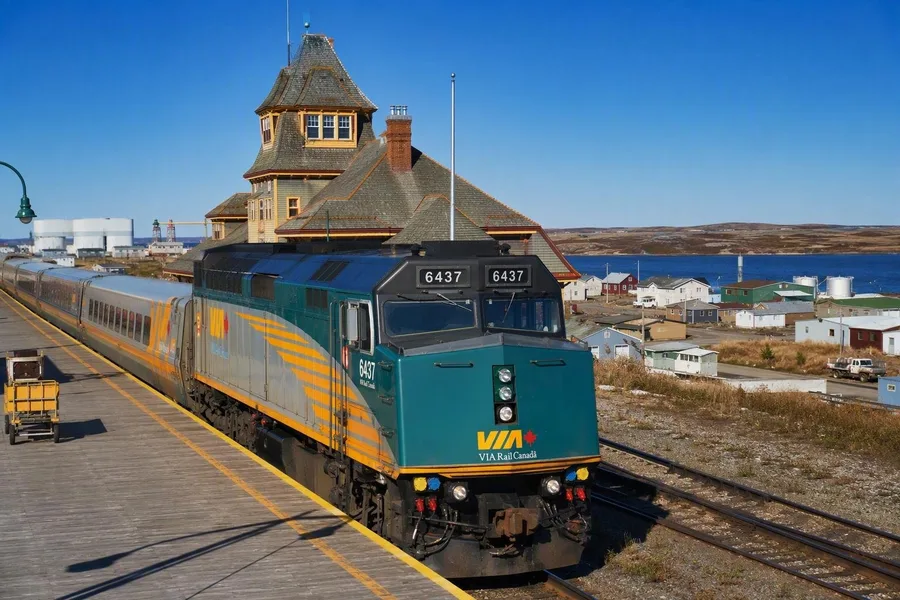 A VIA Rail train arrives at Churchill’s historic station beside the low coastal town.
VIA Rail currently leaves Winnipeg twice weekly, on Sunday and Tuesday, and departs Churchill southbound on Thursday and Saturday. The scheduled journey takes about 45 hours. Check the current timetable before booking. Reserve the train, accommodation and main excursion together: rooms and beluga trips fill months ahead in July and August, while the busiest polar-bear period, from mid-October to mid-November, can require booking about a year ahead.
At the terminus, the station platform ends near the low coastal ground. Beyond the Churchill River mouth, Hudson Bay lies open in summer and sealed by sea ice in winter.
Keep exploring