Bread from the Wall in Lahore’s Mozang Bazaar
Mujahid Taj Din Naan Bakers occupies a modest shop on the main street of Lahore’s Mozang Bazaar, where fish and poultry sellers, paan counters, bed makers and hardware merchants work at close range. Behind that small frontage stands a notably large tandoor, and its naan passes from oven worker to owner to customer in a few direct movements.
Mozang Bazaar does not frame the bakery as a destination restaurant. Small shops crowd its narrow main street, selling fish, poultry, tobacco, paan, beds and iron goods; nearby, pakora sellers work over large woks. Mujahid Taj Din Naan Bakers sits among this practical trade, small enough for a passer-by to miss.
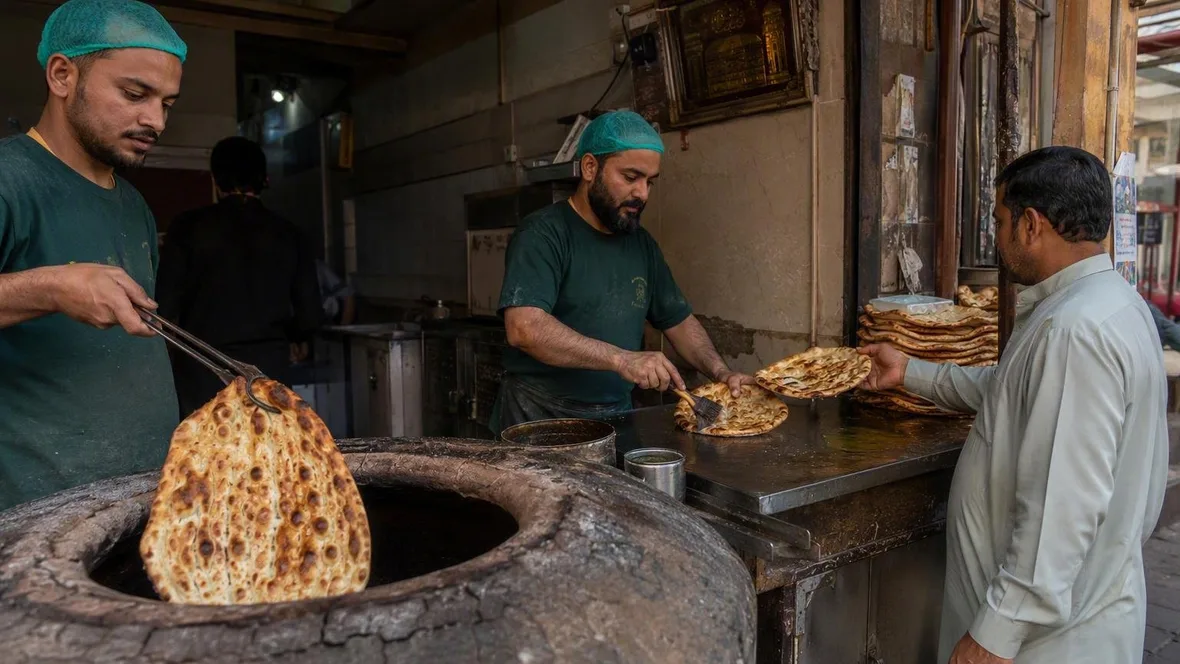
The bakery’s scale changes once the work begins. Its owner described an unusually large tandoor behind the modest shopfront, while a black-and-white photograph of founder Jalal Din hung above the work area. In a documented moment at the counter, the experienced baker Aurangzaib removed naan from the oven. Owner Sikandar-i-Azam spread ghee over another naan and handed it to a customer.
Those actions place the tandoor squarely in the life of the bazaar. The oven produces food that customers carry away while the street supplies groceries, household goods and repairs. This is not, however, Lahore’s standard roti counter. By 2020, the bakery no longer sold ordinary roti, plain naan or kulcha; it concentrated on its own specialist naans.
A wheat trader’s shop on Mozang’s main street
The family traces the business to the 1850s, when Jalal Din traded wheat in Mozang before adding dal, roti and kulcha to his work. Grain trading led here to prepared food, not through a grand reinvention but through a market-street business serving people who bought and carried things home. The family has held the premises since the nineteenth century. Builders replaced the original wood-and-brick ceiling in 1964.
That long tenure matters because the shop remains physically tied to the dense bazaar around it. The tandoor takes up more room than the narrow façade suggests, with other businesses pressed close beside it. Sikandar-i-Azam represents the third family generation at the bakery. When a 2020 report recorded its work, Aurangzaib had already spent more than 55 years there.
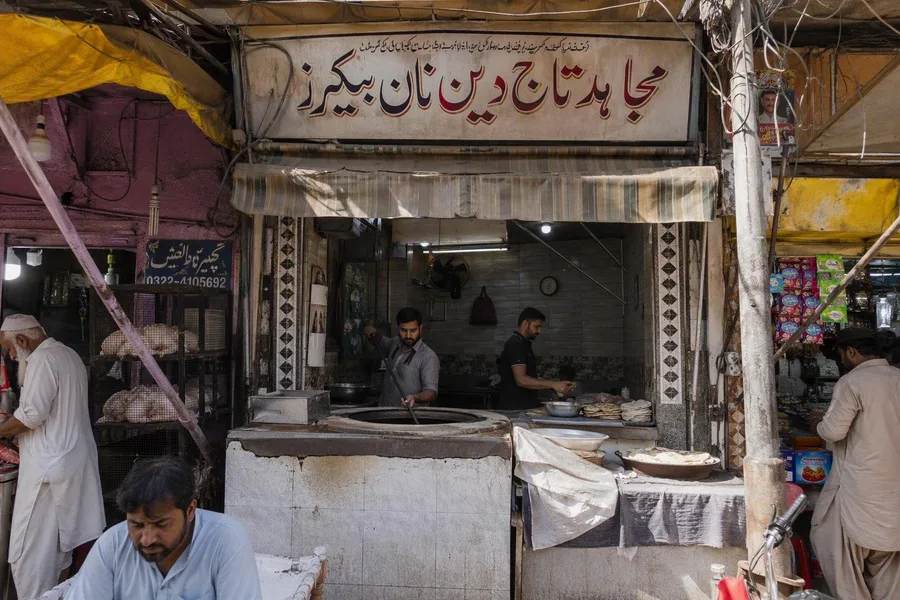 Mujahid Taj Din Naan Bakers sits among tightly packed shops on Mozang Bazaar’s main street.
The family also changed what the oven supplied. Sikandar-i-Azam said his father introduced filled naans in the 1930s, after the business had sold plainer breads. That shift turned the bakery away from basic bread alone and towards naan substantial enough to be bought as a particular meal. The oldest trade in wheat still shows in the bakery’s raw material, but the counter now serves a much more distinctive product.
The heat behind a small frontage
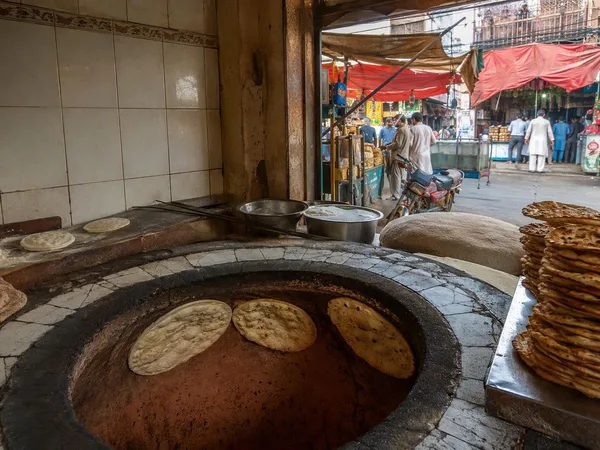
For wall-baked naan, a tandoor is a cylindrical oven with a clay lining. Bakers form leavened wheat dough into thin, elongated pieces and place them against the hot inner wall. Steam in the dough helps it rise, while direct heat cooks the bread quickly.
The available reporting does not record Mujahid Taj Din’s fuel, its firing routine or a fixed baking time. It does show the essential end of the process: Aurangzaib takes naan out of the tandoor, and Sikandar-i-Azam finishes and sells it. The work divides cleanly in a confined space. One person handles the oven; another applies ghee and manages the handover across the counter.
Studies of fully heated tandoors have measured temperatures above 300°C and found that the heat differs between the top and bottom of the oven. Those figures explain why naan cooks so fast on the wall, but they do not describe a temperature inside this particular Mozang bakery. Aurangzaib’s decades at the oven offer firmer evidence of practiced work than any imported number could.
Naan for the way home, and farther away
Roghni naan, finished with ghee, was the simplest bread in Mujahid Taj Din’s recorded range. The bakery also made filled qeema naan, along with potato and besan versions and a small number of sweet specialities. The range marks the bakery’s role in Mozang: customers did not come only for a plain accompaniment, but for a naan chosen for its filling, finish or occasion.
A filled naan can carry bread and a savoury centre beyond the counter. Elsewhere in Lahore, fresh tandoor naan forms part of breakfasts served with chickpeas at small shops and stalls. Mujahid Taj Din’s specialist bread follows a related everyday logic, even when it becomes a meal in itself. A customer can collect it during a round of market errands instead of sitting down for a formal meal.
The bakery’s regular trade extends beyond Mozang’s immediate blocks. Sikandar-i-Azam said that customers who had moved to distant parts of Lahore still came back, while others placed orders by telephone. The report also described customers visiting after returning from abroad. One man from Faisalabad stopped for beef naans that he had bought for years.
Family routines carry the bread even further from the oven. One regular said her family had bought naan here for at least three decades and took it on picnics; she also remembered buying it for Basant celebrations in earlier years. Another family placed a recurring seasonal order for a particular besan naan. These are not claims that every household uses the bakery in the same way. They show how one small shop can remain part of gatherings long after the purchase itself.
Finding the bakery in Mozang Bazaar
Mujahid Taj Din Naan Bakers is listed on Main Mozang Bazaar Road with takeaway and delivery services. Reliable current opening hours are not available in the supplied sources. The useful landmark is the mixed commercial street itself: seek the small food shops, workshops and hardware sellers, not a prominent restaurant frontage.
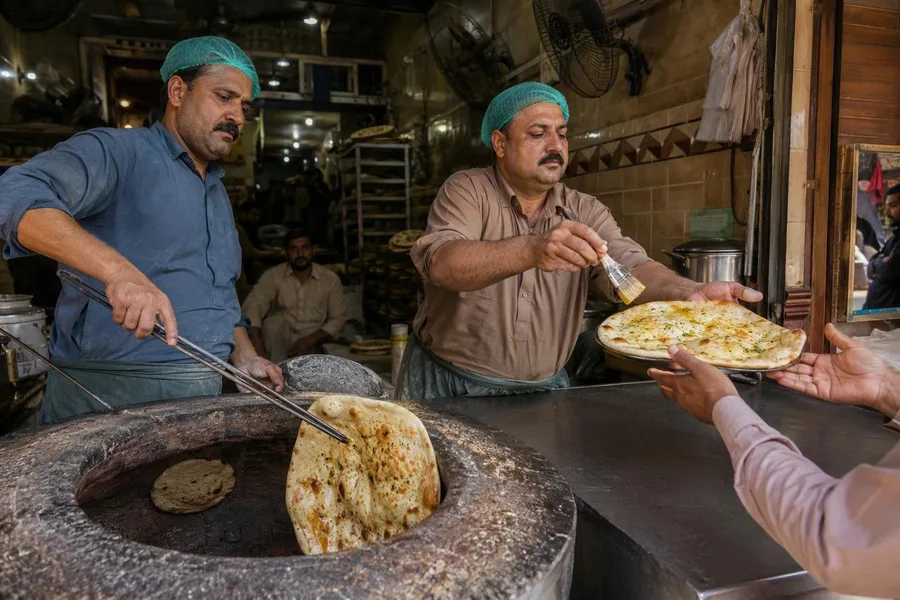 Aurangzaib and Sikandar-i-Azam finish naan for a customer in Mozang Bazaar.
A visitor recorded in 2020 had come from Sahiwal after hearing about the bakery through relatives in Lahore and seeing videos online. He ordered a beef naan.
Aurangzaib pulled naan from the tandoor. Sikandar-i-Azam brushed another with ghee and passed it over the counter.
Keep exploring