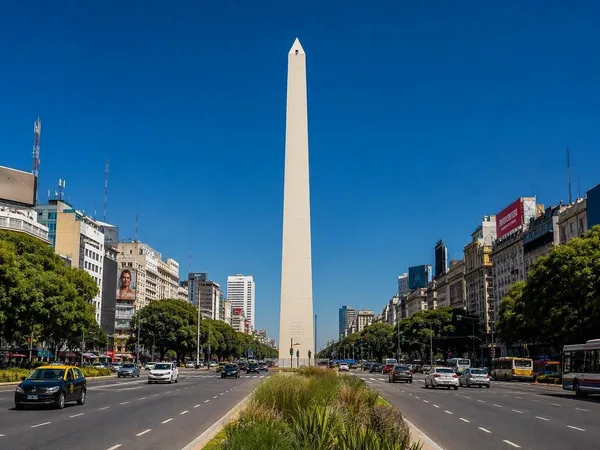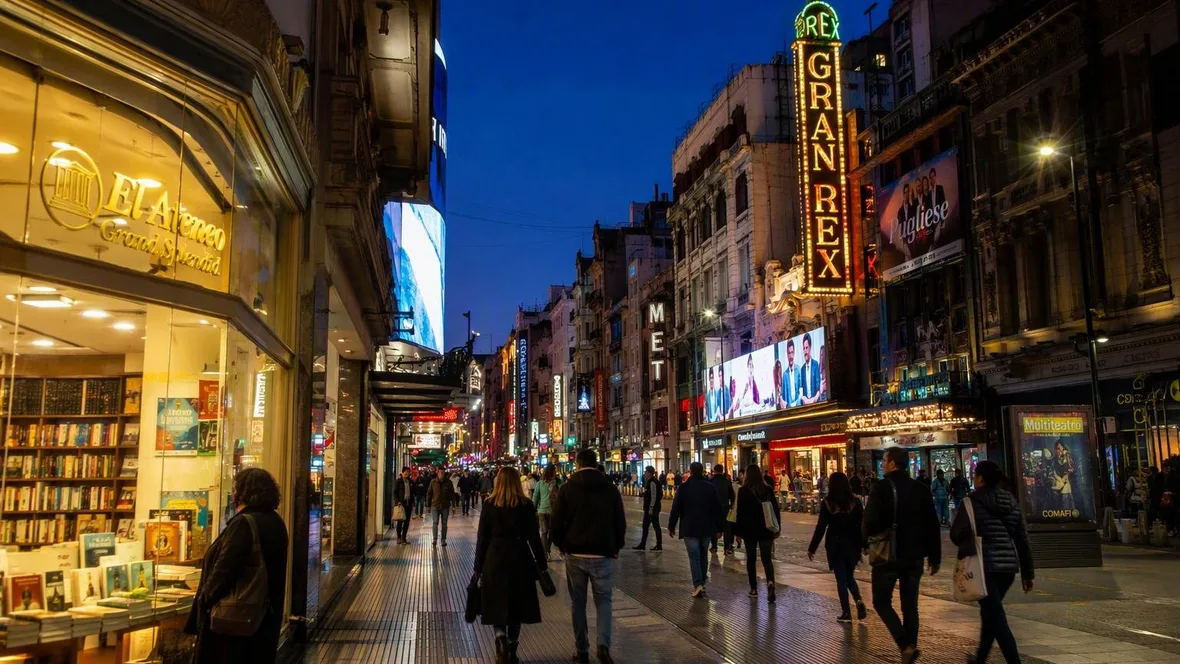
Books After Dark on Avenida Corrientes
After 7 p.m., pedestrians take over the stretch of Avenida Corrientes between Callao and Libertad, passing bookshop windows and illuminated theatre bills. Buenos Aires puts much of its literary life at street level here.
Avenida Corrientes works late. Between Esmeralda and Callao, bookshops stand beside theatres, cafés and pizzerias, and many stay open into the evening. Customers search shelves as theatre audiences gather beneath the marqueses; after a show, the same blocks lead to coffee, pizza and more books.
Older porteños still call it calle Corrientes. The name recalls the narrow street that workers widened into an avenue in 1936, creating the broad carriageway and long theatre frontages that still define the view. Since 2019, the evening pedestrian zone between Callao and Libertad has given walkers part of that space back.
From tango stages to bookshop windows
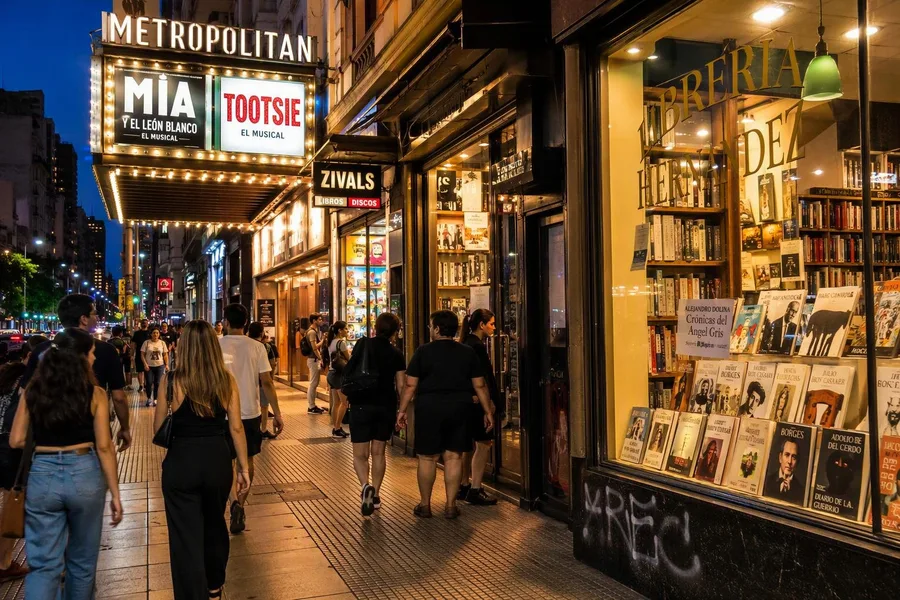 Pedestrians pass bookshop windows beneath theatre marquees on Avenida Corrientes after 7 p.m.
Books did not create Corrientes on their own. Immigration brought hotels, restaurants, cafés and theatres to the street; national theatre, cinemas, publishers, bookshops and literary cafés followed. During the first half of the 20th century, tango musicians played in local bars, cabarets and theatres. Carlos Gardel made his stage debut on Corrientes and lived near the Abasto market.
That history matters because the avenue still mixes audiences rather than separating them. In the 1960s and early 1970s, corner cafés hosted political, cultural and literary debate. A reader, a performer and a publisher could move between café table, bookshop and theatre within a few blocks.
Some of that map has gone. Café La Paz, at Corrientes and Montevideo, once drew writers including David Viñas, Ricardo Piglia, Rodolfo Walsh and María Moreno; it closed after the pandemic. Its absence is a useful correction to the polished myth of Corrientes: literary life depends on businesses that keep their doors open, not on commemorative stories.
La Giralda, at Corrientes 1453, offers a surviving counterpoint. It began in 1930 as an Andalusian milk bar and later became a night-time meeting place where customers read Cortázar, Sartre, Benedetti and Marcuse. The café reopened after restoration in 2021 with white tiles, a granite floor and marble tables. Those surfaces belong to a working café, not a museum display.
Hernández, Losada and the politics of the shelf
At Librería Hernández, readers look through tables near the entrance, follow long bookcases and ask booksellers for help. The shop opened in 1956 and has occupied Corrientes 1436 since 1973. Its stock brings literature and social sciences from large and small publishers together.
The shop also carries the violence that literary Buenos Aires endured. During the military dictatorship, authorities closed Hernández for a year, seized thousands of books labelled “subversive” and forced its founders into exile. Their daughters, grandchildren and booksellers continue the business. A novel remains an everyday purchase here, but the shelves also mark a hard-won continuity.
A short walk away, Librería Losada joins retail shelves to publishing history. Editorial Losada was founded in 1938 and published Spanish exiles during the Franco period; its list included writers of the Generation of ’27 and faced a ban in Spain for a time. The Buenos Aires publisher also issued Borges’s El Aleph, works by Bioy Casares and David Viñas, and translations of Camus, Sartre and Faulkner.
Losada still works as an independent publisher. Its premises at Corrientes 1551 combine a bookshop with the Auditorio Losada, while its series cover literature, theatre, philosophy, psychoanalysis, education and art. The address makes a publisher’s backlist and its public programme visible from the avenue.
Across the road, Teatro General San Martín explains why books and performance remain so closely linked here. Since 1960, the complex has contained theatres, an art-house cinema, exhibition spaces and a documentation centre with a theatre library and periodical collection. On Corrientes, readers and audiences often use the same pavement.
Used books, records and public conversation
Near the Obelisk, Librería Dickens buys used books and entire private libraries, then sells them alongside publishers’ remaining stock. Its shelves keep second-hand magazines, classics, specialist editions and hard-to-find titles in circulation.
At the Callao corner, Zivals takes the exchange between books and other arts further. The business began as a record shop in 1971 and added books the following year; two entrances and an internal passage link its Callao and Corrientes sides. Its stock runs from art, film, history and philosophy to tango, folklore, rock, jazz, classical music and vinyl. The corner brings readers, music collectors, students and theatre-goers through the same doors.
The annual Noche de las Librerías makes that ordinary street traffic more public. Shops stay open deep into the night for author talks, round tables, presentations and launches. On other evenings, the quieter gestures say as much: turning over a jacket copy, hunting an out-of-print title or asking a bookseller to find a book among full shelves.
A theatre filled with books
El Ateneo Grand Splendid sits on Santa Fe 1860, near Callao, rather than on Corrientes itself. The short detour matters because the bookshop gives the wider literary district its clearest example of theatre architecture put to a new use.
The Grand Splendid opened as a theatre-cinema in 1919 and became a bookshop in 2000. Shelves replaced the cinema seats on the main floor, while the balconies, gilded ornament, theatre lights and painted dome remained. The small boxes, still furnished with seats, now serve as reading spaces.
The former stage is now a café behind a half-open crimson velvet curtain. Below the balconies, shelves fill the old auditorium. The building also preserves a connection with Gardel, who began recording there with the Nacional Odeón label and sang for Radio Splendid. The conversion did not freeze the theatre in time; it gave its sightlines, curtain and boxes another daily purpose.
Practical details
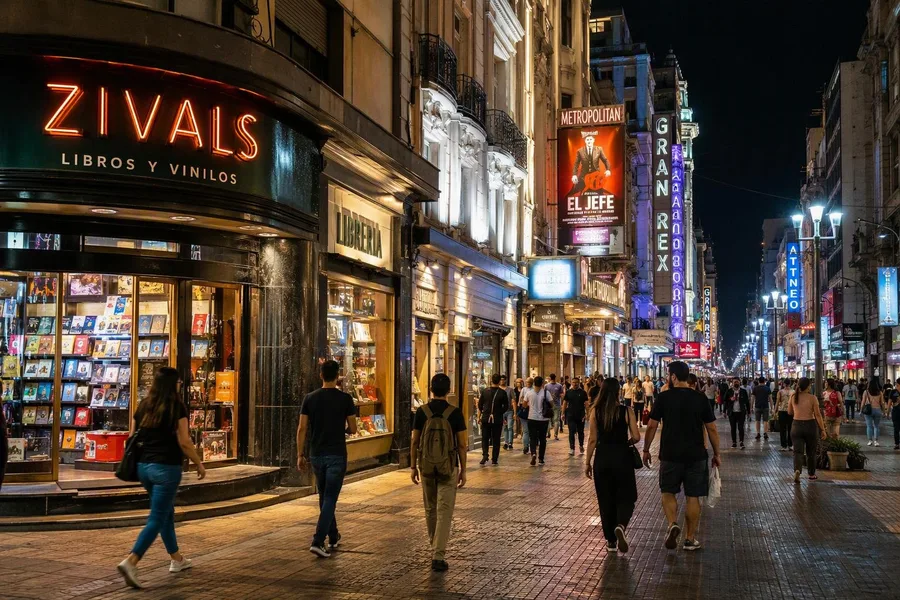 Pedestrians pass Zivals at Callao on Avenida Corrientes after the avenue becomes pedestrianised.
The main bookshop stretch runs from Esmeralda to Callao. The Callao–Libertad section becomes pedestrian territory after 7 p.m. Hernández, at Corrientes 1436, opens Monday to Saturday from 10 a.m. to 9 p.m. and closes on Sunday. Teatro Gran Rex and Teatro San Martín have changing programmes, with tickets sold through their own box offices or official sales links.
At Callao after 7 p.m., the kerb gives way to the pedestrianised avenue. Zivals holds the corner; bookshop windows line the blocks southward, and theatre signs shine farther along Corrientes.
Keep exploring