Bondi to Coogee, Beach by Beach
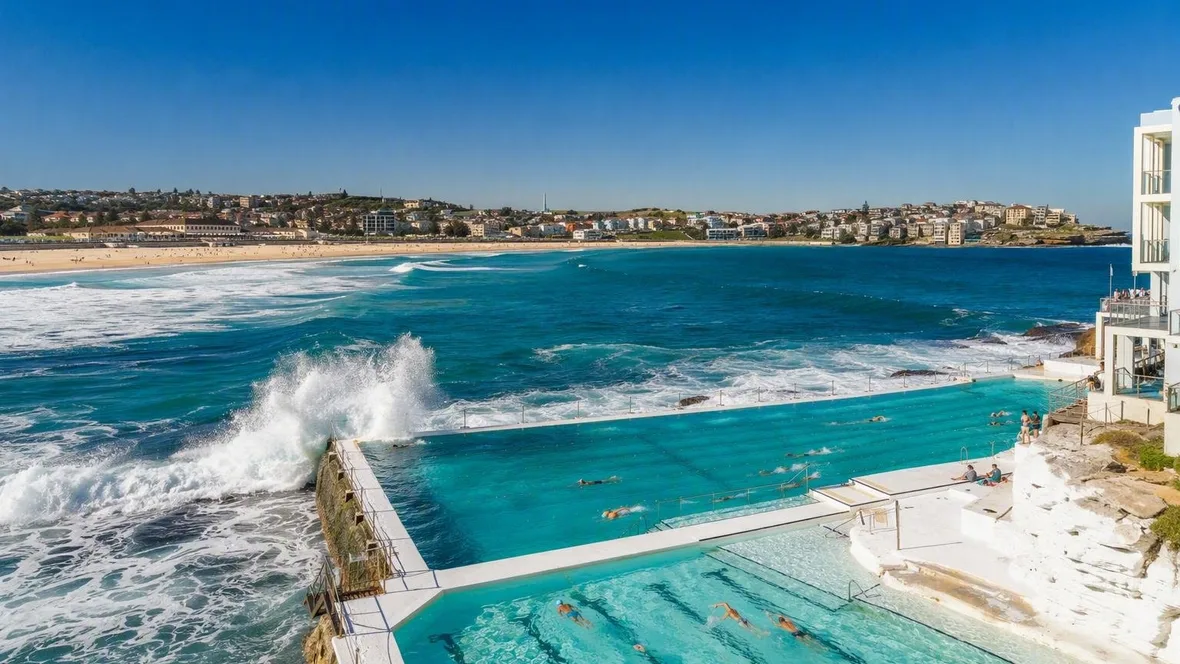
At South Bondi, swimmers trade the open surf for saltwater lanes cut into the rock below Bondi Icebergs. From there, a paved coastal path follows sandstone headlands, small beaches and swimming bays for six kilometres to Coogee.
Bondi begins with surf and saltwater lanes
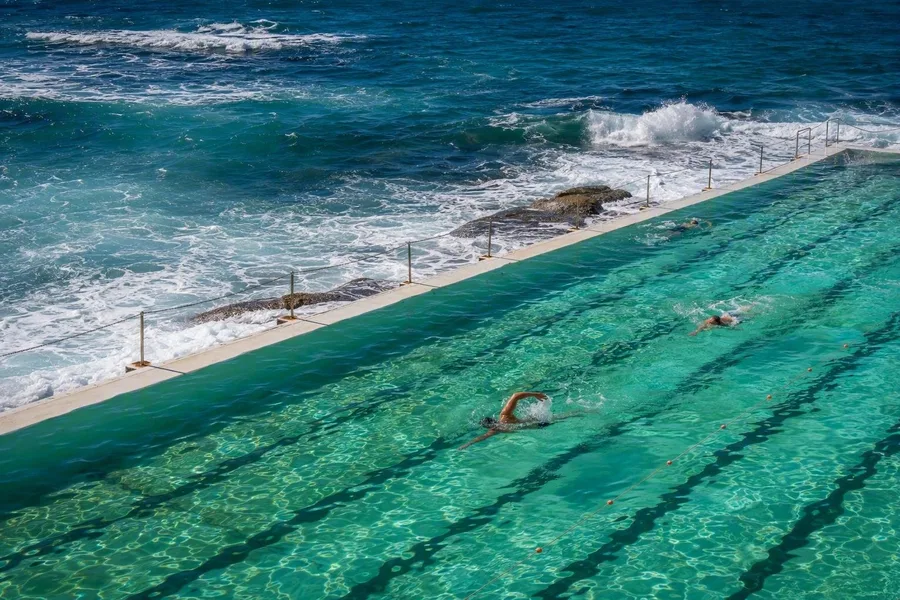 Swimmers use Bondi Icebergs’ saltwater lanes beside the surf at South Bondi.
Bondi’s broad curve puts Sydney’s beach culture in plain view: surfers beyond the break, swimmers between patrol flags, and the white edge of Bondi Icebergs on the southern rocks. The beach became a public recreation ground after trams arrived in 1884. Bathing sheds, a large pavilion and sea bathers soon followed.
Surf swimming brought real danger from currents and changing conditions. In 1907, local swimmers established Australia’s first recorded surf lifesaving club here, using volunteer patrols and rescue equipment; the model later spread around the country.
Bondi Icebergs gives the same sea a different shape. Residents first asked for baths in 1883, and a pool was built over a natural rock basin in 1887. Lifesavers founded the Icebergs Winter Swimming Club in 1929 to keep swimming through colder months. The public now uses the saltwater pools year-round, though tides and swimming events can affect access.
The higher path leaves Icebergs and heads south; the former low path at South Bondi remains closed. Pavement climbs around McKenzies Point, where the view runs back across Bondi’s long arc. Hawkesbury Sandstone forms the headland. Rivers laid down its sand in the Sydney Basin about 220 million years ago, and pressure later cemented the layers into rock.
At Marks Park, traditional Aboriginal engravings remain beside the coastal track. Steps and paved slopes then drop towards a far smaller strip of sand.
Tamarama fits between steep headlands
Tamarama sits in a narrow inlet, squeezed between sandstone points with surf entering straight into the beach. Its amusement-park past was much larger than the present-day shore. The Royal Aquarium and Pleasure Grounds stood here in the late nineteenth century, followed by Wonderland City and its roller coaster beside the sand.
Today, Tamarama serves surfers, swimmers and walkers passing above the beach. In spring, Sculpture by the Sea places artworks along this stretch of shore.
The stairs out of Tamarama make one of the route’s sharper climbs. Cracks in the sandstone give waves, salt and weather places to work; blocks can break away as the cliff slowly retreats. Low rock platforms remain at the foot of the cliff. On their seaward edges, the swell breaks hardest.
Bronte leaves space behind the sand
Bronte opens into a small surf bay with a notably large green park behind it. Picnic tables and barbecues give local families and groups room to spend the day away from the sand.
Three swimming spaces sit close together. Surfers use the open bay, while Bronte Baths occupies the southern rock platform and the natural Bogey Hole gives swimmers a more sheltered spot beside it. Builders completed Bronte Baths in 1887, part of Sydney’s long practice of putting saltwater pools directly against the sea.
South of Bronte, the grass gives way to cliff edge. The path passes Calga Reserve and runs beside or through heritage-listed Waverley Cemetery, where monuments stand above the Pacific. The cemetery places a substantial piece of Sydney’s eastern-suburbs history on the sandstone coast rather than behind the beach strip.
Clovelly makes a bay for swimming
Clovelly barely resembles a conventional beach. Two rocky ridges enclose a long, narrow inlet, and a breakwater reduces the force of the sea entering the bay. Concrete promenades line both sides, with steps down into the water.
That construction changes the daily use of the coast. Swimmers and snorkellers use the sheltered inlet, people sit on the concrete platforms, and lap swimmers use the 25-metre saltwater pool on the low southern side. A ramp on the northern side provides another entry into the water.
The walls and platforms leave the bay open to saltwater, but the narrow entrance and long sides produce calmer conditions than the surf beaches at Bondi, Tamarama and Bronte.
Gordon’s Bay keeps boats by the water
Beyond Clovelly, the route climbs before descending into Gordon’s Bay. A spring-fed wetland lies in the valley, and raised walkways cross part of the way down to the pocket beach.
Boat racks used by the local fishing club line the shore. They give the bay a practical character that differs from Clovelly’s swimming platforms. Snorkellers and divers use the sheltered water and rocky ledges. Underwater, a marked nature trail follows a 600-metre chain fixed between submerged drums.
More stairs lead out of the bay. The route is mostly paved, but it is not a level promenade. The final headlands then turn towards the wider curve of Coogee Bay.
Practical notes for the full walk
Allow two to three hours for the six-kilometre one-way walk, plus swimming stops. The signed route has mostly paved paths but also several steep staircases, and it is not suitable throughout for wheelchairs or pushchairs. Bus 333 links the city and Bondi Junction with Bondi Beach; bus 313 links Coogee with Bondi Junction and T4 train services. Bronte Ocean Pool is free and generally open daily. Bondi Icebergs and Wylie’s Baths charge separately; Wylie’s opens daily at 7am, with closing times and admission varying.
Coogee ends at a bay of ocean baths
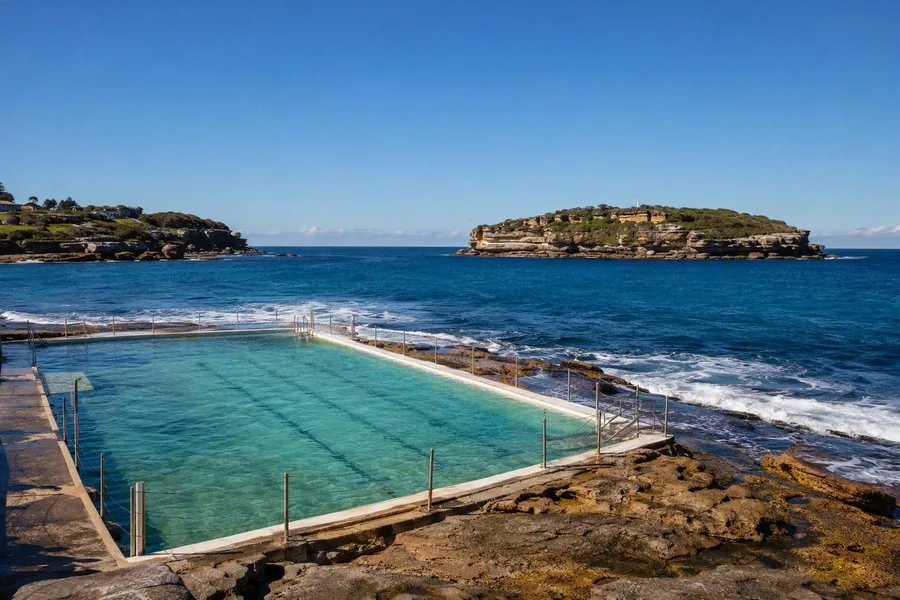 Saltwater laps the Ross Jones Memorial Pool on Coogee’s southern rocks, with Wedding Cake Island beyond.
Wedding Cake Island takes some force from the ocean swell before it reaches Coogee Beach. Parkland, a promenade, cafés and picnic areas line the landward side of the sand. After the narrow bays and staircases, Coogee has the scale of a neighbourhood beach.
Its shoreline also gathers the bathing traditions seen along the walk. Giles Baths and the Ross Jones Memorial Pool sit on the rocks near the main beach, while Wylie’s Baths lies farther south beneath the coastal path. Built in 1907, Wylie’s still serves recreational and lap swimmers. Mina Wylie, daughter of its builder and later an Olympian, trained there.
Between the beach and Wylie’s, McIver’s Ladies Baths stands on a rock platform with a brick sunbathing area, changing rooms and a clubhouse. Women had used the site for bathing before 1876. It remains Australia’s last seawater pool reserved for women and children.
At Coogee’s southern rocks, saltwater laps against the edge of the Ross Jones Memorial Pool while Wedding Cake Island sits beyond the bay.
Keep exploring