
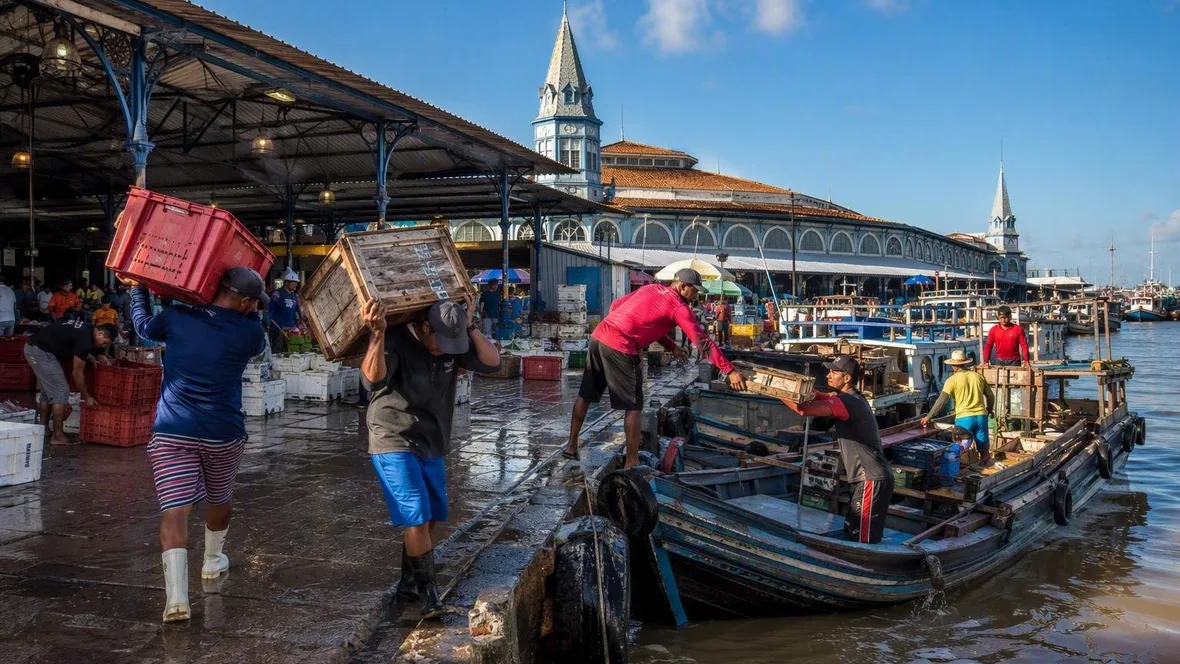
Before Daylight at Ver-o-Peso
Before sunrise, fish comes ashore at Pedra do Peixe in wooden and plastic crates, while açaí arrives in woven baskets at the neighbouring Feira do Açaí. At Ver-o-Peso, the shortest journey of the morning runs from riverboat to quay, scales and stall.
At Ver-o-Peso, the first work takes place at the waterline.
Before daylight, fishing boats tie up at Pedra do Peixe, beside Belém’s fish market. Workers lift the catch from the boats and carry plastic and wooden crates towards rows of large scales. They clear the narrow ground beside the quay for the next load. Some balance the crates on their heads.
Wholesale fish trading here runs from midnight into the early morning. By the time the sky begins to lighten, some workers have already spent hours lifting, weighing and moving the catch.
Dourada, filhote and pirarucu pass through this chain of hands. A crate leaves a boat. A porter brings it to the scales. A seller weighs fish by the kilo, keeps stock in a box and selects fish for customers. Elsewhere in the market, families teach children to clean fish and set out the display.
The trade carries the penetrating smell known locally as pitiú. Sellers call from their boxes. Buyers cluster near the scales and bargain over the catch. Crates hit the ground. Weights settle. Hands reach back towards the boats.
The Mercado de Ferro rises beside this work, its four corner towers visible above the fish trade. Builders assembled the prefabricated iron structure here in 1901 after its parts arrived from England and the United States. It stands beside the Doca do Ver-o-Peso. Symmetrical façades and arched openings enclose a hall of exposed iron columns, beams and roof trusses. Glazed lanterns in the roof bring daylight down over the selling places.
Pale morning light falls on the ironwork. It reaches fish scales, wet crates and the workers bent over the scales.
Ver-o-Peso developed beside a natural landing place at the mouth of the former Piry waterway. The quay and broad boulevard came later. The market now stretches along the Baía do Guajará and includes the docks. Pedra do Peixe marks the fish landing, and the Feira do Açaí stands immediately beside it.
The fruit follows a different measure.
Before sunrise, dozens of boats bring freshly picked açaí to the Feira do Açaí. The berries arrive in woven baskets, not in the sealed retail packs seen far beyond Pará. At the quay, traders have traditionally measured the fruit by the basket. They stack baskets along the edge and carry purchases across the road towards vehicles.
The fruit spoils quickly. The early buying and selling therefore moves fast. As the sky grows brighter, the açaí rush eases, and the piles of baskets gradually return towards the boats.
Fish sits cold and heavy in a crate. Açaí fills a rough-woven basket with small rounded berries. Wooden gunwales press against the quay while hands grip handles, brace loads against shoulders and keep a path open along the water.
Further inside the market, vendors serve açaí thick and unsweetened in bowls, often with fried fish or farinha. At the quay, however, the fruit remains a fresh river arrival. A dourada goes onto a scale. Açaí remains in a basket. Both travel only a few metres, but each passes through a different set of hands.
By six o’clock, the sky has taken on more colour. Fish and açaí trading begin to thin at the waterfront. Other workers start laying out tables for tapioca and coffee. Herb sellers arrive, and fruit and vegetable vendors spread their goods across counters and stands. By around eight, every part of the market is busy.
Jambu lies in green heaps among the fresh seasonings. Priprioca adds its distinctive scent, while garrafadas, bottles filled with herbal mixtures, stand in rows on the stalls. These counters hold a quieter kind of work than the quay. Vendors sort leaves, arrange bottles, make bundles and pass them over the counter.
At the fruit section, taperebá appears as fresh juice. The sharp fruit cuts through the dense açaí served with fish. Across the market, the goods remain close to the labour that has shaped their morning: fish in crates and boxes, açaí in baskets, herbs in piles and bottles.
After the fish trade, workers wash Pedra do Peixe. Water runs over the ground as the daylight strengthens. The waterfront offers different kinds of shelter. The Mercado de Ferro has an iron frame and tiled roof. The restored Mercado de Carne has a korodur floor and a repaired wooden roof structure. Long canvas coverings shade open sections along the bay.
The physical edge of the market remains exposed to the water. Boats arrive at the quay. Crates and baskets cross the same strip of ground. The market’s iron halls, open feira and landing place stand in one continuous line along the Guajará.
For an early visit, Ver-o-Peso lies on Boulevard Castilhos França in Campina. The public market is listed as open Monday to Saturday from 05:00 to 18:30; individual fish, herb and food sections keep different hours. Arriving around 05:00 catches the final stretch of overnight fish trading.
Beyond the stalls, boats moor below the market, and their masts rise beside the Mercado de Ferro’s four towers. At high water, the fish market can appear to stand on the bay itself. The first açaí baskets have returned towards the river craft. Fish crates have moved inland, been weighed, opened and emptied. Water from the washed quay runs towards the brown Guajará and lifts against the hulls at the market’s edge.
Keep exploring