
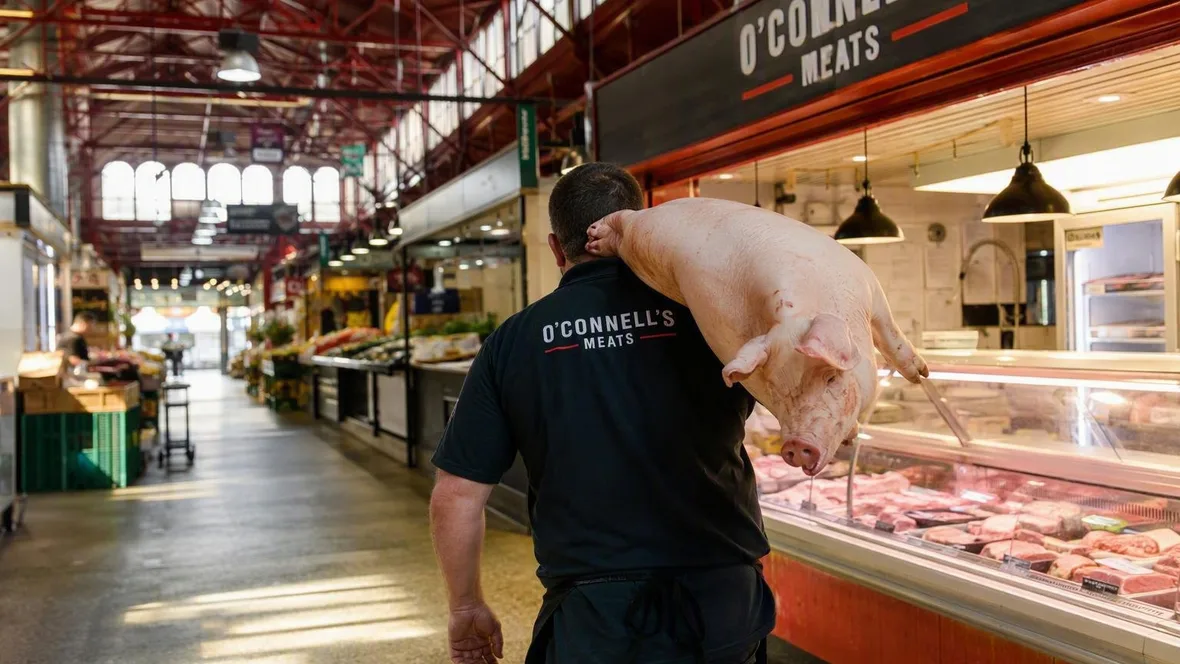
Before Breakfast at Adelaide Central Market
Behind the brick frontage on Grote Street, Adelaide Central Market starts with goods in motion. Counters fill, traders cross the covered lanes, and food from South Australian orchards, coasts and family kitchens enters the city’s daily trade.
Grote Street, before the counters fill
The Grote Street entrance gives Adelaide Central Market a solid public face: two storeys of brick, arched upper windows, a tower and a veranda added shortly after the façade was built in 1900. Behind it, the present market runs in bright north–south lanes, with stalls selling from both sides. That interior layout dates from the major rebuilding of 1965–66, when 76 renewed stalls replaced almost all of the earlier interior.
Morning starts as work, not display. Traders move through the hall before the counters turn into shops, bringing fresh goods into place. The market’s more than 70 traders sell fruit and vegetables, meat and poultry, fish and shellfish, bread, cheese, smallgoods, spices, flowers and prepared food under one roof. A customer may stop for coffee near the Grote Street entrance, then make for a familiar butcher, fishmonger or greengrocer.
The aisles make that traffic visible. Coloured lanes divide the covered floor, while the older brick building holds its line along the street. This practical shape comes from the market’s earliest days. In 1869, growers and produce sellers left the crowded East End Market for a new municipal site between Grote and Gouger streets, where they could sell directly from open ground behind a fence and by gaslight before sunrise.
Two timber-and-iron cart sheds stood here by June that year. In 1873, a roof covered the roadway between them and another shed was added. Carts and produce set the first rhythm. Deliveries still set the morning in motion.
Fruit from the hills, oysters from the coast
A pile of apples shows the market’s original purpose with particular clarity. South Australian Royal Gala and Granny Smith apples appear in the market’s local range, while autumn brings Sundowner, Red Delicious, Fuji and Pink Lady varieties. The trade is simple: fruit leaves an orchard and reaches a city kitchen through a counter in the CBD.
At Angelakis Bros, local oysters sit alongside other South Australian seafood. The market’s online range also lists oysters from Smoky Bay. Those shells carry a different regional line into the hall, from coastal waters and seafood handling to a direct sale in central Adelaide. Three specialist seafood traders work in the market.
The stalls do more than pass goods across a counter. Butchers offer advice on cuts and cooking, while cheese and delicatessen counters include tasting and explanation as part of the sale. That exchange keeps food connected to the person who has selected, cut or prepared it.
The families behind familiar foods
A piece of salami at Barossa Fine Foods brings another South Australian chain into view. The business buys meat from the Barossa and elsewhere in the state, then produces smallgoods through a German family tradition. Regional livestock, family knowledge and a city counter meet in one purchase.
Italian growers had already connected family farming to this market long before Adelaide became known for its postwar European food businesses. Families from Veneto settled on Adelaide’s outskirts in the 1920s, buying or leasing land, growing vegetables and selling their crops at the market. Their work extended the direct producer-to-city trade that had brought growers to the site in 1869.
Lucia’s gives that history a cooked form. Lucia Rosella opened Adelaide’s first pizza bar at the market in 1957, beginning with a small premises and seven stools. Her daughters still run Lucia’s with inherited recipes for pizza, pasta and minestrone, the Italian vegetable soup. During summer, the business turns local tomatoes into sauce with basil, garlic and olive oil on the premises. The tomatoes arrive as a seasonal crop and leave as jars and meals for the city.
At Con’s Fine Foods, the Greek-Australian thread remains equally concrete. Con Savvas once ran five continental-food stalls serving Greek, Italian and other migrant communities; his son Alex now runs the business. The older term “continental” named the ingredients that helped migrant households keep familiar food on the table.
From the hall towards Chinatown
The market precinct widened again in the 1970s and 1980s, when Asian migrants, particularly from Southeast Asia, established businesses in Chinatown and Market Plaza. Paifang gates, stone lions, red lanterns and pagoda-style roofs mark that neighbouring area.
Inside the hall, Sunmi’s Sushi places Korean food among the older European businesses and fresh-food stalls. Sunmi Kim moved from Seoul to Adelaide and serves bibimbap, rice with vegetables and other ingredients, as well as Korean pancakes and sushi. The counter belongs to the same everyday market economy as the fruit stalls and butchers: food is prepared, bought and carried home.
Le Souk adds another set of ingredients and methods. The stall sells chakchouka, made with cooked peppers and tomatoes, alongside couscous, house-made merguez sausages, Algerian spice blends and dates. Dates hold an association with hospitality in Algerian custom. At the market, they also sit among ordinary provisions, packed and ready for sale.
These businesses do not turn the hall into a museum of migration. They keep recipes, ingredients and food habits in daily circulation through trade.
Planning an early visit
Adelaide Central Market opens at 7am on Tuesday, Friday and Saturday; Wednesday and Thursday opening is 9am. The market is closed on Sunday and Monday, and Wednesday trading is optional, so some stalls may not open. The market stands at 44–60 Gouger Street, a short walk from the Victoria Square/Tarntanyangga tram stop. Covered UPark parking sits directly above it.
The first heavy load
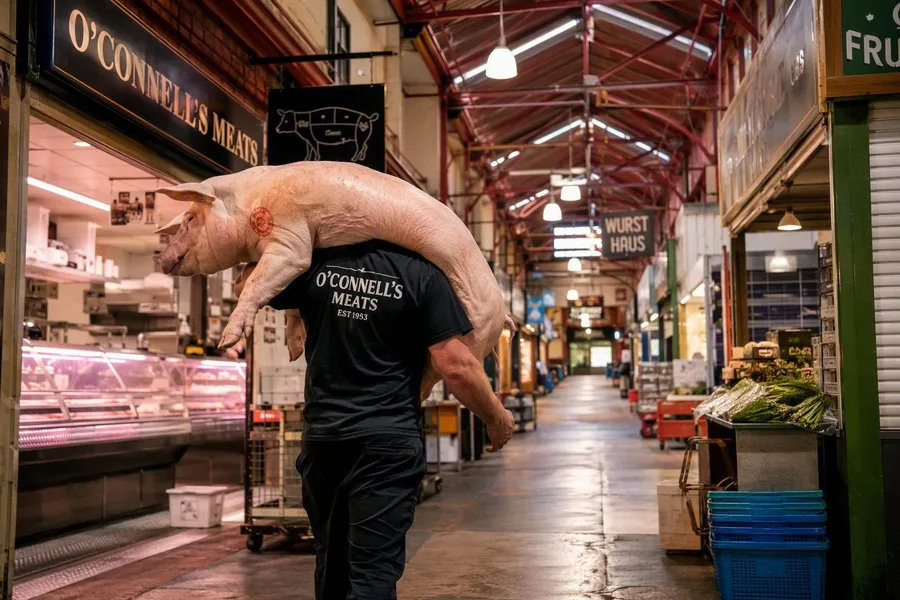 An O’Connell’s Meats butcher carries a pig carcass through Adelaide Central Market’s bright lanes.
Before a butcher can discuss a cut of meat, the meat has to reach the block. On a documented Tuesday morning near the Grote Street food court, an O’Connell’s Meats butcher carried a pig carcass over his shoulder through the hall.
He crossed the bright lanes as counters shifted from preparation to trade. The carcass reached the stall, and the morning had begun.
Keep exploring