
At Heming Tea House, the Day Begins with a Broom
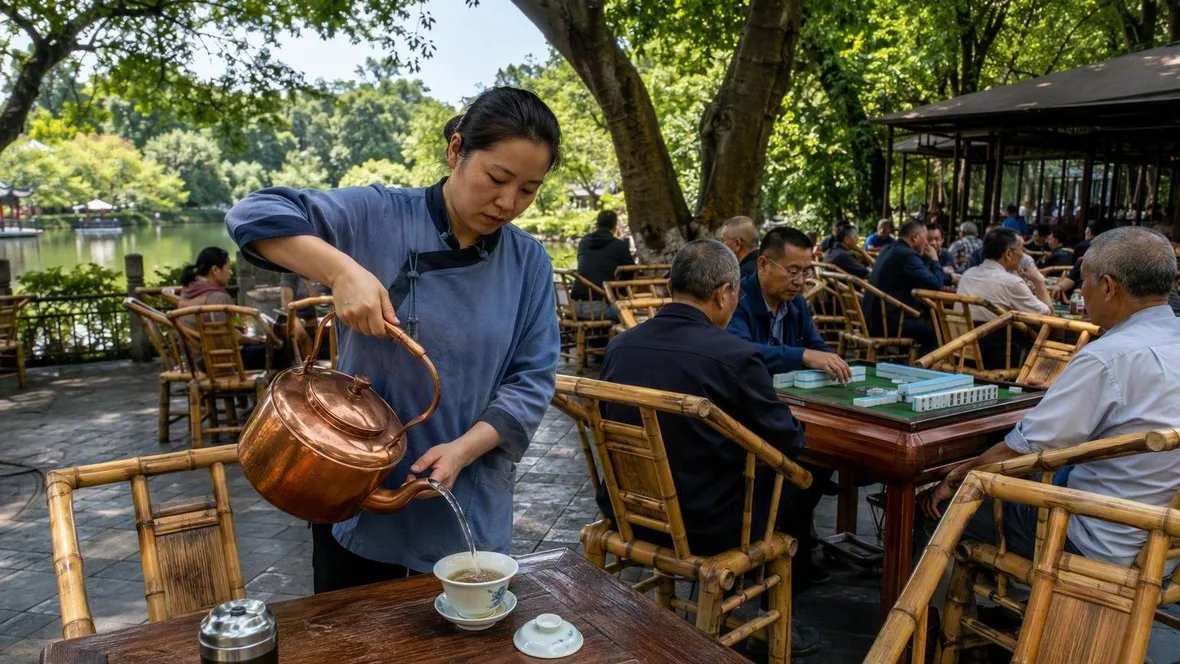
Before seven, staff sweep the blue-grey paving beneath the trees at Heming Tea House in Chengdu’s People’s Park. Then bamboo chairs shift over stone, copper kettles send up steam, and porcelain lids begin to tap against their bowls.
Before the first bowls
Heming Tea House sits beside the lake in People’s Park, where outdoor tables stand among large trees. Rows of bamboo chairs face wooden tabletops. Blue-grey stone shows between their legs, and the warm metal of copper kettles catches the eye among bamboo, wood and porcelain.
The teahouse opened in 1923. Its long history does not alter the first work of the day. Before seven, employees sweep the paving around the tables and prepare the seats for the first tea drinkers. The lake lies at one edge of the seating area. Tree cover replaces walls and a ceiling.
Between seven and nine, regular customers begin to fill many of the chairs. A person sits down. Bamboo rubs against stone. A gap between two tables disappears as another chair moves into place.
No formal quiet settles over the tables. Birds sound in the park, while talk begins in low clusters and porcelain answers with a sharper tick. Kettles add their own small clatter. Heming serves a crowd that comes to stay, not a hushed room arranged for a ceremony.
Bowl, lid, water
A server brings the day’s essential object: a gaiwan, made of saucer, bowl and lid, with leaves already resting in the bowl. Then comes the water. A copper kettle tilts, hot water strikes porcelain, and a short plume of steam rises before the open air breaks it apart.
The leaves float and begin to open in the bowl. The drinker shifts the lid to hold them back and drinks through the narrow gap between rim and lid. The saucer protects the hand from the heat of the porcelain. This is a practical set of movements, repeated without fuss at table after table.
Some servers use long-spouted kettles and lift the stream in a practiced arc before bringing it down into the bowl. Other kettles at Heming have short spouts, a local detail the teahouse has retained alongside its bamboo tables and porcelain bowls. Both kinds of pour end the same way: the water settles, the lid comes back to the rim, and the person in the chair resumes a conversation, a newspaper or a game.
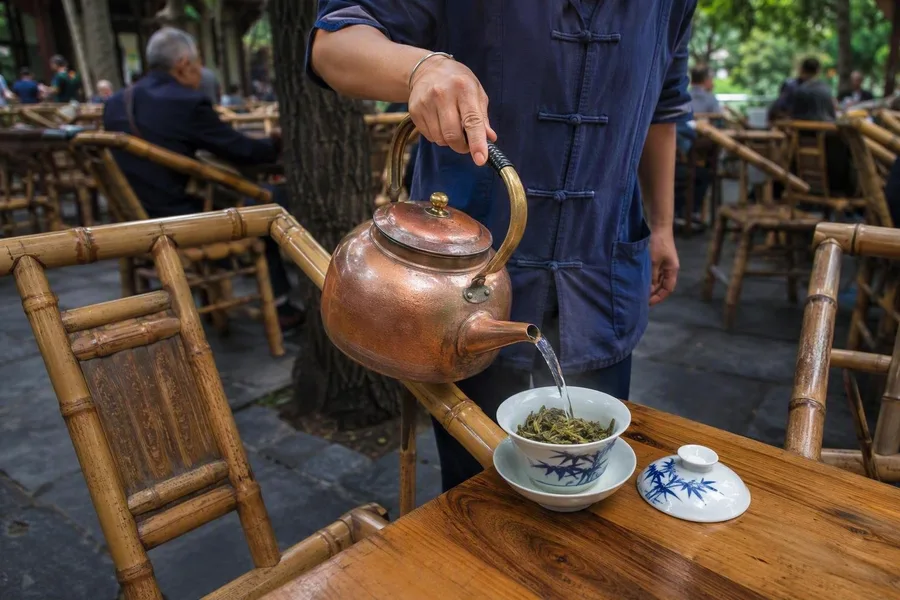 A server fills a leaf-filled gaiwan beside bamboo chairs at Heming Tea House in People’s Park.
The scent stays close to the bowls. Jasmine tea is one of the fragrant choices documented here. A lid touches a saucer. A kettle meets a tabletop. Those small sounds travel clearly between the voices.
One bowl can hold a chair for hours. When the water has fallen to about a third, the drinker props the lid at an angle against the rim. A passing server sees the signal and refills the bowl. Fresh water lifts the leaves again. Steam rises, then goes.
Servers in light or dark blue uniforms thread between chair backs with kettles in hand. Their work comes in quick, exact pieces: notice the tilted lid, judge the distance from spout to bowl, stop before the water reaches the edge. At the next table, the same sequence begins again.
Tiles on wood
Mahjong gives the room one of its clearest sounds. Tiles click on the wooden tables as players sort and place them beside their gaiwan. Card games occupy other tables. A card slides across wood; a tile knocks against another tile; a porcelain lid taps its bowl.
The tables also hold quieter occupations. Some customers read. Some talk for long stretches. Some doze in their chairs. A documented group of photography students played cards beside an unused bamboo chair that held their cameras. At other tables, hands crack roasted sunflower seeds. The dry snap of shells cuts through the softer wash of conversation.
Ear cleaners move through the seating area with fine metal tools, feathers and tuning forks. Customers who choose the service stay in their bamboo chairs while the work takes place at the table. A tuning fork or metal instrument gives off a brief ring. Then the mahjong tiles take over again.
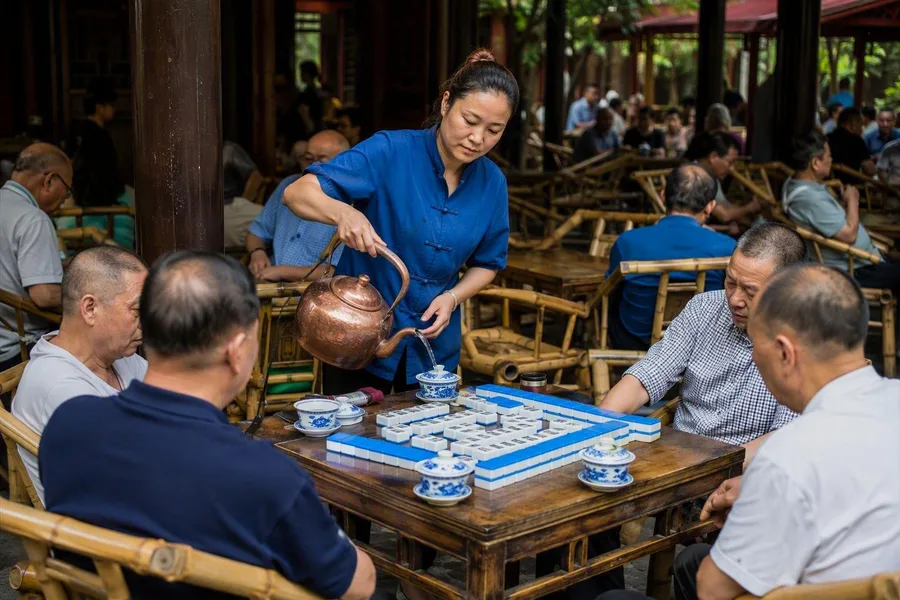 A server refills a gaiwan beside mahjong players at Heming Tea House in People’s Park.
Nothing sits behind glass here. The chairs take weight. The bowls are drained and refilled. Players keep their places while servers work around their elbows.
Practical note. Heming Tea House stands beside the lake in Chengdu’s People’s Park. Morning seats fill quickly; the afternoon brings a denser, more tourist-heavy crowd.
When the chairs fill
After midday, empty chairs become harder to find. More voices cross the space between tables. Laughter, kettle sounds and the clack of mahjong tiles rise together, while servers weave through the tighter rows with hot water and, when called for, snacks.
The trees, lake edge and stone paving remain in view, but human activity fills the open-air room. Visitors drink tea, eat, play cards, handle mahjong tiles and sit for ear cleaning. Performers may prepare nearby. The day does not pause for any of it. A server reaches over a table, fills a bowl, and moves on.
A short action marks each refill. The lid leans. The kettle tilts. The stream ends. The longer occupations continue around it: a hand holds a fan of cards, another moves a mahjong tile into line, and a reader lowers a page before lifting the bowl.
Eventually, a chair scrapes back and a table clears. No fixed farewell marks the departure. Another person takes the place, receives a bowl with leaves, and waits for the water.
The porcelain lid settles on its rim. A mahjong tile clicks against the table.