Asmara to Massawa: Eritrea’s railway down to the Red Sea
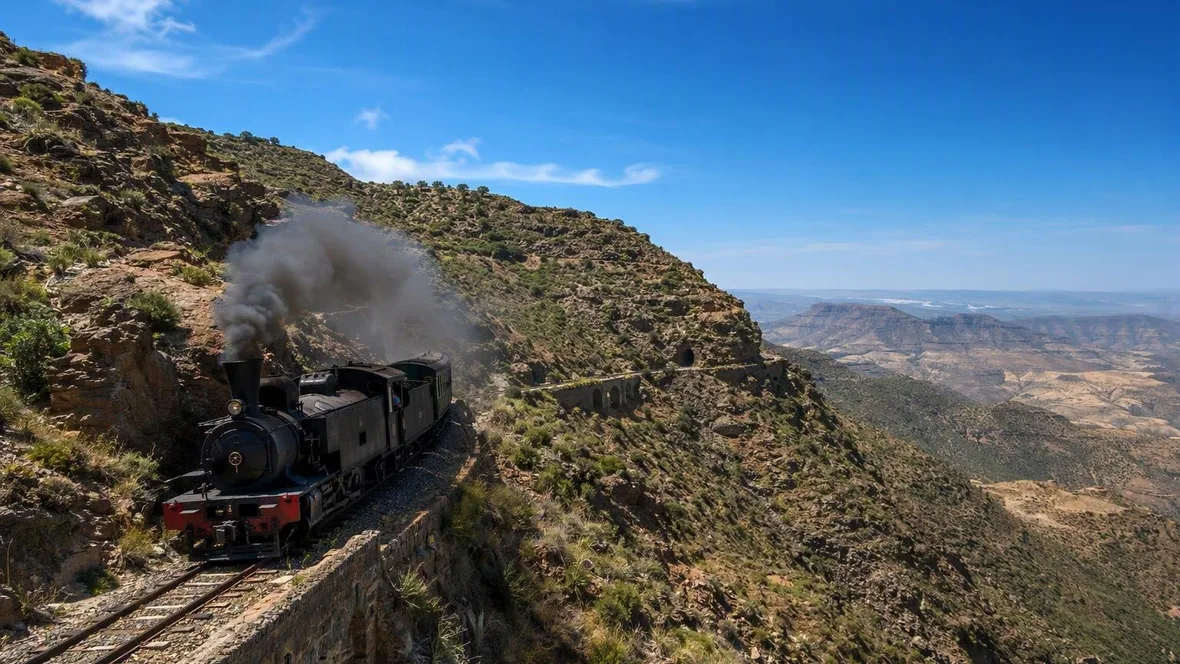
At Asmara station, 950-mm rails pass workshops built for locomotives that once tied a highland colonial capital to the Red Sea. Over 118 kilometres, the line drops through tunnels, tight curves and stone viaducts towards Massawa, tracing both an extraordinary piece of railway engineering and the harder history behind it.
Asmara, at the top of the line
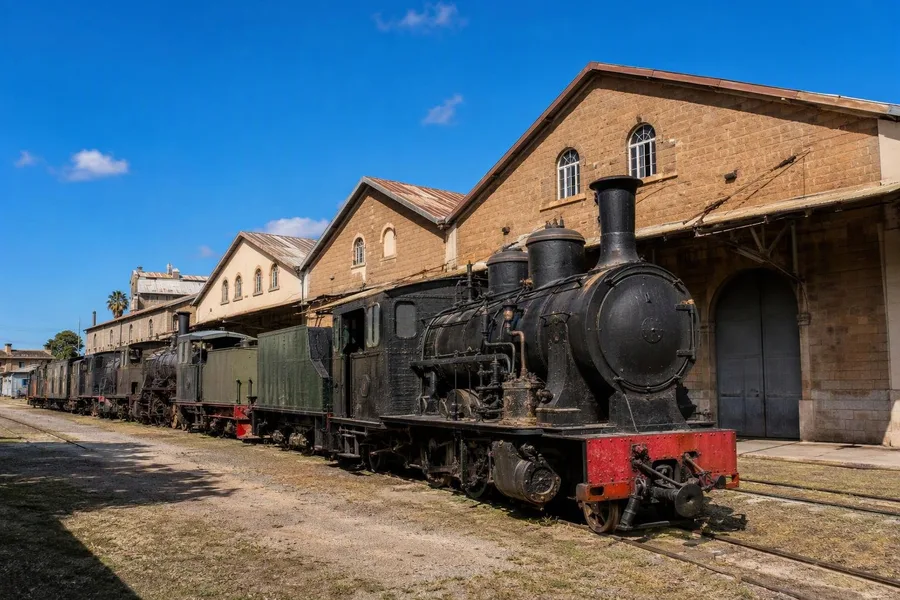 Historic Mallet steam locomotives stand beside the railway workshops in Asmara.
Asmara station and its workshops offer the clearest view of Eritrea’s surviving railway heritage. Locomotives can be stored and maintained here, while the museum beside the station holds railway objects, photographs and drawings. The rails use the Italian 950-mm gauge, a narrow format that allowed the sharp curves needed on the mountain route.
Asmara stands on a plateau more than 2,000 metres above the Red Sea. Italy moved its colonial capital here from Massawa in 1900, choosing the cooler highland site for the administrative and military centre of its Eritrean colony. The city had grown from an Italian military post in the 1890s; after 1935, Italian authorities added government, residential and commercial buildings in a rationalist style that still shapes much of the centre.
The railway arrived before much of that architecture. After Italy occupied Massawa in 1885, colonial military engineers began laying track inland in 1887 to supply forward positions. Governor Ferdinando Martini resumed construction around 1900 as Italian rule expanded. The rails reached Nefasit in 1910 and Asmara in 1911, linking the inland capital to the port.
That origin matters when the polished brass and old machinery catch the eye. Italy built the line first for military supply, colonial administration and the transport of products from the interior, not as a scenic route between two cities. Asmara’s station, administrative buildings and street grid formed parts of the same colonial project.
The climb above Ghinda
The route between Massawa and Asmara covers about 118 kilometres. From almost sea level at the coast, it climbs to 2,394 metres just before Asmara, then drops slightly into the city. This was never a straight ascent. The track crosses the coastal plain relatively gently to Mai Atal, steepens towards Ghinda, and takes on its toughest mountain character above that town.
The narrow gauge gave engineers room to work around the escarpment rather than through it. Between Ghinda and Asmara, curves tighten to a minimum radius of 70 metres and gradients reach 3.5 percent. Above Ghinda, the line gains height in loops and long bends along the slope. Near Nefasit, Arbaroba and Shegerini, separate levels of track cross the mountainside; some viewpoints show several sections at once.
Thirty tunnels lie between Massawa and Asmara, including one 372 metres long. The line also crosses the Obel near Moncullo on a viaduct with fourteen arches. Those structures were not decorative flourishes. They gave trains a way through rock, gullies and steep ground where a broad, direct railway could not run.
The surviving locomotives explain the scale of that problem. Articulated Mallet steam engines from Ansaldo and Breda were built to work around tight bends and sustained gradients, while Fiat Littorina diesel railcars later brought a different kind of Italian engineering to the line. Documented special workings in 2025 used Mallets on sections between Asmara, Arbaroba, Nefasit and Ghinda; reports from the same period described the historic diesel equipment as too unreliable for dependable service.
Nefasit, Ghinda and a broken connection
Nefasit and Ghinda mark the change in terrain. Above Ghinda, tunnels, curves and viaducts cluster on the escarpment. Below it, the ground opens towards Mai Atal and the dry coastal plain.
The railway did not stop at Asmara in its colonial years. Italy extended it to Keren in 1922, Agordat in 1928 and Biscia in 1932, though a planned onward connection towards Sudan was never completed. The Massawa–Asmara section remained the crucial link: the port received supplies and military traffic from the sea, while the railway carried colonial administration and goods between the coast and highland interior.
War broke that connection. After British forces took Eritrea in 1941, the outer section beyond Agordat was abandoned in stages. During Eritrea’s independence war, Ethiopian forces damaged the main line, removed rails for fortifications and plundered workshops. Railway operations stopped in 1975, and the line formally closed in 1976.
Eritrean railway workers and former employees began reconstruction after independence in 1994. They relaid recovered track, repaired stations and workshops, and restored locomotives and carriages. Trains returned between Massawa and Ghinda in 1996. In 2003, a train again completed the Massawa–Asmara connection.
The restoration did not create a normal passenger railway. The line now operates chiefly through charters and special trains, with recent steam activity concentrated on mountain sections rather than the full run to Massawa. Arbaroba, Nefasit and Ghinda remain identifiable railway points, but they do not serve a daily passenger network.
Practical: Visitors can request a pre-booked heritage charter from Asmara to Arberebu, generally a short return excursion rather than transport to the coast. No public timetable or verified tourist service currently links Asmara and Massawa. Travel beyond the Asmara area requires a permit, so a local operator should arrange the vehicle, paperwork and any railway charter in advance.
Massawa, the Red Sea terminus
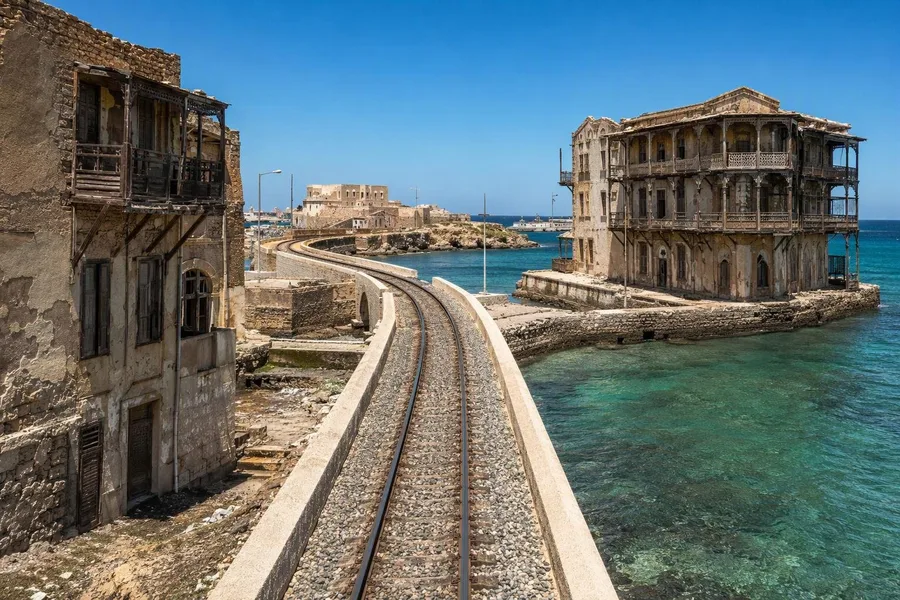 Causeways link Massawa’s islands beside damaged coral-stone buildings and the Red Sea.
Below Ghinda, the track runs through flatter and drier country towards Massawa. Asmara’s high elevation brings milder conditions, while Massawa has a hot desert climate; summer daytime temperatures there reach around 40°C, with sea humidity adding to the heat.
Massawa was a trading port long before the railway or Italian rule. Ottoman authority began in 1557, and the old city developed on the islands of Basé and Taulud, linked by causeways to each other and the mainland. Coral-stone houses with wooden balconies stand among mosques, an Egyptian palace, and Italian-era commercial and administrative buildings.
Italy seized Massawa in 1885 and used it as the colony’s first capital before moving the administration inland. The railway made the port’s connection with Asmara physically direct, but Massawa was never merely a colonial terminus. Its harbour still handles coastal vessels, feeder containers, and cargoes that include grain, cement and building materials.
The city also bears the damage of the 1990 battle for Massawa, when shelling and bombing hit large areas. Damaged buildings remain among intact structures in the old centre. The historical railway ends at this low, hot edge of Eritrea: beyond the island causeways, the Red Sea lies open beside coral walls and scarred balconies.
Keep exploring