
City · Syria
Damascus
Damascus is Syria’s capital, set at the edge of the Barada oasis in the country’s southwest. Its walled Old City preserves a dense sequence of Roman, Umayyad, medieval and Ottoman monuments.
The city in context
Damascus developed where the Barada River reaches the edge of the Syrian desert, below Mount Qasioun. Its position between inland Syria, the Mediterranean routes and the Arabian pilgrimage road made it a commercial and political centre for millennia.
The historic core is a compact, walled district shaped by a Graeco-Roman street grid. Damascus became the capital of the Umayyad Caliphate in 661, and later rulers added citadel walls, religious schools, caravanserais, bathhouses and courtyard houses. The Ancient City has World Heritage status.
Read the Old City on foot
The main east–west line follows the Roman decumanus, now traced by Straight Street and the covered Medhat Pasha Souq. Bab Sharqi marks the eastern end; Bab al-Jabiya lies to the west. The route is useful less as a checklist than as a way to understand the city’s layers: Roman planning remains under an Islamic and Ottoman commercial fabric.
Look for:
- City walls and gates: surviving stretches, especially around the historic perimeter.
- Souqs and khans: market lanes and former merchant inns show Damascus as a working trade city.
- Courtyard architecture: plain street façades often conceal richly detailed interiors, fountains and reception rooms.
Major monuments
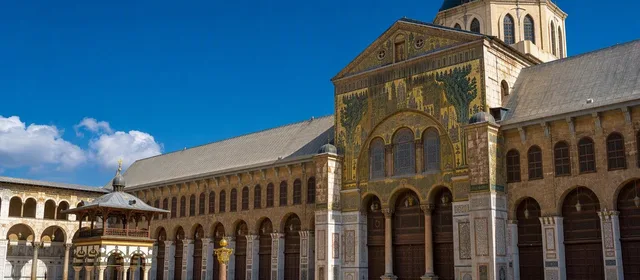
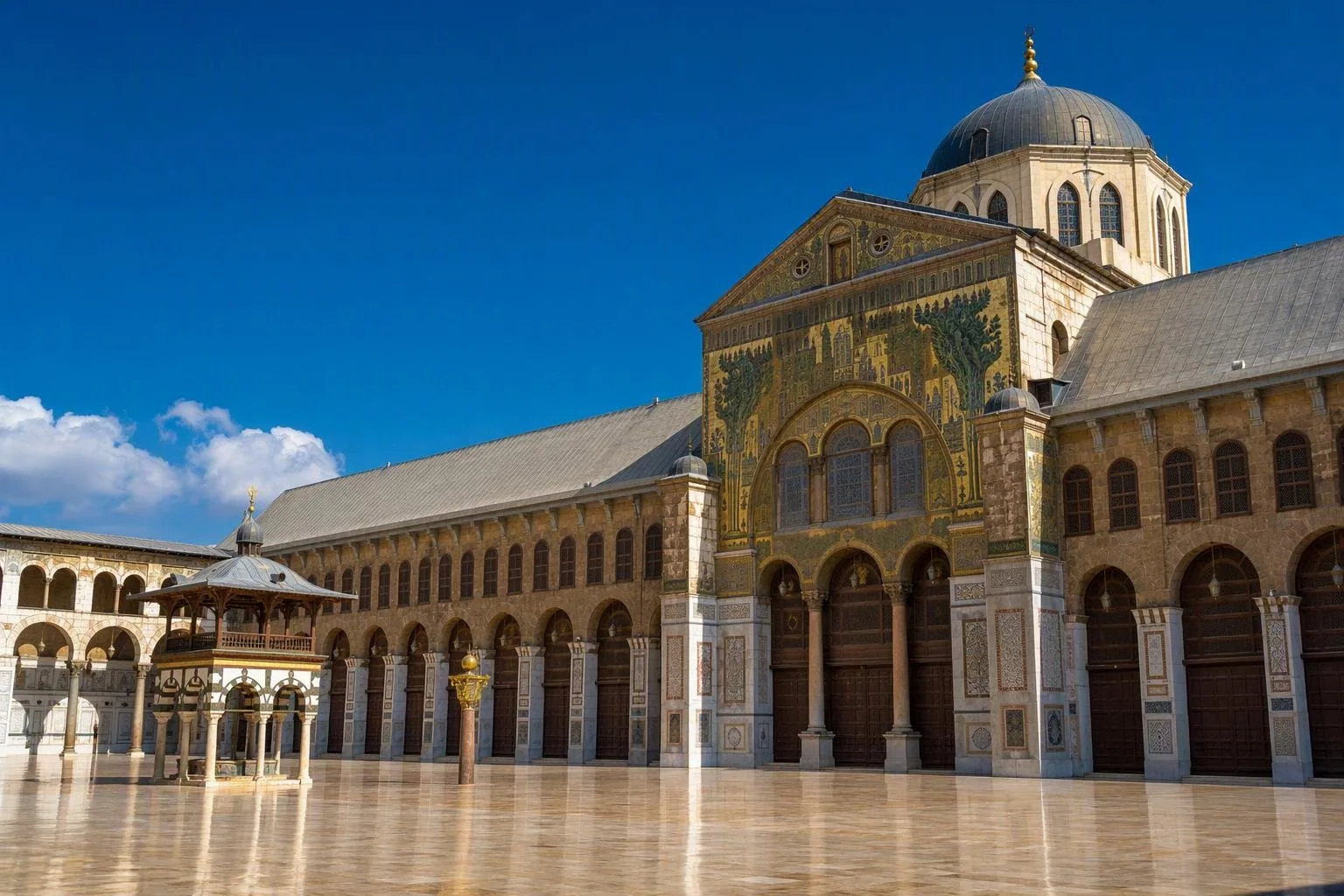
The Umayyad Mosque is the indispensable landmark. Built in the early eighth century on a site that had held an Aramaean sanctuary, a Roman temple and a Christian church, it anchors the old urban plan. Its arcaded courtyard, prayer hall and surviving mosaics make the building the clearest expression of Damascus’s Umayyad period.
Near the mosque, the Citadel of Damascus occupies the Old City’s northwestern corner. The Azm Palace, an 18th-century governor’s residence, demonstrates the Damascene courtyard-house tradition on a grand scale. These monuments belong to a cityscape in which Islamic, Roman, Byzantine and Ottoman traces remain closely interwoven.
Craft and exchange
Medieval Damascus was organized around specialist crafts. The city’s reputation extended beyond textiles and metalwork to luxury glass. Fourteenth-century makers produced enamelled and gilded cobalt-blue glass, including the workshop tradition represented by the Cavour Vase. Such objects connect local kiln skills to court patronage and long-distance trade in materials and motifs.
Current travel reality
This is not presently a leisure-travel destination. Security conditions in Syria are volatile, and major government travel advisories advise against all travel because of armed conflict, terrorism, kidnapping and severe disruption to services and transport. Do not make independent visitor plans for Damascus; access, movement and monument availability can change abruptly.
From the magazine
Stories about Damascus
Editorial stories linked directly to Damascus.
No stories about Damascus have been published yet.
Routes from our editors
Travel through Damascus
Editorial routes connecting Damascus with other countries, cities and hotspots.
No routes through Damascus have been published yet.
More in Syria
Related hotspots
Other cities, nature areas and places within Syria.
There are no other hotspots in Syria yet.