
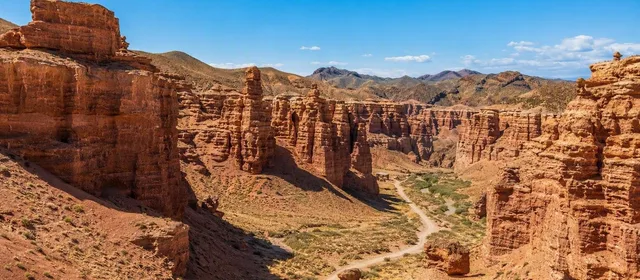
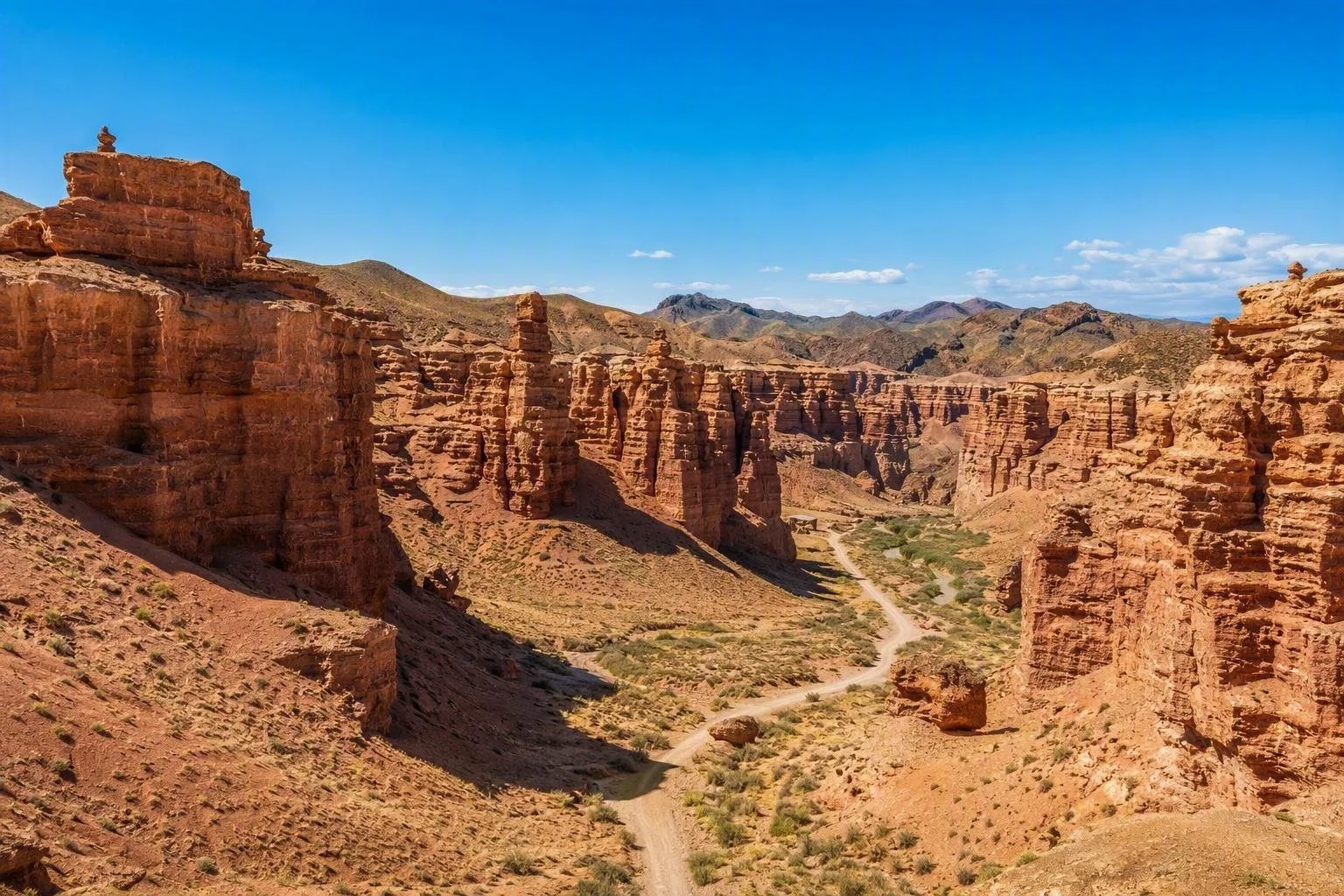
Look beyond Kazakhstan’s big cities and the distances quickly become part of the picture. Roads and railways cross long runs of steppe, then the southeast breaks into deep canyons and high mountains. At Charyn Canyon, the Charyn River cuts below red sandstone walls. In the Valley of Castles, wind and water have left towers of layered rock along the canyon floor. South of Almaty, the snow-covered Tian Shan rise above alpine meadows and Big Almaty Lake.
Almaty makes a good starting point for the southeast. Its leafy streets pass Soviet apartment blocks, contemporary galleries and market stalls stacked with dried fruit, nuts and kurt, the small balls of salted curd eaten across the steppe. On restaurant tables, beshbarmak—noodles topped with boiled meat—appears alongside food from Russian, Uyghur, Korean and Uzbek kitchens.
In Turkistan, the blue-tiled Mausoleum of Khoja Ahmed Yasawi marks an important Muslim pilgrimage site and recalls the rule of Timur. Astana presents another side of the country. After independence, Kazakhstan built its new capital here with broad avenues, government buildings and conspicuous modern towers. Nomadic pastoral life, Silk Road trade, the Russian Empire and the Soviet Union all left traces in daily language, food and architecture. Take time for more than one city, sit down for tea and a proper meal, and Kazakhstan starts to feel less distant.


