Region · Bhutan
Lhuentse
Lhuentse is a remote district in northeastern Bhutan, centred on the Kuri Chhu valley. It is the historic Kurtoe region, known for royal history, fortress-monasteries and Kishuthara weaving.
Orientation
Lhuentse lies in northeastern Bhutan, in the historic region of Kurtoe. The district spreads across steep valleys, forest and mountain roads; its administrative centre is Lhuentse town. This is not a compact town-break destination. Treat it as a deliberate eastern-Bhutan stop, with the road journey and scattered cultural sites forming part of the experience.
Lhuentse is the ancestral home of Bhutan’s Wangchuck dynasty. Its other defining thread is textile craft: the district is widely associated with finely made Kishuthara, a complex silk brocade.
Start at Lhuentse Dzong
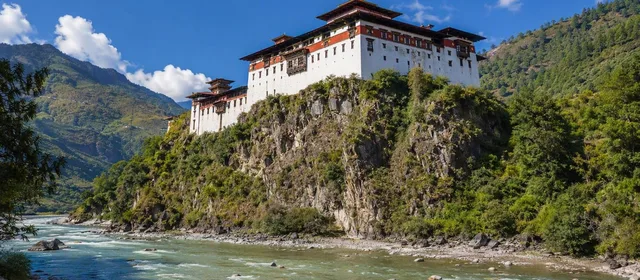
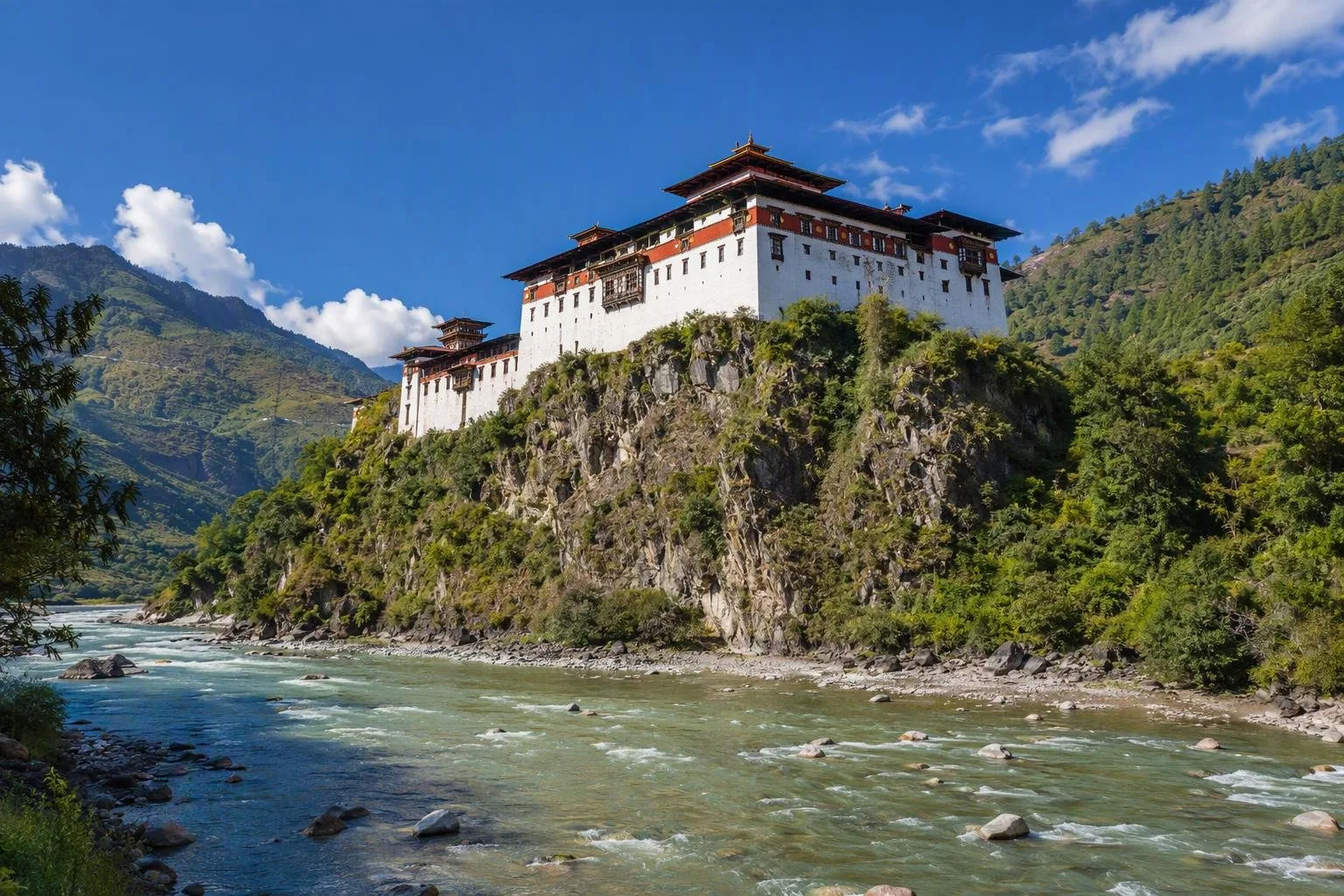
Lhuentse Dzong is the district’s essential landmark. The fortress-monastery occupies a rocky outcrop above the Kuri Chhu and remains both the administrative and religious centre of the district. Its setting is reason enough to stop: whitewashed walls and layered roofs rise above a deeply cut river valley.
The present dzong was built in 1654 on the site of an earlier temple dating to 1552. Give the complex time rather than treating it as a roadside photograph; it provides the clearest introduction to Lhuentse’s religious and political history.
Weaving and village craft
Khoma village is the principal destination for Kishuthara. The intricate woven textiles are a local speciality, and weaving is closely tied to household life. Khoma is reached on foot from the dzong area; allow time for the walk and for the fact that workspaces are homes rather than a formal museum.
For a different craft tradition, go to Gangzur village, above Lhuentse Dzong. Its small community is known for earthen pottery. These two villages make a useful pair: one focuses on loom work and silk brocade, the other on clay and domestic vessels.
Sacred sites beyond town
The hillside Takila Guru Statue looks over the Tangmachu valley. The monument to Guru Padmasambhava is ringed by eight large and 108 smaller chortens, and the ascent passes fields and traditional houses.
Other straightforward additions include Jangchhuling Goenpa, a road-accessible monastery near the dzong, and Kilung Lhakhang, on a ridge above the Kurichhu. Both are quieter than the dzong and help show how religious sites are distributed through the valley rather than concentrated in town.
Getting there and planning time
The road from Mongar to Lhuentse is about 74 km and typically takes around three hours. The distance is modest; mountain-road pace is not. Use a vehicle for the district’s dispersed sights and build in slack for weather and road conditions.
A practical minimum is one overnight: arrive from Mongar, visit the dzong and Khoma, then use the following day for Takila or another valley site. Lhuentse’s eight local administrative areas cover a broad, rugged district, so trying to see every landmark in a single day turns the visit into driving.
From the magazine
Stories about Lhuentse
Editorial stories linked directly to Lhuentse.
No stories about Lhuentse have been published yet.
Routes from our editors
Travel through Lhuentse
Editorial routes connecting Lhuentse with other countries, cities and hotspots.
No routes through Lhuentse have been published yet.
More in Bhutan
Related hotspots
Other cities, nature areas and places within Bhutan.