
Where Lake Victoria’s Catch Comes Ashore at Kigungu
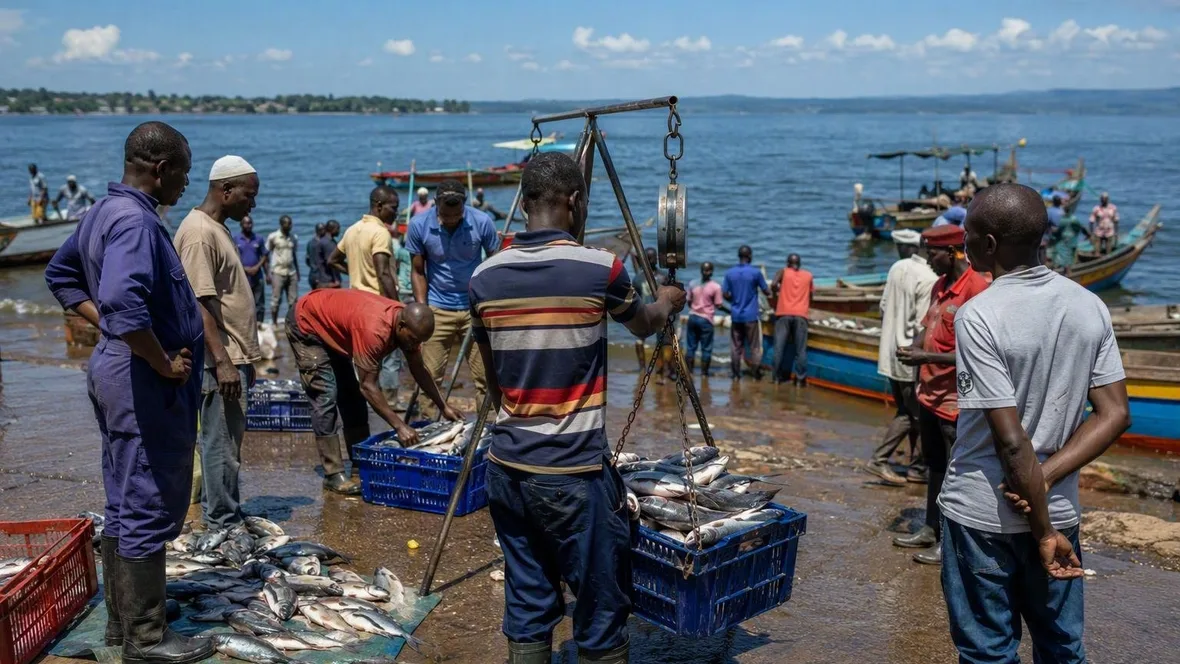
At Kigungu Fish Landing Site, boats from Lake Victoria meet a weighing place where fishers and traders gather around the catch. Fish moves from boat to shore, then into fresh sales or the smoke ovens used by local households.
Between Lake Victoria and the airport
Kigungu Fish Landing Site lies on the southwestern side of Entebbe, on Lake Victoria’s northern shore and close behind Entebbe International Airport. It is both an active fishing ground and a named landing site. Fishing supports much of the surrounding community.
Entebbe Municipality identifies Kigungu as one of its designated fish landing sites and has provided a loading place where fishers can assemble catches. Boats moor at the shore. The work then spreads across a narrow strip of water’s edge, handling area and settlement, where fishers, helpers, processors and traders have distinct jobs.
Lake Victoria is the route that brings the catch to Kigungu. Fishers work on the lake, return by boat and transfer fish to people waiting on land. The water also determines where that transfer can happen. In 2024, high lake levels submerged Kigungu’s usual docking area, and fishers moved their boats onto adjoining land; the flooding also reached local roads, homes and the Catholic church.
That episode shows why Kigungu does not operate like a fixed harbour with an unchanging edge. Its working ground follows the waterline. The lake supplies fish, but a rise in water can move the point where a boat meets the shore.
The airport shapes this waterfront in another, more unusual way. Fish remains and household waste can draw scavenging birds into aircraft flight paths, and clean-up activities have addressed waste around Kigungu. The issue starts with an ordinary consequence of fish work: remains from the catch stay near a densely inhabited lakeshore that sits beside an airport.
From boat to weighing place
Fishers land their boats at the water’s edge, where helpers unload the catch. A report from Kigungu describes a wooden measuring stick used to check fish against minimum size before sale. That simple tool marks one of the checks between the lake and the market.
On 28 April 2025, fishers and traders were documented together at Kigungu’s fish-weighing area. Research also identifies a fish-handling slab on the waterfront, alongside places known as Makusa, Misoli, the church area and a corner near a communications mast. The named points show that the shore contains separate work areas rather than one undifferentiated beach.
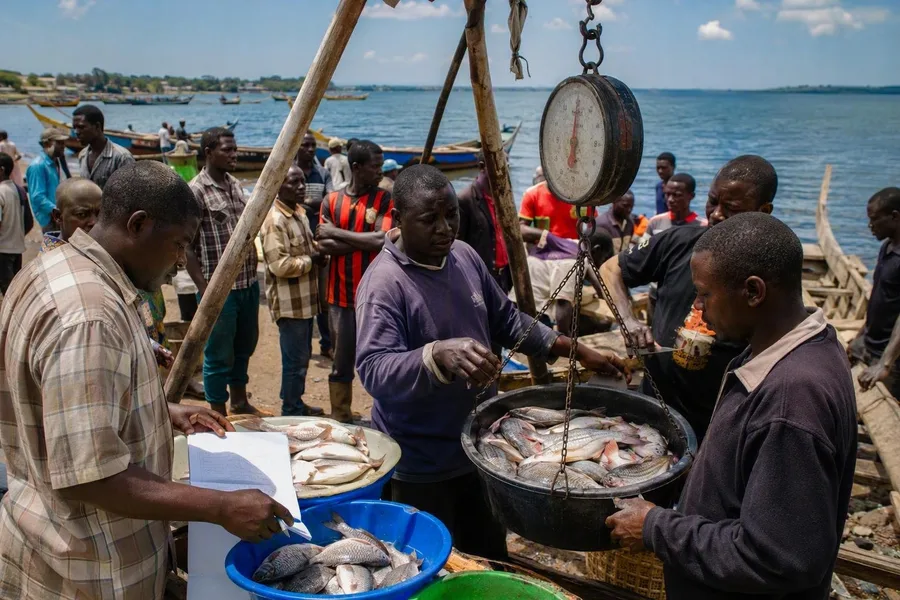 Fishers and traders gather at the fish-weighing area at Kigungu Fish Landing Site.
A FAO visit in 1989 recorded the landing process in detail. Workers registered catches by boat and species, then sorted and counted the fish after landing. Fresh fish moved on to one market, while smoked fish followed another market route. That record does not establish present-day volumes or stall locations, but more recent research still identifies fresh-fish sellers and fish smokers at Kigungu.
The documented chain remains clear. Fish arrives by boat, passes through handling and weighing, then changes hands through fresh sale or processing. Kigungu’s role is concentrated at that short handover from water to land.
Nets, needles and smoke ovens
Landing a catch is only part of the work at Kigungu. Field observations recorded experienced fishers preparing nets and hooks, setting and retrieving nets, and repairing damaged gear. Learners helped with rigging and repairs, gaining skills through work with relatives and other fishers.
The gear repair has a physical precision of its own. Researchers recorded nylon and braiding needles used to mend a cast net at the landing site. Nets and hooks therefore connect the shore to the lake long before a boat returns with fish.
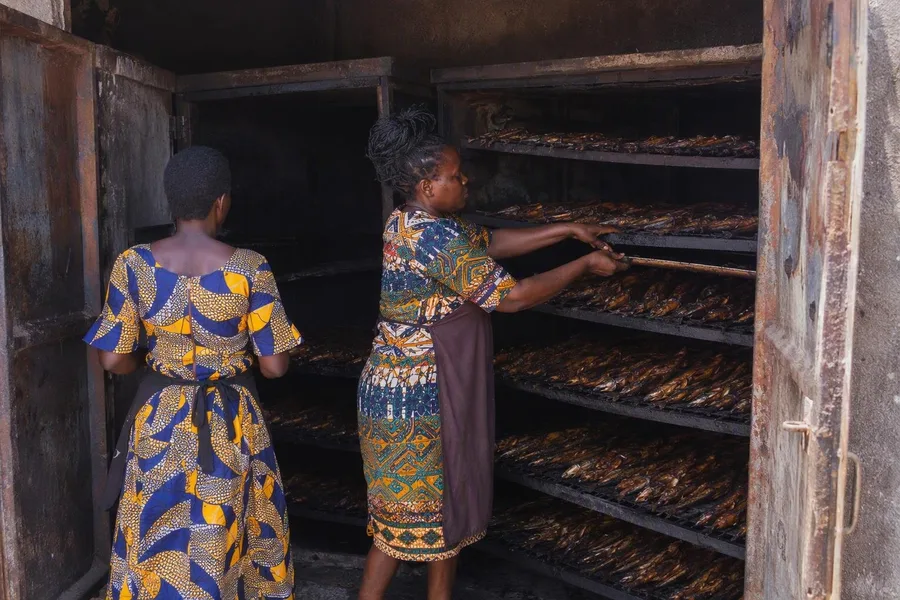 Women smoke fish in an enclosed oven at Kigungu Fish Landing Site.
Women carry much of the documented work after landing. Every woman interviewed in one Kigungu study processed fish in at least one way; the group included fresh-fish sellers and fish smokers. A later study also recorded fishers’ wives smoking fish at Kigungu. The same research describes fishing on the water as predominantly men’s work, while women processed and sold fish, ran eating places and helped prepare fishing gear ashore.
Smoking is Kigungu’s clearest confirmed preservation method. Two enclosed, improved smoking ovens served more than 50 households. They used less firewood than older methods, and their roofs protected fish from rain and theft while smoking took place. Households sold smoked fish locally, with some fish also entering markets beyond Uganda.
The evidence does not confirm active cooling at the landing site. An ice-block and fish-processing plant proposed in 2019 had not been shown to be operating there. It is more accurate to describe Kigungu as a place of landing, fresh sale, smoking and onward trade than to picture cold rooms or an industrial processing plant.
A lakeshore with older arrivals
Local tradition traces Kigungu’s name to a tree where fishers hung fish to dry while waiting for buyers. The story cannot map the present shore, but it links fish preservation and sale to local memory.
The same waterfront also holds a Catholic landmark. French missionaries Siméon Lourdel, known as Mapeera, and Brother Amans arrived there by water on 17 February 1879. A monument and church stand near the landing place, and pilgrims gather annually on 17 February to mark that arrival.
The church and memorial do not replace the fish work. They stand near a shore where boats continue to land and fish continues to pass through hands, weighing and processing. Lake Victoria connects both histories through the practical fact of arrival by water.
A short, respectful visit
Kigungu is a residential fishing community, not a managed visitor attraction. No current official visiting hours or entrance fee are published, and the landing site appeared on an official 2006 list as private. A taxi or pre-arranged car from Entebbe is the most realistic way to reach it; reporting described the access road as poor in 2024. Ask permission before entering work areas, approaching boats or photographing people.
At Kigungu, the last movement is always physical. A boat reaches the Lake Victoria shore, helpers unload the catch, and fish crosses the wet edge to the weighing place on land.