
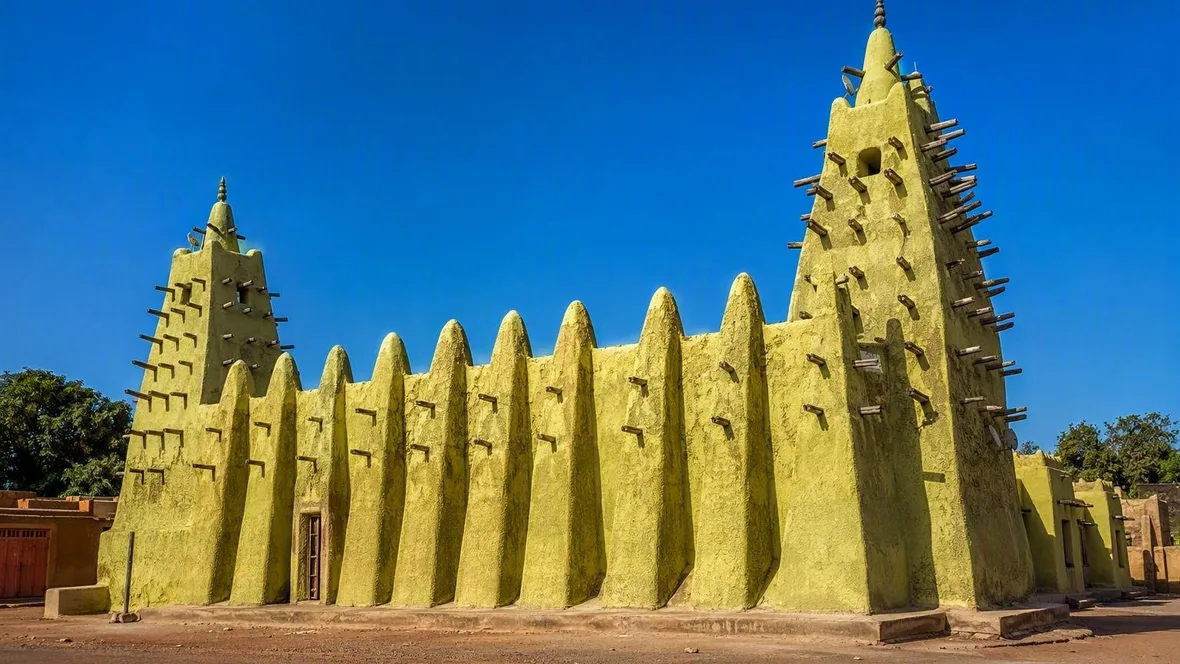
Sya, the Old Heart of Bobo-Dioulasso
Bobo-Dioulasso grew around Sya, but the old settlement remains a lived-in part of the city between the Houet and Sanyo watercourses. Its earthen mosque, family compounds and workshops place worship, domestic life and skilled work within the same close-built neighbourhood.
The city grew beyond Sya
Sya predates the name Bobo-Dioulasso. Oral traditions give several accounts of its foundation, while historical and linguistic research identifies an early Bobo farming settlement that existed before Dioula communities arrived. The settlement stood on raised ground between two watercourses and may have included more than one village from an early stage.
The old core still carries that layered history. It includes Kibidoué, Tiguisso and a Bobo-Dioula community, shaped by families and linked residential compounds rather than one founding village. Dioulassoba, another name for the old quarter, refers to the connection between Bobo and Dioula communities that helped form the city.
Sya lay between savanna country and forested lands farther south. Long-distance trade, links with Kong, and the spread of the Dioula language and Islam brought merchants and political connections to the settlement. In the eighteenth century, Dioula from Kong settled among Bobo, Tiéfo, Komono, Viéwon and other groups already living in the area. Alliances, marriages and political ties joined these communities, and Sya became the capital of Gwiriko.
French forces conquered Gwiriko in 1897. The colonial administration adopted the name Bobo-Dioulasso in 1904, then developed administrative, transport and commercial districts outside the older settlement. Sya did not turn into an abandoned remnant. Homes, a school, customary institutions and places of work remain within its historic fabric.
That location changes how the quarter reads. Sya is not an old town beyond modern Bobo-Dioulasso. Streets from the larger city run straight into low earthen buildings, later cement blocks and corrugated-metal roofs standing close together.
The Great Mosque at Sya’s edge
The Great Mosque of Bobo-Dioulasso, also called the old mosque of Dioulassoba, stands at the edge of Sya. Sources disagree on the precise year of construction, but the most secure dating places it in the second half of the nineteenth century.
Builders made the rectangular mosque from banco, or earthen brick, and finished its walls with a pale lime coating. Wooden toron project from the exterior, while horizontal yiri reinforce the structure. The projecting timbers also give builders footholds when they repair the earthen plaster.
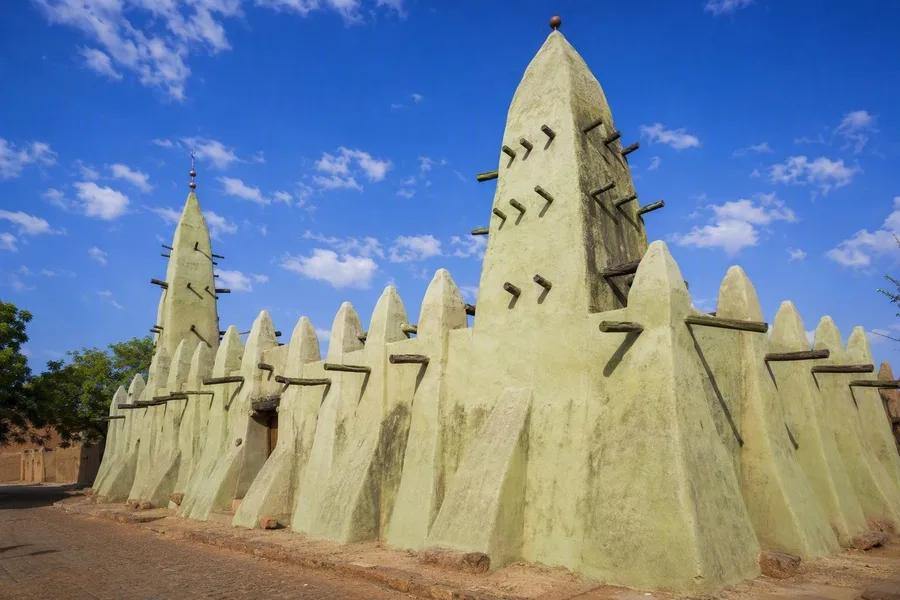 The Great Mosque’s earthen walls and projecting timbers stand at the edge of Sya.
The mosque uses the same broad family of materials as the compounds nearby, at a larger scale. Buttresses break the outer walls into deep vertical bays. Two towers mark the building: one stands beside the mihrab and qibla on the eastern front, and the northern tower serves as the minaret. Heavy rectangular pillars carry the flat roof over the prayer hall, while a courtyard occupies the western side.
The building remains a functioning mosque, not a monument reserved for visitors. Its maintenance depends on specialist knowledge of earth, plaster and structural timber. The same beams that give the exterior its distinctive profile also support that work.
Practicalities. Sya is an inhabited district with no confirmed entrance gate, ticket or general visiting schedule. The mosque generally receives visitors outside prayer times, though access to parts of the complex can change and Friday is less predictable. No current official hours, fee or advance-booking system is reliably published. Ask the custodian or an available local guide about access and any charge on arrival. Cover shoulders and knees, remove shoes before entering the prayer hall, and ask before photographing people or interior details. Private compounds and culturally significant rooms in Sya are not automatically open to visitors; entry depends on permission from those responsible.
Compounds behind the mosque
The houses give Sya its density. Historically, builders joined earthen rooms into large compounds around the homes of founding families and lineage elders. Streets cut between tightly packed blocks, while flat earth terraces once connected so extensively that people could cross the settlement by roof.
From public streets, the construction remains legible. Earthen walls form low rectangular volumes, and wooden poles and beams support roof terraces. Sya does not present one untouched building style. Families have replaced or supplemented parts of the earth construction with dressed stone, cement blocks and corrugated metal, while some important lineage houses receive repairs in traditional materials.
These compounds hold more than rooms. Sya’s three communities are associated with eighteen household hearths, each with a maison mère, the house of a founder or senior lineage figure. Family responsibilities and social or ritual meanings remain attached to these buildings. Courtyards and significant interior spaces therefore belong first to the people who use them.
Public and domestic functions stand close together. Wara-Wara, an open space beside the residential compounds, now contains a primary school. Sya also has a reception space for the canton chief. The short distances between houses, school and reception space show that the quarter still serves daily city life.
Metalwork among the homes
Smiths and bronze casters work in the part of Dioulassoba associated with metalworkers and griots. They make agricultural tools, bronze objects and musical instruments, with workshops set among living compounds rather than in a separate industrial zone.
Bronze working elsewhere in Bobo-Dioulasso follows a similar domestic arrangement. A documented workshop in an old residential neighbourhood combines home and workplace, using wax, charcoal and collected metal supplied through urban and rural trading networks. Its makers supply local customers as well as buyers farther away.
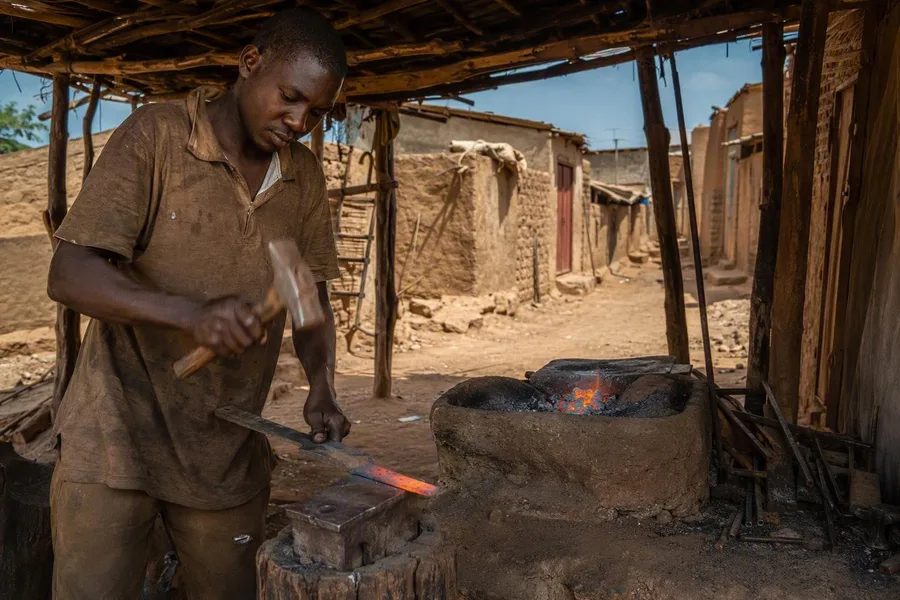 A smith works on an agricultural tool among residential compounds in Dioulassoba.
Earth building also remains a working skill. Repairs to the mosque call for knowledge of banco, plaster and timber, so maintenance keeps those trades in use without turning them into a demonstration. A compound wall and a mosque buttress differ sharply in scale, but both depend on earth, wood and regular repair.
The trade links continue beyond Sya. In Tounouma, the historic centre of Koko dunda production, dyers fold and tie cloth before repeatedly immersing it in dye baths. Tailors make the fabric into clothing, bags, shoes and household textiles, and workshops often combine production with sales. The Village artisanal brings makers and sellers together around textiles, leather, jewellery and bronze.
In Dioulassoba’s metalworkers’ quarter, those larger urban circuits narrow again. Earthen walls and roof timbers enclose courtyards where workshops stand between the homes, and smiths and bronze casters make tools, instruments and cast objects within Sya’s inhabited streets.