
Stone in the Harare Light
In central Harare, the National Gallery traces the institutional roots of Zimbabwe’s modern stone sculpture. In Msasa, Chapungu Sculpture Park places figures, animals and abstract forms among indigenous trees while sculptors continue to work on the grounds.
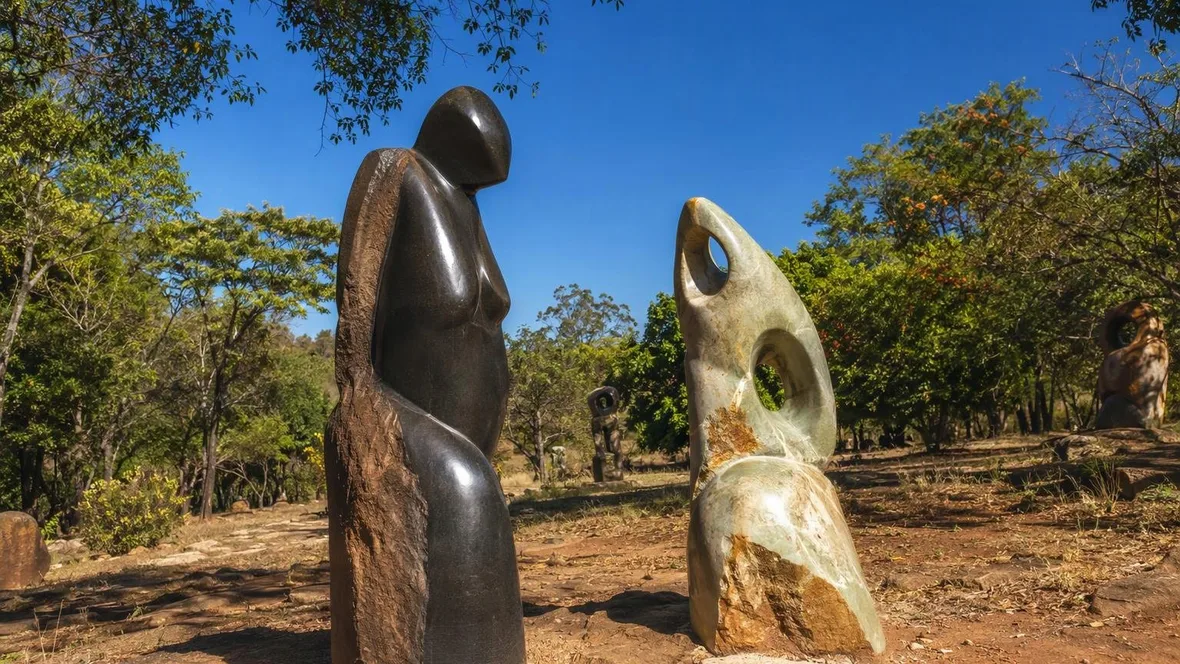
A block of springstone can hold two distinct surfaces. A sculptor may polish its dense black interior to a deep sheen, then leave part of the softer reddish-brown outer skin untouched. That contrast between cut stone and its original crust provides a useful way into Harare’s galleries and sculpture gardens.
Harare played a central part in the rise of modern Zimbabwean stone sculpture. The National Gallery gave early artists workspace, materials and access to exhibitions, while Chapungu later brought work by several generations together and established studios where sculptors still make pieces for sale.
The National Gallery’s workshop legacy
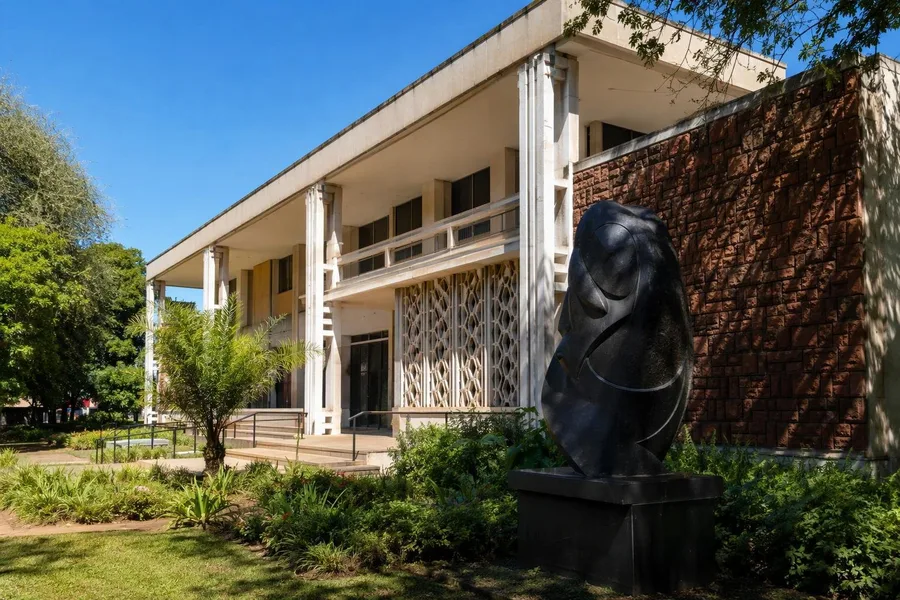 The National Gallery of Zimbabwe stands beside Harare Gardens in central Harare.
The National Gallery of Zimbabwe opened in 1957, when Harare was still called Salisbury. Its first director, Frank McEwen, started a small workshop for painters. During the 1960s it became the Workshop School for painters and sculptors.
The school offered artists a practical foothold: space to work, materials, criticism, exhibitions and sales. McEwen did not follow a conventional academic syllabus. He encouraged artists to develop forms and subjects from their own lives and ideas.
Joram Mariga had already experimented with harder stone and a personal sculptural language, helping shift attention beyond the small soapstone carvings often made for tourists in the 1950s. Henry Munyaradzi emerged as one of the Workshop School’s best-known early artists. His compact sculptures can combine human, bird and insect forms through rounded volumes, sharp cuts and minimal faces.
McEwen mattered greatly, but he did not invent the art form or hand artists a finished tradition. Local carving, mission education, artists’ networks, colonial institutions and international art circuits all shaped its development. The stone buildings and carved birds of Great Zimbabwe also offered an important cultural reference.
The gallery helped Workshop School works reach buyers and museums abroad. In 1968, the travelling exhibition New African Art: The Central African Workshop School opened in the United States and presented works for sale. The exposure created opportunities, but foreign catalogues and galleries also grouped very different artists under one label.
That makes the familiar term “Shona sculpture” useful but incomplete. Many artists draw on Shona family ties, ancestral beliefs, stories and relationships with animals. Not every artist placed under the label is Shona, however, or even Zimbabwean. The term works best as shorthand for a broad modern Zimbabwean practice, with close attention to individual makers.
The National Gallery’s displays change, and its public programme does not provide a permanent room-by-room list of stone sculptures. The building still matters because the gallery and its current art school continue the institution from which the Workshop School grew. Contemporary artists also work beyond an established stone vocabulary. Gideon Gomo mainly uses hard, dark springstone, but he combines it with metal, copper sheet, wood and found objects.
What the stone contributes
Most stones associated with Zimbabwean sculpture come from the Great Dyke, a mineral belt running through the country. Serpentine varieties range from yellow and green to brown and black, while iron can leave weathered sections rust-coloured.
Springstone ranks among the hardest and darkest materials. Its fine grain allows crisp detail and an almost mirror-black polish. Opal stone is a pale serpentine rather than precious opal. It is softer and may be milky green, marked with brown, orange, red or blue, so sculptors often use it for smoother, flowing volumes.
Fruit serpentine carries deep multicoloured layers and veins. Cobalt stone can run purple and green with yellow, white or brown-orange streaks; verdite has green swirls; dolomite is crystalline; leopard rock is hard and yellow-black speckled. Polishing exposes these veins, spots and colour fields, which can become part of a torso, face or abstract form.
Material changes the work at every stage. Dense springstone holds sharp contours, while softer opal stone allows gentler modelling. At Chapungu, Luke Saidi has worked in springstone, opal stone, lemon opal and verdite. Benjamin Katiyo uses springstone, verdite and dolomite, setting polished areas against textured ones.
Chapungu among trees and studios
Chapungu Sculpture Park lies in Msasa, beyond central Harare. It began as a small gallery in 1970 and developed into an open-air collection; works that did not sell remained on site, preserving sculpture by several generations.
The entrance path passes beneath a tree canopy known as “the cathedral.” More than 90 species of indigenous trees grow around the sculptures, and a tributary of the Mukuvisi River crosses the grounds. Visitors can walk around larger works rather than meet them against a white gallery wall. Changing daylight brings out different contrasts between polished and rough stone.
The permanent collection includes Nicholas Mukomberanwa, Henry Munyaradzi, Sylvester Mubayi, Joseph Ndandarika, Boira Mteki, Bernard Matemera and John Takawira, as well as early artists from the Tengenenge community. Since 2014, sculptors have also worked on the grounds and made pieces for sale. They include Nhamo Chamutsa, Nicholas Kadzungura, Benjamin Katiyo, Brian Nyanhongo and members of the Saidi family.
The subjects move between spiritual reference and ordinary work. Leo Berekai carves women caring for children, collecting wood and sorting seeds, as well as drummers, hunters and groups sitting together. Chamutsa’s Birds in Flight studies the movement of wild birds. Gift Tembo’s Bride uses a woman’s posture to evoke a wedding.
Family groups and ancestral figures recur in Zimbabwean sculpture, but they do not carry a single fixed meaning. Some mother-and-child forms link kinship and fertility with the Shona idea of mwana vevhu, a child of the earth. Other artists use openings, hybrid bodies, or human and animal forms when addressing spirits and transformation. A bird may refer to cultural belief, close observation or simply the challenge of making solid stone suggest flight.
Practical details
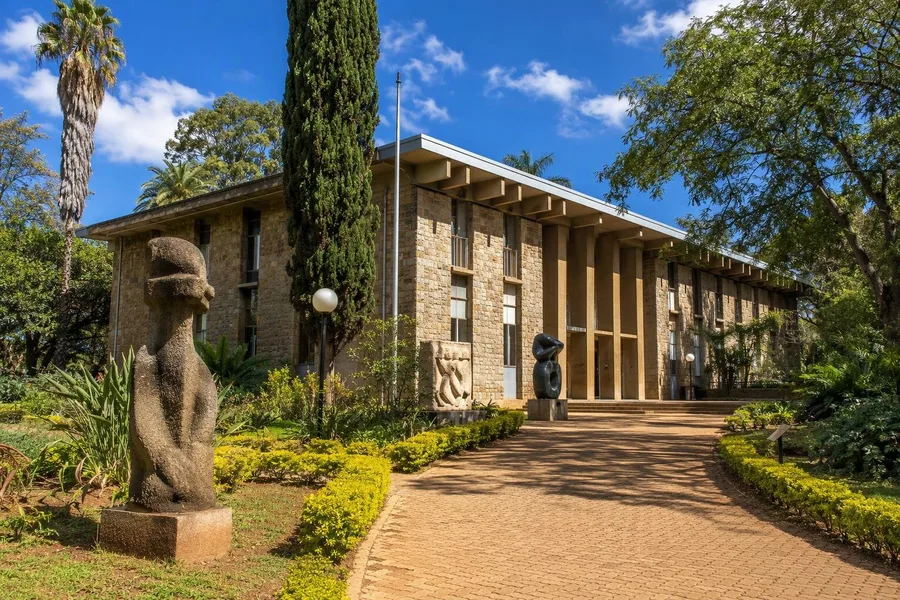 The National Gallery of Zimbabwe stands beside Harare Gardens in central Harare.
The National Gallery stands at 20 Julius Nyerere Way beside Harare Gardens. It opens daily from 9am to 4.30pm except on public holidays; international adult admission is US$15, and groups larger than 12 need to reserve ahead. The gallery is walkable from the central business district and local minibuses serve the area. Chapungu is at 1 Harrow Road in Msasa, about a 10-minute drive from central Harare, and is best reached by taxi or a prearranged car. It opens Monday to Friday from 9am to 4.30pm, Saturday from 9am to 1pm and Sunday by appointment. Chapungu does not publish a regular admission price, so confirm the fee and any tour arrangements before travelling.
Near Chapungu’s main gallery, Tembo’s Bride returns the eye to the human body. Trees and open sky stand behind the figure instead of an exhibition wall. Daylight crosses its worked surface, catching polish, texture and the posture held in stone.