
Dosa, filter coffee and the streets of Basavanagudi
A thick, crisp dosa at Gandhi Bazaar leads into a Bengaluru neighbourhood of flower stalls, old tiffin rooms and quick coffee stops. Follow DVG Road towards the Bull Temple and breakfast becomes a close look at how Basavanagudi works.
Basavanagudi takes its name from Dodda Basavana Gudi, the Bull Temple: basava means bull and gudi means temple. The shrine stood on its rocky rise long before the streets below became a Bengaluru neighbourhood. That order still matters. Temple offerings, market shopping and breakfast counters occupy the same short stretch of city.
The residential district grew after the plague outbreaks of the 1890s as a planned extension with houses set farther apart for air and ventilation. Its 1898 layout made room for homes, open space, schools, religious sites and daily provisions. Broad diagonal roads and circles extend from what is now M.N. Krishna Rao Park, while older houses, temples and shops share the blocks around them. Basavanagudi does not read as one long commercial strip. It opens and tightens between residential streets, market trade and tiffin rooms.
Gandhi Bazaar and Vidyarthi Bhavan
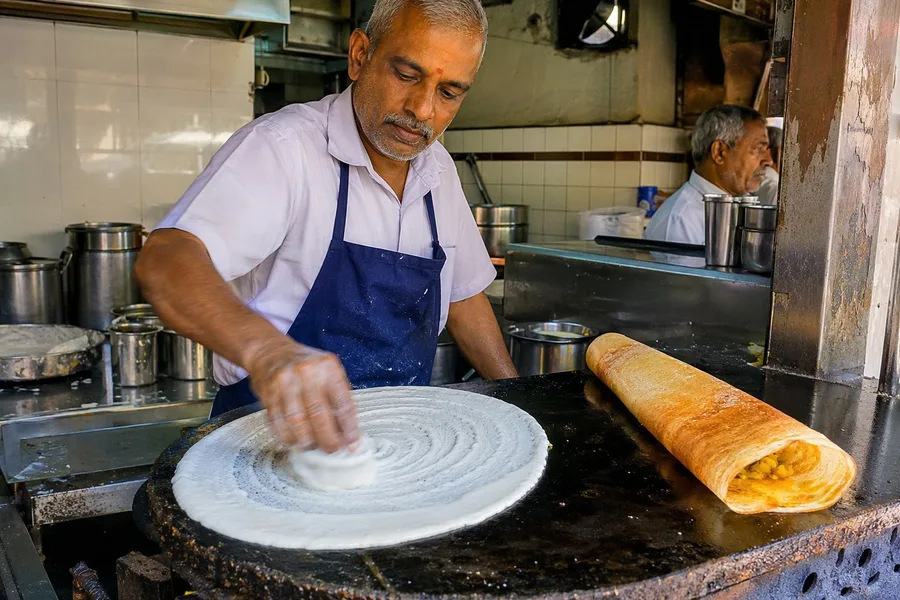 A cook prepares a thick golden benne masala dosa at Vidyarthi Bhavan on Gandhi Bazaar Main Road.
A useful breakfast route starts at Mavalli Tiffin Rooms on Lalbagh Road, just beyond Basavanagudi. MTR occupies an art-deco building from 1959, with a through-kitchen that keeps food moving through the dining room. From there, the walk runs towards Gandhi Bazaar and Vidyarthi Bhavan at No. 32 on Gandhi Bazaar Main Road.
Gandhi Bazaar began as a residential road in planned Basavanagudi. Residents gradually gave their front rooms to shops, creating the bazaar structure visible today. Formal storefronts and pavement stalls line a broad road shaded by large rain trees. Flower sellers work beside fruit and vegetable vendors. Shops stock coconuts, incense, turmeric, rice powder and oil lamps for puja.
The goods serve ordinary errands as well as worship. Gandhi Bazaar also sells banana leaves, spices, sandalwood and groceries, while modern supermarkets stand among shops for ritual supplies. The neighbourhood’s food addresses belong in this trade rather than apart from it.
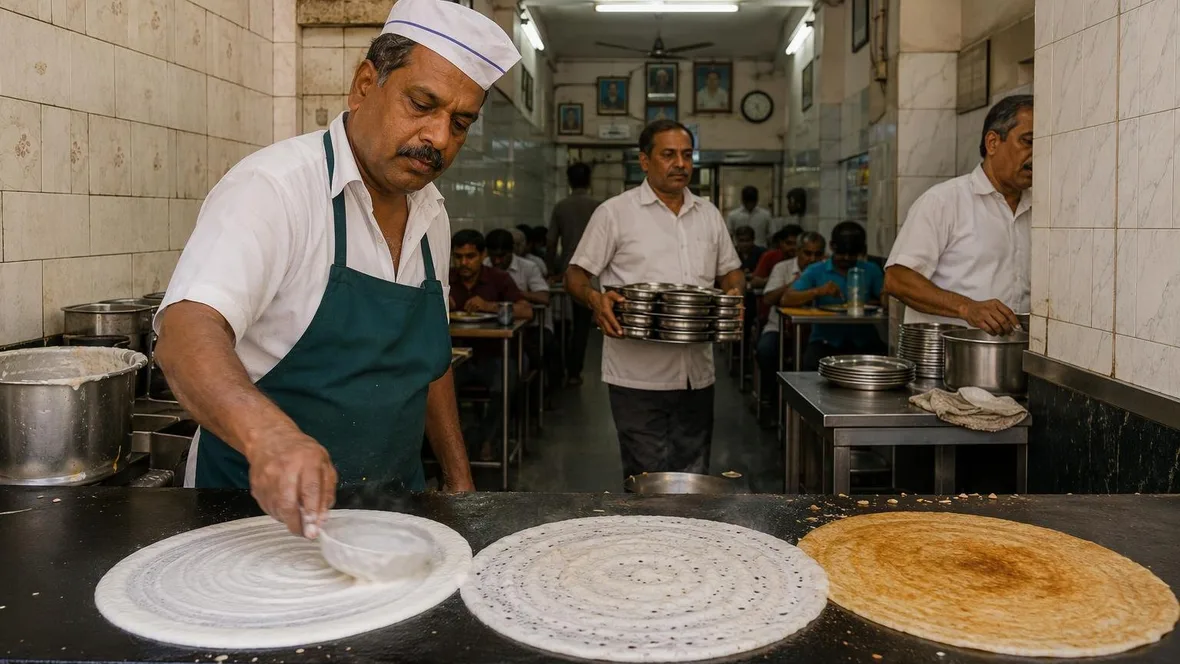
Vidyarthi Bhavan has served Gandhi Bazaar since 1943, when it opened for students. Its signature is the benne masala dose, made with urad dal, red rice and fenugreek. A cook spreads the fermented batter on a hot, greased tawa. The underside turns golden and crisp as it cooks. At Vidyarthi Bhavan, the dosa remains thicker than the paper-thin version many visitors expect, with a firm crust, a softer middle, potato palya and coconut chutney.
The room is narrow, with pastel walls, chequered tiles and portraits. Staff carry high stacks of plates between the tables, and people waiting for a seat give their names outside. It is a sit-down tiffin house, but nobody mistakes it for a languid café.
DVG Road: tiffin at two speeds
DVG Road cuts through Gandhi Bazaar from Nettakallappa Circle to North Road. The street commemorates Kannada writer and philosopher D.V. Gundappa. Vegetable carts, flower sellers, household-goods shops and tiffin rooms pack the road more tightly than the surrounding residential lanes.
The darshini suits this part of the neighbourhood. This Bengaluru format emerged in 1983 with a short menu, self-service, standing tables and fast turnover instead of a long meal at a table. Upahara Darshini on DVG Road was an early example. An idli and coffee can fit between market purchases or a temple errand.
Mahalakshmi Tiffin Room, on the extended DVG Road near Gandhi Bazaar, keeps another tempo. Its weathered sign still carries the year 1926. Inside, wooden furniture, marble-topped benches and a chequered floor mark it as a seated tiffin restaurant rather than a darshini counter. The menu includes sagu masala dosa, masala dosa and akki-rave idli with sambar and chutney.
These places differ in pace, not in their place in the street. Basavanagudi’s planned residential fabric left room for daily trade, and DVG Road has become one of the routes where that trade concentrates.
Coffee, idli and chutney on Ranga Rao Road
From DVG Road, Ranga Rao Road leads towards Brahmins’ Coffee Bar near Shankar Math. The café began in 1965 with coffee and snacks; khara bath joined the menu in 1970. The offering remains deliberately brief: idli, vada, khara bath, kesari bath, filter coffee and the house coconut chutney. Sambar is notably absent.
Queues often extend into the street during the early hours. The food comes quickly. Staff serve generous spoonfuls of chutney and pour strong Chikmagalur coffee between metal vessels.
South Indian filter coffee begins in a two-part metal filter. Fine coffee sits under a pressure disc in the perforated upper chamber, while hot water drips through into the lower chamber as a dark decoction. Hot milk and sugar turn that concentrate into coffee, served in a steel tumbler set inside a broad, shallow dabarah. The small metal pair carries heat well and replaces the porcelain cup with a form closely associated with this style of coffee.
Practical details for the breakfast walk
Vidyarthi Bhavan closes Friday; it opens Monday to Thursday 6.30–11.30am and 2–8pm, and weekends 6.30am–noon and 2.30–8pm. Expect about ₹150 for two; cash, UPI and cards are accepted, and staff take names for benches at busy times. Brahmins’ Coffee Bar opens Monday to Saturday 6am–noon and 3–7pm, closes Sunday, costs roughly ₹100 for two and has very limited seating; cash is useful. MTR closes Monday; from Tuesday to Friday it opens 6.30–11am and 12.30–8.30pm, while weekend service runs until 9.30pm. Meals cost about ₹200–400 per person, and cards are accepted.
The Bull Temple above the breakfast streets
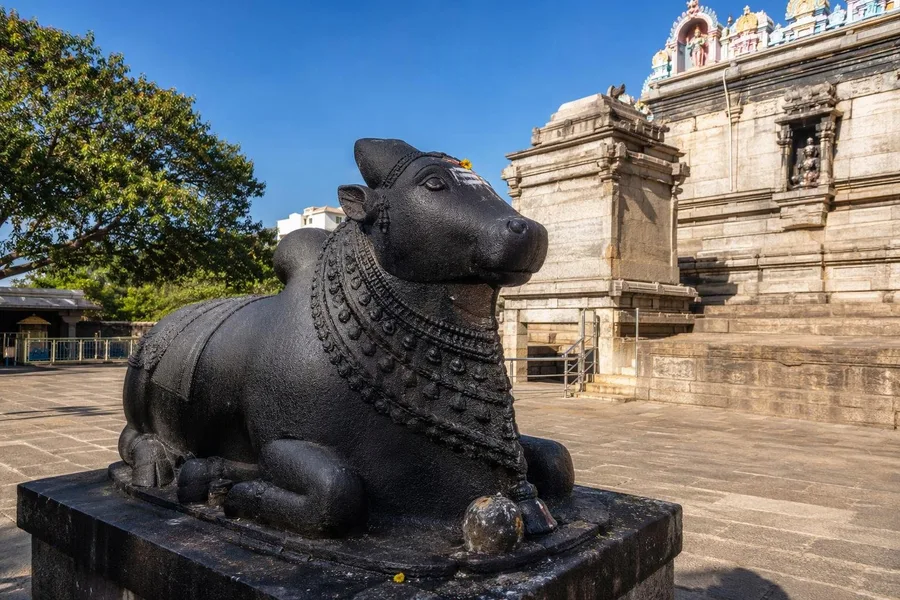 The oil-darkened granite Nandi stands in the open courtyard of Bengaluru’s Bull Temple.
The final stretch runs southwest towards Dodda Basavana Gudi on the Bugle Rock rise. Builders completed the temple in 1537 in a Dravidian form associated with the Vijayanagara tradition. At its centre stands Nandi, Shiva’s vehicle, carved from a single block of granite.
The temple also explains an older link between ritual and trade. During Kadalekai Parishe, Basavanagudi’s annual groundnut fair, vendors pile groundnuts around the Bull Temple, nearby Dodda Ganapathi Temple and Bugle Rock Park. The fair recalls the local tradition of offering the first groundnut harvest to Nandi.
The open courtyard ends at the heavy granite temple mass. Repeated offerings of coconut oil have darkened the once-grey Nandi to a deep black. The stone bull fills the final approach.