
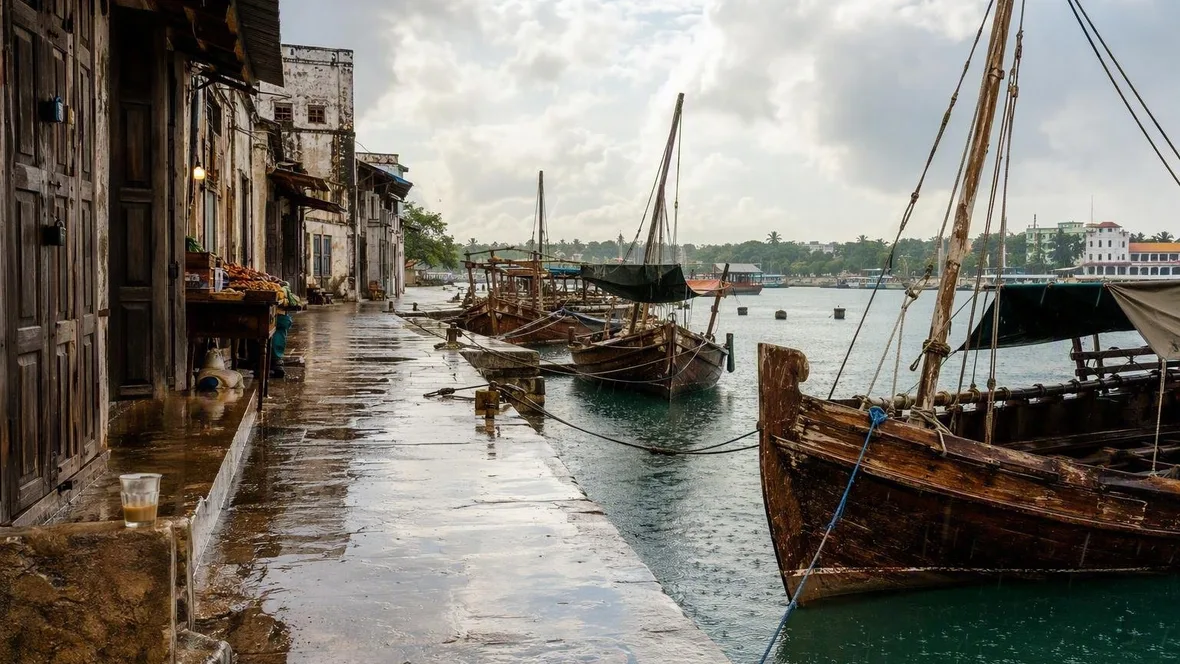
Rain Runs Down to Stone Town’s Dhow Harbour
A hard shower redraws a short stretch of Stone Town. Under Darajani’s roof, trade holds its ground; beyond it, Market Street and Kiponda Street narrow into wet stone, dark doors and shallow running water before the lanes open at the dhow harbour.
Rain first gathers people and goods beneath Darajani Bazaar’s corrugated roof. Fruit and vegetables stay heaped in the covered market hall, while spices fill the passages behind the produce stalls. Hands point, weigh and exchange. The business does not stop. It shifts a few paces inward, away from the water falling beyond the market’s edge.
Around the bazaar, bread sellers park bicycles with baskets and arrange the loaves in pyramids. Dates, clothes, sandals and kitchen goods sit at nearby stalls. Small dukas keep tins and dry provisions behind narrow openings that face the street. Rain shortens the space between seller, goods and pavement. A shop threshold becomes the line between a dry stack of cans and water moving through the lane.
Tea provides a small pause in that work. Stone Town stalls pour strong, sweet spiced chai into small glasses. Steam gathers above the drink and clouds the glass for a moment. Outside the awning, the shower taps on metal and runs along the street.
Darajani gives shoppers a largely dry way past its produce stalls. At its edge, feet move closer to walls, thresholds and the low masonry baraza that runs along many façades. These raised platforms serve as steps, seats and trading places. During rain, they also keep shoes above the thin flow that finds the uneven floor of the lane.
Market Street carries that movement northwest. Pale walls stand close together, broken by shop openings and wooden doors. Builders used coral stone set in thick mortar of lime, earth and sand, then covered the walls with lime plaster or whitewash. Where the surface has worn away, irregular stone and old joints show through.
Water changes the wall without disguising it. Stone Town’s coral stone and lime mortar absorb moisture, and weathered render and joints can powder, flake and lose their surface. Rain darkens the worn sections first. It settles in a chipped edge, follows a line of mortar, then drops from a sill to the pavement.
 A view of Rain Runs Down to Stone Town’s Dhow Harbour.
The street does not need a broad drain to direct the walk. Water follows low seams in the narrow, bending lanes, while pedestrians use the wall edge, a doorstep or a baraza to skirt the deeper patches. One stretch of stone stays almost dry. The next holds a film of water and takes a careful step.
Dark carved doors sharpen against the limewashed walls. Some bazaar shops use Gujarati four-panel doors that open across the full width of the trading space, placing goods and hands directly at the street. The rain deepens the timber’s surface. Carved borders and geometric patterns hold beads of water while a seller works from the shelter behind the frame.
Those doors carry a visible trace of the harbour nearby. In the eighteenth and nineteenth centuries, wealthy merchants and rulers commissioned costly hardwood doors, often from timber brought across the Indian Ocean; the carving displayed wealth and skilled labour. Here, that history sits at shoulder height beside a wet doorstep, not behind glass.
Kiponda Street continues northwest from Market Street, then feeds into the short, crooked lanes on Stone Town’s Malindi side. Houses and courtyards press close. The passages formed between clusters built by different migrant communities in the old trading town.
The rain fixes attention on surfaces. Coral stone wears softly. Lime mortar takes up water. Mangrove timber forms part of many historic houses alongside stone and mortar. Plaster, wood and masonry meet within arm’s reach, each with a different wet sheen and each marked by use.
Stone Town stands on a coral peninsula beside a natural harbour that sheltered fishing boats and linked Zanzibar to the African mainland. The compact streets behind Darajani grew with that waterfront trade. Shop rooms faced the bazaar streets, living quarters stood behind them, and the route from goods to harbour ran through the same dense blocks.
 A view of Rain Runs Down to Stone Town’s Dhow Harbour.
At Malindi, the close walls finally fall away. The northern harbour zone opens beyond the last bends of the lane. The view extends across working water rather than stopping at another pale wall or dark doorway.
The fish market keeps the shore busy. Raised voices cross its wet floor, and a dense fish smell hangs over the trade. Tuna, kingfish, barracuda, grouper, red snapper, octopus, squid and shellfish move quickly through the market. Here the wet ground comes from more than the weather. Fish, ice, washing and rain leave their separate marks on the same floor.
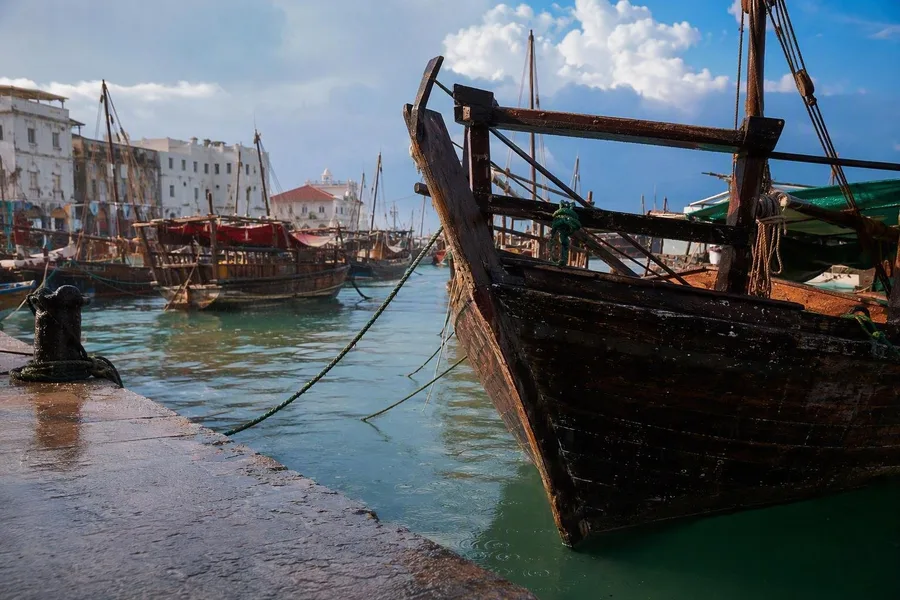
Traditional wooden cargo dhows lie offshore with other vessels. They still carry goods between Zanzibar’s islands and the Tanzanian mainland. Their presence gives the nearby market streets a practical scale. Food, cloth, spices and household supplies pass through small shopfronts, market aisles and port connections that have long shared this corner of Stone Town.
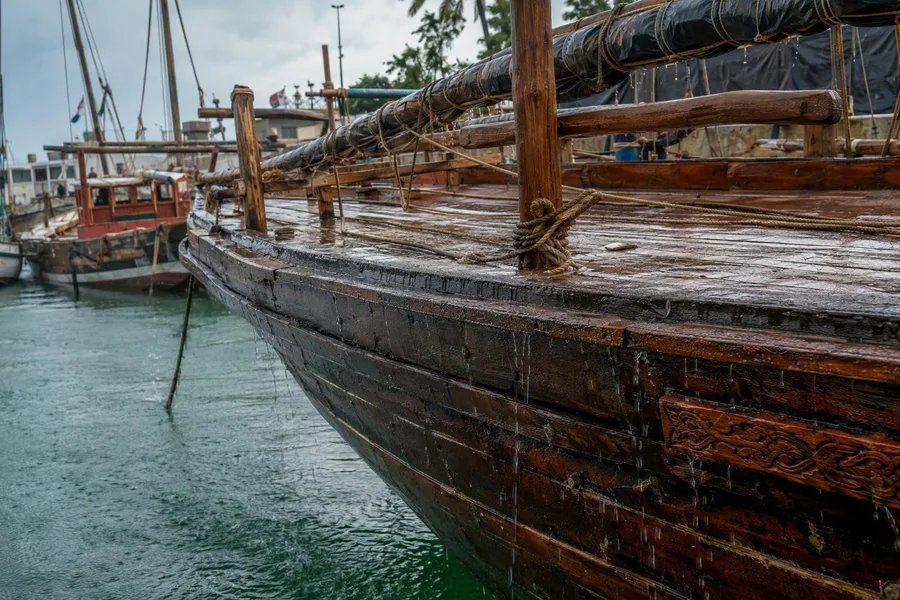
A large jahazi shows a planked wooden hull and triangular sail. Smaller mashua boats serve fishing, short crossings and cargo work. Board meets board along the hulls. The surfaces show wood rather than the smooth shell of a moulded modern boat.
The shower reaches the harbour without shelter. Rain patters on the dhow planks, runs down the darkened wood and breaks into small rings on the water below. At the edge of Stone Town, wet timber meets the harbour surface, then the tide takes the rain away.