
Morning Behind Nishijin’s Wooden Lattices
At half past eight, fresh doughnuts sit behind the L-shaped counter of a renovated machiya on Inokuma-dori, where staff finish them in an open kitchen. Around Nishijin, breakfast begins before much of the textile district opens itself to the street.
The first counters
A renovated machiya on Inokuma-dori starts the day with doughnuts. Staff apply the last touches in an open kitchen behind an L-shaped counter, and the old townhouse serves breakfast from 8.30am. The work is small and plain: trays, counter, kitchen, door.
Nishijin does not turn on all at once. A coffee house near Teranouchi and Jōfukuji opens at seven; elsewhere, bakers, cafés and food shops follow in their own time. Fronts that had held back the rooms behind them begin to sell coffee, bread, tofu, pickles and rice crackers.
That sequence gives the district its early shape. Workshops share the streets with homes, small restaurants and neighbourhood businesses; no single trade fills every doorway. The first visible work often belongs to food: a hand at a pastry, stock set behind a counter, a shop made ready for the day.
Teranouchi’s working houses
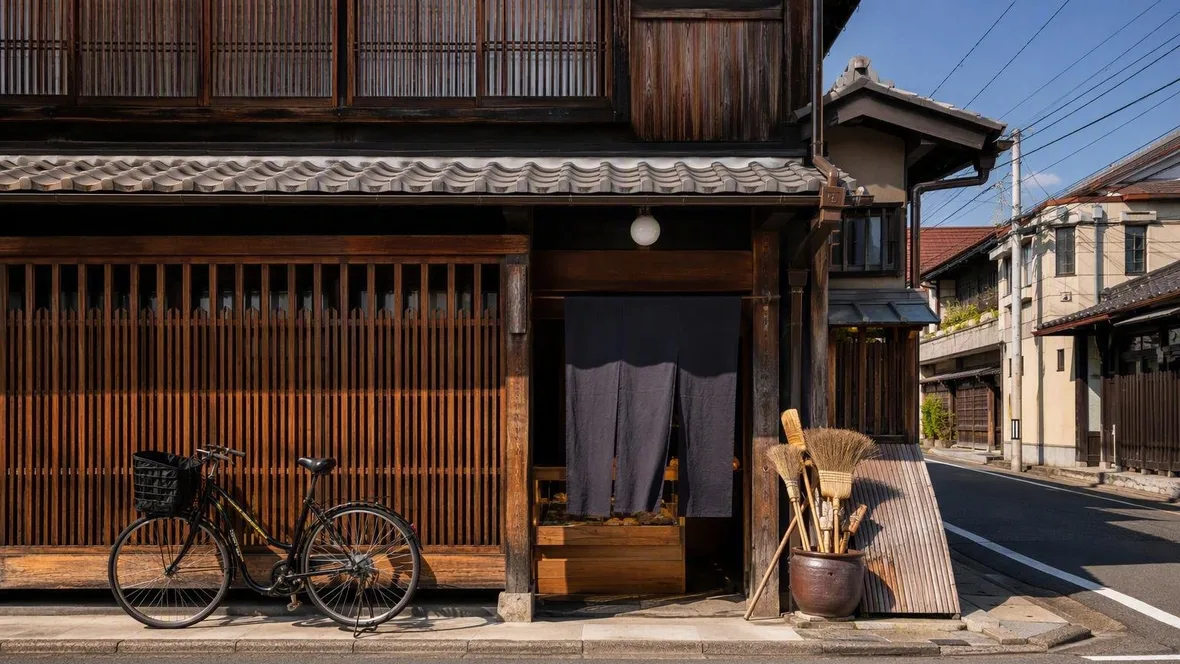
Around Teranouchi-dori, Ōmiya and Jōfukuji, the street still holds houses built for both living and weaving. One registered former weaver’s machiya has two wooden storeys, a tiled roof, a projecting lattice and two low mushiko windows. Its details carry their use without any need for ornament.
Dark vertical slats cover the front openings. They admit light and air while keeping the rooms behind them screened from the road. At some textile premises, the upper section of the lattice was cut back so more daylight could fall on thread and colour. A practical alteration changes the face of the building.
Inside one former weaver’s house, an earthen passage runs from the entrance towards the rear, where a high open workroom stands. Another documented house has tatami rooms, roof lights, a rear courtyard and a heavy central timber post beside its earth-floored toriniwa. Dark wood, compacted earth and woven straw form a reserved setting for the close work of examining silk.
A 130-year-old machiya in the same area now sells rice crackers. Its business keeps an old house in ordinary use. The lattice still performs its old, useful task: it gives the interior air and light, but does not put the whole room on display.
A narrow strip of cloth
Sasaya-chō, near Chiekōin-dori, keeps the textile trade close to the street. Obiya Sutematsu works from a production atelier there, using looms, design drawings and colour plans beside its machiya headquarters.
The loom explains more than a long account of technique could. A weaver takes a place at a large wooden frame and adds rows of lustrous thread. Under taut white warp threads, a narrow band of white-and-gold cloth appears. Wooden parts meet with a dry clack as the fabric moves forward.
Other work gathers around that frame. One person spins thread at the back of the room, while another guides silk threads through the loom. A drawing and a chosen range of colours lie near the equipment, fixing the pattern before it reaches the cloth. The finished obi carries those repeated, separate actions in its surface.
Nishijin fabrics use silk threads dyed before weaving. That preparation accounts for the clean colour and gleam of finished cloth. White and gold catch the light against timber and tatami. The sound may travel farther than the silk: local workshops still describe the clatter of looms among the district’s working sounds.
Horikawa’s broader pavement
Horikawa-dori marks a different edge of Nishijin. It is not a continuous old shopping street lined with weavers’ houses. Food shops, a supermarket, confectionery, coffee, books, printing and textile displays sit in separate premises along the road.
Near Nakadachiuri, the Horikawa Shinbunka Building brings a bookshop, coffee bar, print counter and galleries under one roof. Breakfast begins there at 8.30am. Farther along the road, Fresco stocks food, drink and household goods. Narumi Mochi sells mochi and wagashi made in the workroom behind its shop.
The change comes in layers. Coffee and breakfast start first; the supermarket opens at nine; other public-facing businesses follow. A shut frontage becomes a place to buy paper, sweets, groceries or a hot drink. That simple progression keeps Horikawa tied to the daily errands that run alongside Nishijin’s specialist workshops.
At Horikawa–Imadegawa, the Nishijin Textile Center places fabric, looms and craft demonstrations beside this commercial road. Its programme begins later than the first cafés and food counters. Before then, the street’s public business stays modest: breakfast, shopping bags, shop doors and goods arranged for sale.
Practical details
Most public textile venues open after the first breakfast businesses. The Nishijin Textile Center opens at 10am, offers free entry, demonstrations and making activities, and generally closes on Mondays. Orinasukan opens Tuesday to Sunday from 10am to 4pm; admission is charged, and its hand-weaving activity requires a reservation. Inagaki Kiryo, a weaving-tool shop, opens from 9am to 5pm and closes on Sundays, public holidays, and the second and fourth Saturdays.
On Horikawa-dori, Narumi Mochi marks its machiya frontage with a black-dyed noren. The short cloth panel remains at the doorway, between the pavement and the sweets made behind it.