
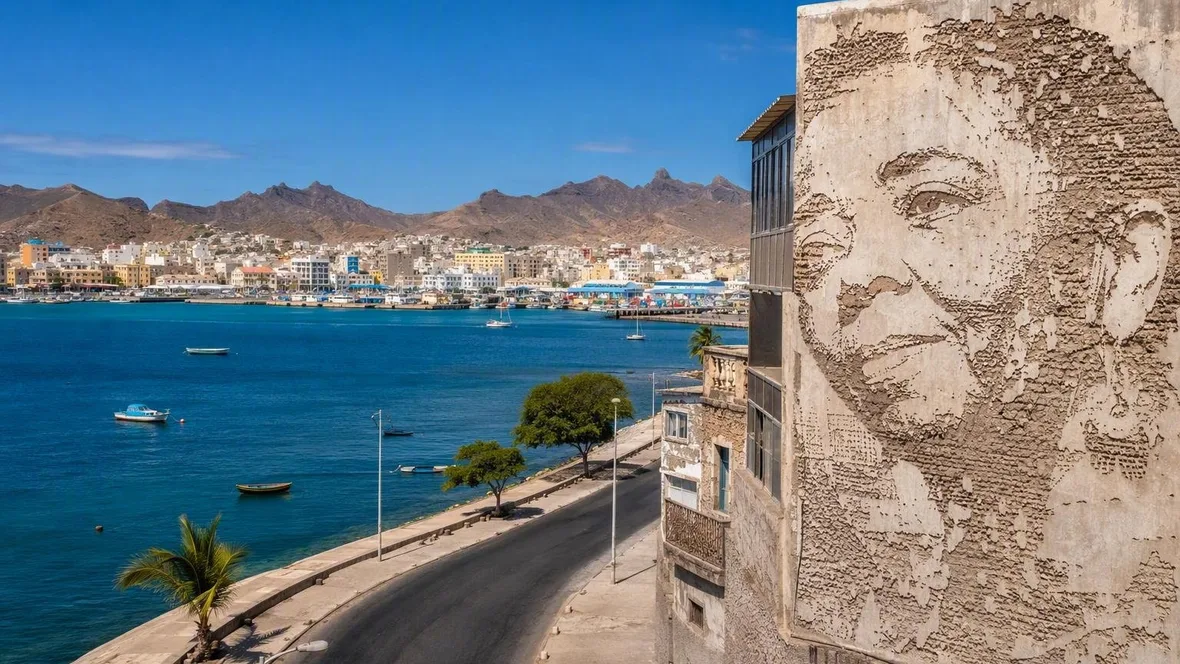
Mindelo, in the Key of Morna
At Mindelo’s fish market, tuna, swordfish, grouper and moray come ashore from Porto Grande. A short walk inland passes through the old port city to places where morna is played, preserved and cut into a wall beside the waterfront.
The fish market stands near the replica of the Torre de Belém on Mindelo’s waterfront. In the morning, fishers bring in their catch and traders sell tuna, swordfish, grouper and moray beneath murals by local artists.
Porto Grande explains why Mindelo stands here. British coal companies used its deep, sheltered bay to supply steamships on the mid-Atlantic route during the nineteenth century; piers, depots and maritime work drew people to São Vicente. Residents arrived from other Cape Verdean islands, while ships brought travellers and goods through the harbour. That traffic put songs, instruments and repertoires in circulation.
Mindelo did not invent morna. The port gave the music one of its most influential urban homes.
The harbour behind the song
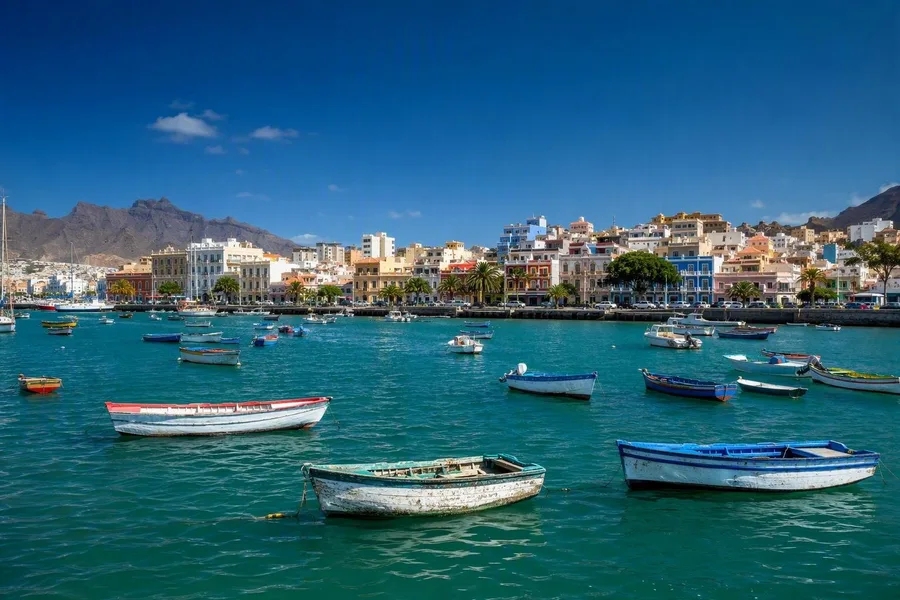 Porto Grande’s sheltered bay borders Mindelo, the harbour that shaped the port city.
The oldest documented memories of morna point to Boa Vista, where women sang it in the nineteenth century and sometimes used verses for satire. On Brava, the poet Eugénio Tavares gave the form greater literary and lyrical depth. Morna then spread across the archipelago and through Cape Verdean communities abroad.
In Mindelo, bars and nightlife venues on the social margins made morna particularly popular in the 1920s and 1930s. Luís Rendall and, above all, B. Léza developed a more harmonically elaborate style. Brazilian influence informed transitional chords and characteristic semitone movements.
Morna usually moves slowly in four-beat metre, with tonal harmonies that often lean towards minor keys. The violão, or guitar, carries both accompaniment and melodic lines. Cavaquinho and violin often join it; later ensembles added piano, bass and percussion.
The songs are generally in Cape Verdean Creole. Their words hold love alongside departure, emigration, separation, the sea, home and return. Sodade is not simply a label for sadness. It describes the pull between distance and attachment that runs through a music shaped by ocean crossings and migration.
Morada, close to Porto Grande
Mindelo’s historic centre, Morada, retains the compact shape of a trading port. Praça Pidjiguiti lies near the early settlement, and Rua Libertadores da África, formerly Rua Lisboa, runs inland from the coast as an old commercial and administrative axis. Praça Amílcar Cabral, also called Praça Nova, lies farther north.
Late nineteenth-century buildings, pavements, gardens and squares record the city’s colonial-era expansion. Customs facilities, warehouses and quays once served the bay’s commercial traffic. Shops, public buildings, bars and cultural spaces now stand within a short walk of the waterfront.
The municipal market keeps the working city in view. Its stalls sell fresh and dried food, meat, herbs and crafts; cafés and a sewing workshop operate under the same roof. At the Centro Cultural do Mindelo, classes and rehearsals cover music, singing, theatre and visual art. Morna sits within this wider musical life, alongside other Cape Verdean forms and newer sounds.
Cesária Évora on Rua Guerra Mendes
The Núcleo Museológico Cesária Évora at Rua Guerra Mendes 24 offers Mindelo’s clearest account of the singer’s career. Opened in 2015, it preserves and presents the life and work of Évora, who was born in Mindelo and became morna’s best-known international voice.
Évora sang largely in the Barlavento Creole of São Vicente. Her recordings carried a local language and a Cape Verdean musical form to listeners far beyond the islands, while retaining songs about separation, migration and attachment. Sodade became closely associated with her, but her importance reaches beyond one song.
The former governor’s residence, now called Palácio do Povo, also holds an exhibition room devoted to Évora. The building links her commemoration to a centre once organised around colonial administration and later Cape Verdean public life.
A more public memorial stands at Praceta Dom Luiz near Avenida Marginal. The Portuguese artist Vhils made a ten-metre low-relief portrait of Évora by drilling into the wall. Her face remains in the public street, close to the harbour and the city where she was born.
Morna after the museum closes
Casa da Morna by Buxa, on Avenida Marginal, combines Cape Verdean and Portuguese food with scheduled live music. The venue has announced performances by Jorge Humberto, Mick Lima and Tito Paris with guest musicians. It is Mindelo’s most clearly documented address for a meal alongside planned morna, though bills vary and the programme does not consist only of morna every night.
Le Metalo offers a broader musical programme. The restaurant occupies a historic colonial house with a garden and grew from a food truck established on Praça Nova in 1996. Its programme includes live concerts and Cape Verdean dance sessions featuring morna alongside coladeira, funaná and batuque. Listings have also advertised dedicated morna evenings.
Public events sometimes take the music beyond restaurant tables. In December 2025, Pracinha do Liceu Velho hosted Morna Fest with eight announced artists. The square is not a permanent morna venue, but the festival placed the genre in a civic space.
Practical details
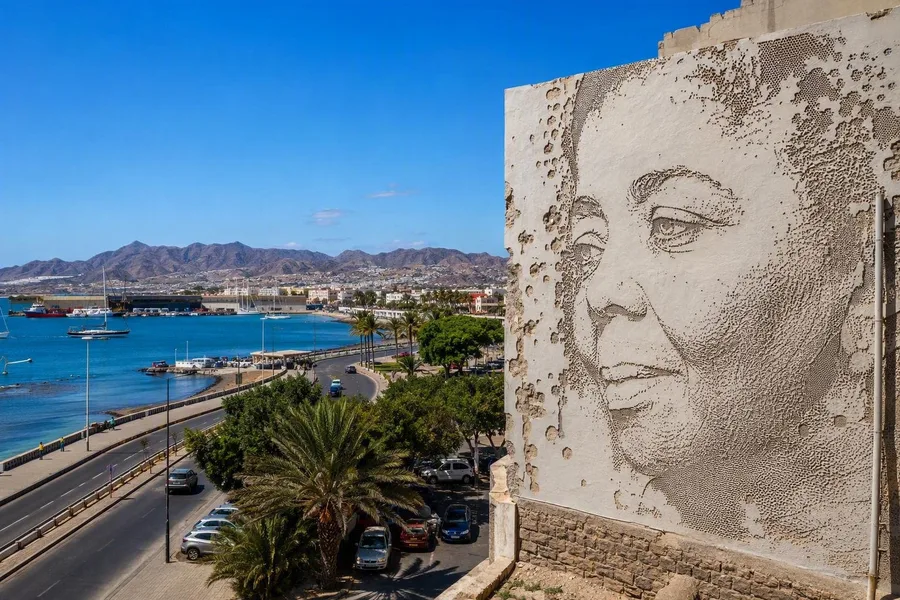 Cesária Évora’s drilled wall portrait rises above Avenida Marginal at Praceta Dom Luiz in Mindelo.
The Cesária Évora museum opens Monday to Friday from 09.00 to 13.00 and 15.00 to 18.00, plus Saturday mornings; foreign admission costs 300 CVE. Casa da Morna opens from 18.00 except on Sundays, while Le Metalo opens from 17.30 from Tuesday to Sunday. Both take reservations. Check the current programme before choosing an evening, since neither venue presents morna alone every night.
At Praceta Dom Luiz, the drilled planes of Vhils’s ten-metre portrait pull Cesária Évora’s face from the wall above the marginal. Below it lies Porto Grande, the sheltered bay whose nineteenth-century shipping traffic built the port city around it.