
In Arusha, a Bicycle Stays Useful Through Work
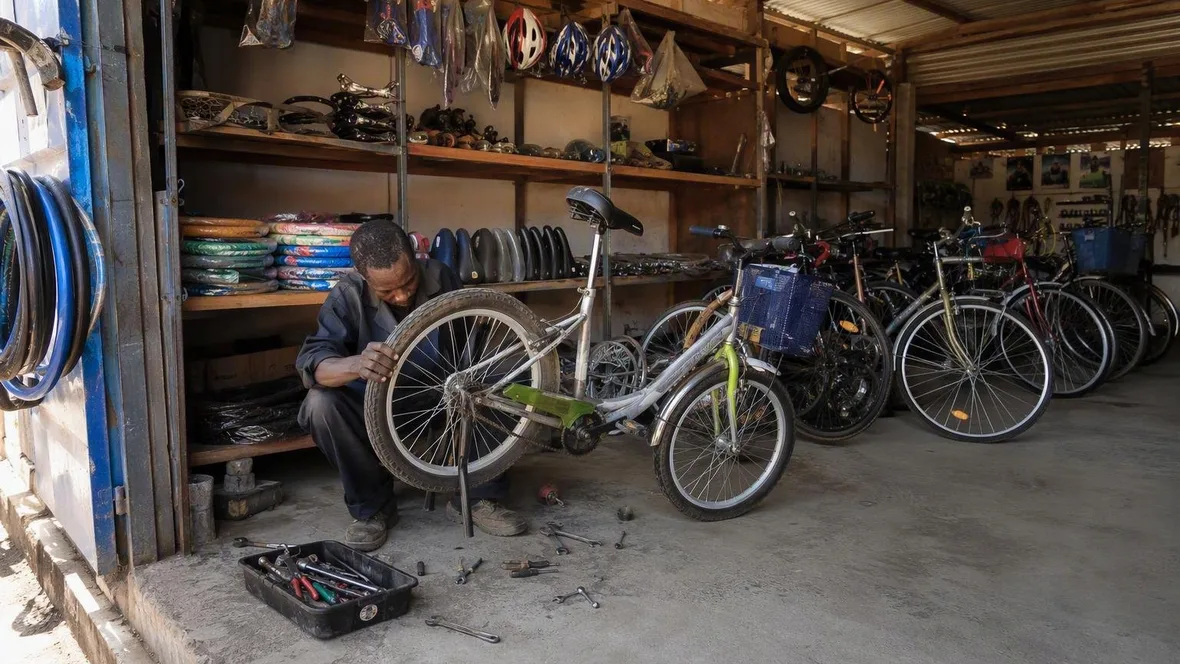
Opposite St Constantine School in Burka, ABC Bicycle Company brings sales, spare parts, maintenance and repair under one roof. The garage on Tanga General Road serves a modest but practical part of Arusha’s daily transport: bicycles used by riders that the company describes as daily commuters.
The garage on Tanga General Road
ABC Bicycle Company started in 2015 with one shipping container, 480 bicycles and four employees. The business has since added bicycle sales, rentals, repairs and parts services in Arusha and elsewhere in Tanzania. Its Burka garage gives those services a clear street address: Tanga General Road, opposite St Constantine School.
The address matters because it fixes the bicycle in the ordinary business of the city. ABC sells bicycles and replacement parts, carries out maintenance and repairs, and names daily commuters among the people it serves. A bicycle can carry someone to work or through a day of errands. At the garage, the same bicycle becomes the object of skilled labour.
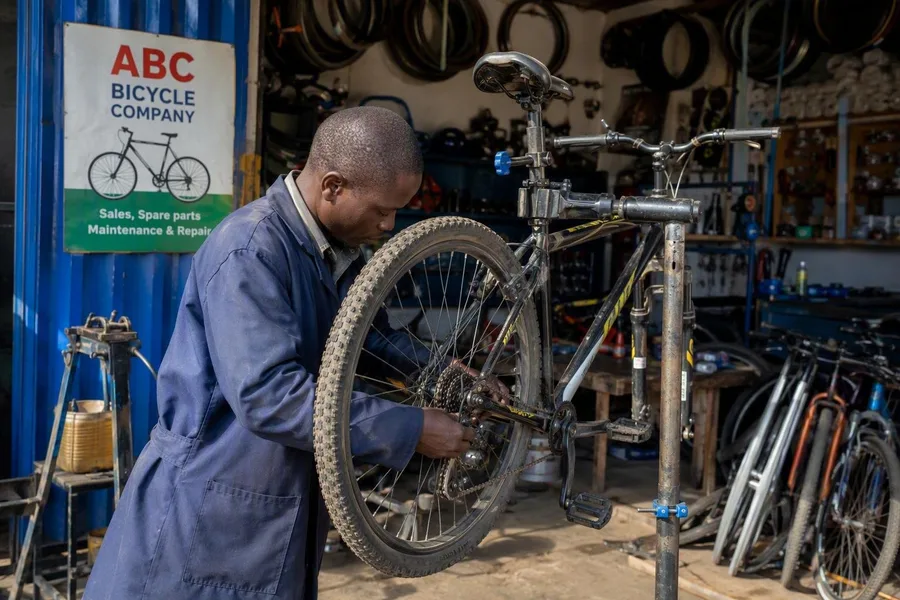 A mechanic repairs a bicycle at ABC Bicycle Company’s Burka garage on Tanga General Road.
That work has a material basis. Parts are sold alongside repairs, and the company offers professional maintenance from its branches as well as repairs at a customer’s location. A documented customer account describes a damaged luggage rack, derailleur and wheel repaired with available tools and replacement parts. It records one job rather than a full list of work at the garage, but it shows the kind of damage that can interrupt a bicycle’s use.
The sources do not establish a particular traffic flow outside the door, the colour of the building or the tools laid out inside. They do establish a garage where bicycles, components, repair and maintenance meet at one address. That is enough to show a working link in Arusha’s everyday movement.
A city that has spread out
Arusha has expanded markedly beyond its older centre since the 1990s. From 2000 to 2013, its urbanised area grew from 1,389 to 3,229 hectares, and two-thirds of the added built-up land formed contiguous expansion at the city’s edge.
The shape of the land has influenced that growth. Arusha lies on the slopes of Mount Meru, while fertile and valuable land constrained growth north and east of the centre. Development therefore extended strongly towards southern and outlying areas.
The newer urban areas have lower-density development and, on average, narrower roads than the older city fabric: 4.73 metres against 8.72 metres. Homes, workplaces, shops and services now lie across a wider area. People move between peripheral neighbourhoods, main roads and the commercial centre.
Walking remains central to daily movement in Arusha, and daladala minibuses form the main motorised public transport option. Cycling has a smaller place in the available citywide picture. That does not make the bicycle irrelevant. It makes a repair point in Burka more specific: it supports a form of personal transport that needs parts and maintenance to remain usable.
Arusha is also the largest commercial centre in north-eastern Tanzania. Farming and production areas surround the city, while residents from the outskirts and beyond come into its commercial and service areas. The evidence does not identify one standard cyclist or one standard journey. It does show that ABC serves commuters, and that local repair and parts services support their bicycles.
Repair as daily work
A bicycle repair garage covers more than a broken machine. It provides paid work for mechanics, sales work for staff and a local point where parts can be obtained. ABC combines these activities in its Arusha business.
The company’s service model also reaches beyond the garage. Its mechanics can carry out repairs on location, so not every bicycle service takes place behind the Burka address. The Burka site nonetheless remains the strongest documented anchor because its location, sales, parts provision and repair activity are all recorded.
The distinction matters. It would be easy to fill a story about cycling with unverified claims about delivery riders, market loads or commuters on one road. The available evidence does not support those portraits. It supports something more grounded: bicycles are sold, maintained and repaired in Arusha, and some of their users are daily commuters.
For the mechanic, maintenance and repair make the bicycle a trade. For the rider whose bicycle needs attention, those services can return a vehicle to use. The documented luggage-rack, derailleur and wheel repair gives that relationship a concrete form without pretending that every job follows the same pattern.
Training mechanics in Arusha
The Bikepreneur programme extends this work from the garage into training. Its first cohort began in 2024 with lessons in bicycle mechanics, innovation and problem-solving, followed by practical mechanic training and placements.
Participants completed internships in groups at bicycle businesses including ABC’s Arusha headquarters and its Maji ya Chai shop. The practical stage lasted six months. Some graduates then found work with ABC Bicycle Company in Arusha, while former participants from 2025 helped train later groups.
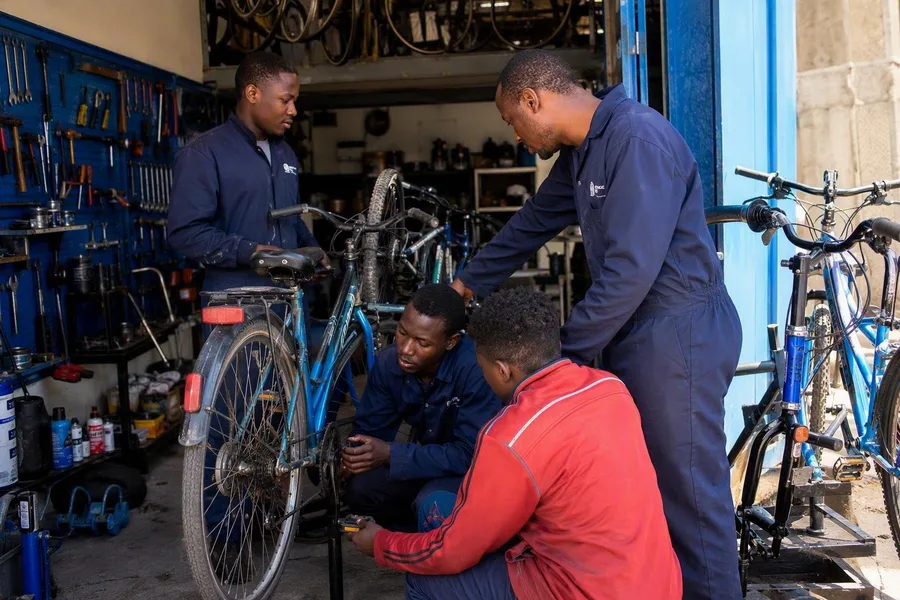 Bikepreneur participants receive practical bicycle-mechanic training at ABC Bicycle Company in Arusha.
The programme combines mechanical training with entrepreneurship. Graduates can take jobs at bicycle companies or establish their own bicycle branches and repair workshops. In this small but visible part of Arusha’s economy, a bicycle provides both a means of travel and the basis for a mechanic’s work.
That role should not be overstated. The available evidence still places walking and daladalas ahead of cycling in Arusha’s broader transport pattern. Yet every bicycle that remains in use depends on ordinary support: a replacement part, repair knowledge and a place where both are available. ABC’s services make that support visible.
Opposite St Constantine School
Tanga General Road ends this account at a precise point in the expanding city. Across from St Constantine School in Burka, ABC Bicycle Company operates its garage for bicycle sales, parts, maintenance and repair.
At that address, the route resolves into documented objects and work: bicycles, spare parts, tools, and a garage where maintenance and repair can put a bicycle back into service.