
Harare in the Key of Mbira
Calling the mbira a “thumb piano” gets the mechanics roughly right and nearly everything else wrong. In Harare, makers, teachers and performers keep an instrument rooted in Shona ceremonial life in active circulation, while chimurenga carries its interlocking patterns into the amplified language of political song.
Metal keys in Highlands
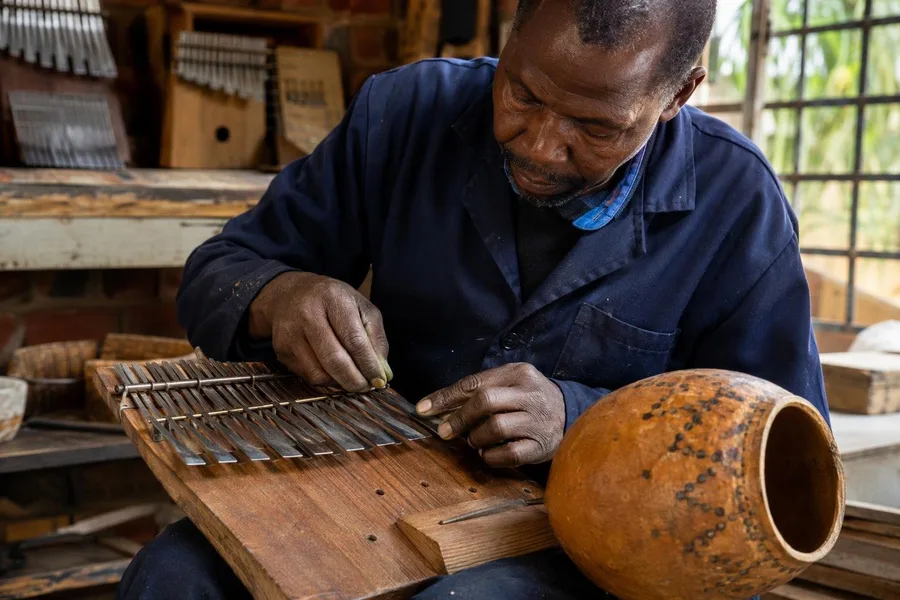 An instrument maker assembles a metal-keyed mbira at the Mbira Centre in Highlands, Harare.
At Harare’s Mbira Centre, traditional and chromatic mbiras take shape alongside their resonators. The centre, led by Albert Chimedza, also began the Mbira in Schools programme, which has reached more than 30 schools.
A mbira dzavadzimu has 22 to 28 metal keys in three rows on a hardwood soundboard called a gwariva. Earlier makers forged the keys from iron ore. Contemporary instruments may use spring steel, bicycle spokes or other reclaimed steel. Players often set the board in a large gourd resonator, the deze, which amplifies its sound.
The buzz belongs to the music. Wires strung with metal beads, bottle tops or shells vibrate beside the keys, putting a soft rattle beneath the bright metallic notes. Both thumbs strike downward and the right index finger plucks upward. Low, middle and high notes cross within short repeating cycles.
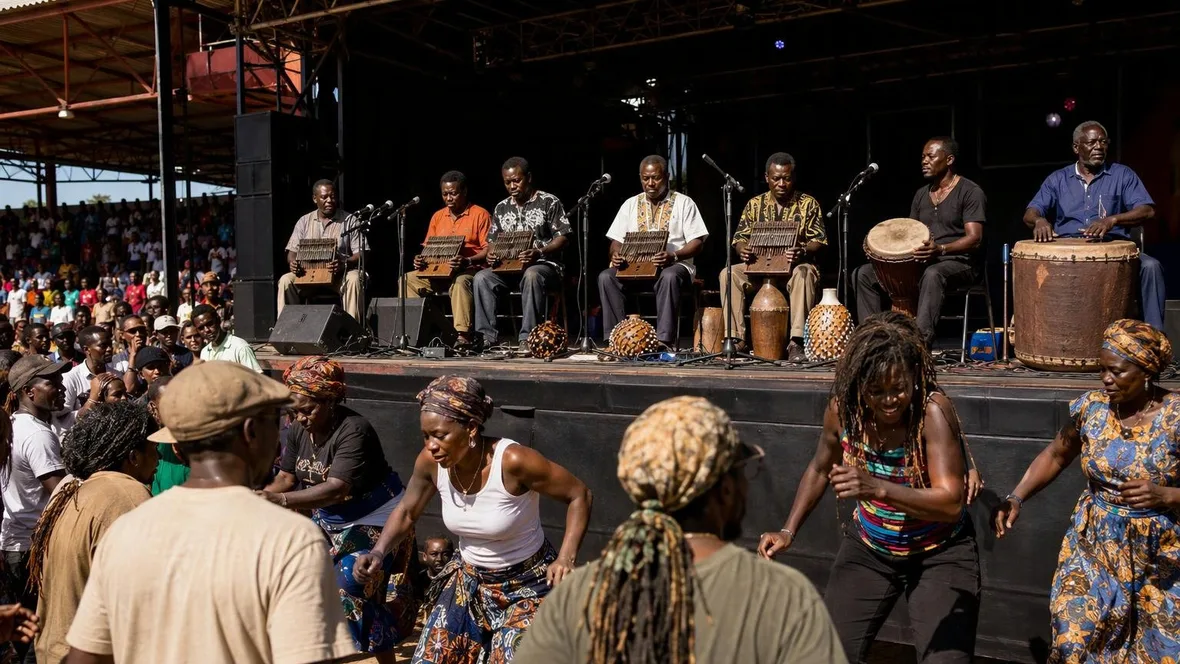
Mbira music rarely follows one melody alone. One player may carry the leading kushaura pattern while another threads the kutsinhira part through it and gives weight to the bass. Singing and the steady shake of a gourd hosho add further lines. The melody emerges from the overlap rather than travelling in a straight line.
That construction explains why the mbira is more than a portable curiosity. The mbira dzavadzimu, or “mbira of the ancestral spirits”, has long been associated with the Zezuru, a Shona group in central Zimbabwe, and is now known more widely across the country. In a Shona bira, musicians repeat particular pieces through the night as singing and dancing accompany communication with family ancestors through spirit mediums. Mbira also sounds during kurova guva, when a deceased person’s spirit is welcomed back into the community. These practices continue, although they do not define the beliefs or participation of every Zimbabwean.
Salisbury guitars become chimurenga
In the 1970s, Harare was still Salisbury and Zimbabwe was still Rhodesia. Thomas Mapfumo began by singing American and British rock-and-roll songs. He then shifted into Shona, drew on traditional melodies and wrote about rural hardship, young men leaving to fight, and the denigration of Shona culture under colonial rule.
With guitarist Joshua Dube and the Hallelujah Chicken Run Band, Mapfumo adapted pieces from the mbira repertoire for an Afro-rock band. His work with the Acid Band from 1976 and later the Blacks Unlimited developed into chimurenga, a term linked to struggle and the liberation wars.
The crucial musical move was not simply adding mbira to an electric group. Lead and rhythm guitars took on its rippling, interlocking figures. Drums echoed stamping dance feet, while cymbals marked a pulse akin to the hosho. During the 1980s, Mapfumo’s band also incorporated mbira and hosho themselves.
The sound carried political force. An amplified band sang in the language of the Black majority and put a cultural form marginalised by colonial rule at the centre of popular music. Mapfumo’s lyrics could be metaphorical or direct, and his songs functioned as dance music, cultural assertion and protest. Rhodesian authorities banned chimurenga from state radio and detained Mapfumo for 90 days in 1977. Clubs and radio stations in neighbouring countries kept the music in circulation.
After independence in 1980, Mapfumo continued to criticise corruption and abuses of power in Zimbabwe. He also brought township dance music, reggae, R&B and African jazz into his mbira-based approach. Chimurenga is not only an independence-era soundtrack. Its guitar patterns still show how an older cyclical language can shape a band and a political song.
Saturday music in Dzivarasekwa
In Dzivarasekwa No. 2, Tsoro Arts and Social Centre links instrument making to neighbourhood teaching. Jacob Mafuleni builds mbiras and marimbas there. On Saturdays, children attend free lessons in music, singing and dance, including hosho and drums.
Tsoro offers a useful view of transmission as practical work: instruments are made, then played by young learners. Contact the centre in advance to ask whether observation or participation is possible.
Harare also has formal routes into the tradition. The Zimbabwe College of Music offers individual tuition on nhare and nyunganyunga mbira, alongside marimba and ngoma, and connects that teaching to music production and a recording studio. Mbiravolution workshops have used mbira as a starting point for reggae, rock, jazz, electronic music and contemporary songwriting.
That range reaches records and stages. Mary Anibal’s 2024 debut Maria Wenyu combines traditional foundations with contemporary Afro-fusion. Vee Mhofu and Dziva ReMbira perform with mbira, voices, drums and hosho. In Harare, the instrument appears in ceremony, instruction, composition and amplified performance without losing its history.
Bira ReMbira and changing concert bills
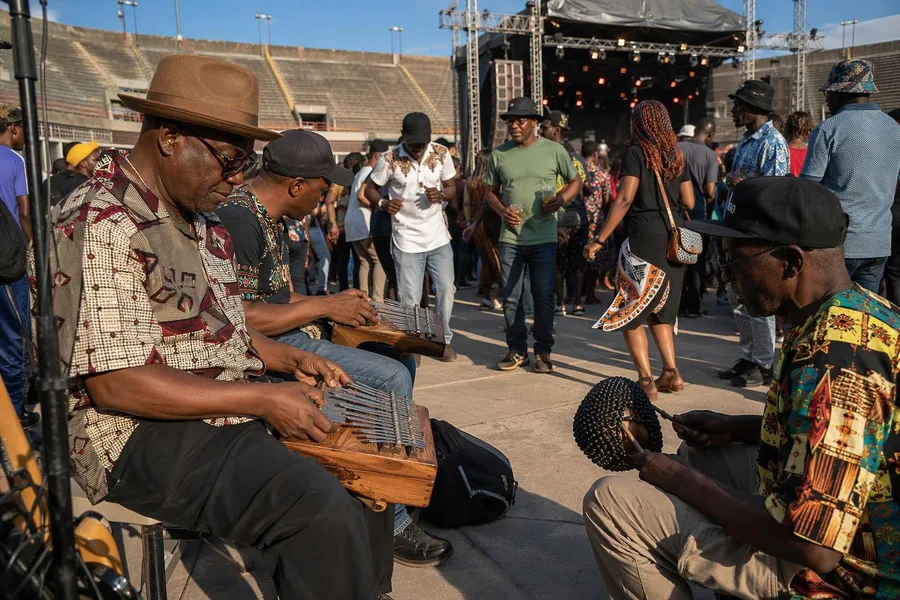 Mbira and hosho players perform as dancers gather near the stage at Glamis Arena.
Harare has no verified weekly club night devoted solely to chimurenga. Concert programmes change, and mbira performances often provide the clearest route into the patterns that Mapfumo translated for electric guitars.
Theatre in the Park has placed mbira on its public programme, including Tendai Mavengeni’s Ngairire Mbira. Bira ReMbira gives Harare its most concentrated annual mbira platform during September’s Mbira Month. Recent editions have paired performances with instrument-building demonstrations and exhibitions, with traditional ensembles, mbira players and Afro-fusion acts on the same bill.
Practical information: The Mbira Centre receives visitors by appointment and lists daily contact hours of 09:00 to 17:00. Ask when booking whether a demonstration, lesson or instrument purchase is possible and what it costs. Contact Tsoro Arts ahead of time if you hope to observe a class. Theatre in the Park and Bira ReMbira publish changing dates and line-ups, so check their current programmes before making plans.
At the 2026 Bira ReMbira in Glamis Arena, traditional, mbira and Afro-fusion acts played from morning into the night. Near the stage, metal keys, voices, drums and hosho held the music in a dense weave as dancers and listeners gathered. The hosho fixed the pulse. Feet answered on the arena floor.