
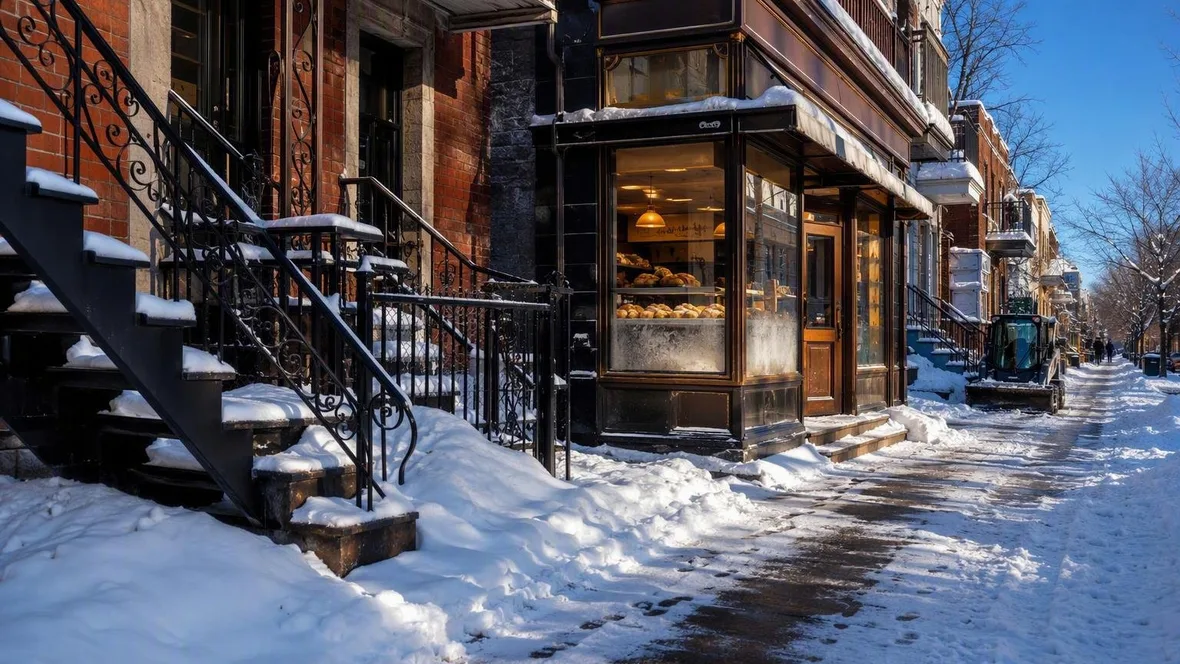
Fresh Tracks on a Villeray Morning
Fresh snow lies loose across Villeray’s pavements, smoothing the ground beneath brick plexes and curling iron staircases. Then shovels, tracked pavement machines and the first pairs of boots cut dark lines through the white.
Snow beneath the iron stairs
Fresh snow hides cracks, kerbs and small breaks in the pavement. Its airy surface softens distant traffic, while a boot sole, a shovel blade and a small engine sound close by.
Villeray’s houses stand close to the street. Rows of two- and three-storey duplexes and triplexes have flat roofs, tall stacked windows and raised ground floors; balconies and curved exterior staircases run down towards the pavement. Snow gathers on wooden balcony edges. It catches on dark wrought-iron rails and throws the red, ochre, brown and beige brick into sharper relief. Grey limestone sills and lintels break up the masonry, while metal roof edges make thin dark strokes above it.
The street gives up its details one doorway at a time. A front garden sits behind a low drift. A tree trunk rises from its snow-filled pit. Beyond the stairs, tall windows hold the first dull light of the day. Mature trees line Villeray’s broad residential streets, and narrow yards and green back lanes sit behind the long rows of façades.
Cold alters each step. In hard cold, brittle crystals break beneath boots with a dry creak. Wetter snow yields more quietly, clinging to the sole before it drops away in small white clots. The first person leaves a clean print in the loose layer. The next follows it, and separate heel-and-toe marks soon become a darker, packed strip.
The first cleared pavement
Work starts before many front doors open. Small tracked machines clear Villeray’s pavements during snowfall and in the hours that follow, pushing snow towards the edges and leaving room for people to pass. Their low engines move along the houses, close to fences, steps and small front gardens.
A shovel has a sharper voice. The blade moves softly through fresh powder, then rasps when it finds paving beneath. Shovels and snow blowers have worked Villeray streets during heavy snowfall, while pavement machines have passed through the neighbourhood’s tight spaces beside iron fences and garden edges. There is not much room for error between a stair rail and a snowbank.
Behind the machine, the pavement takes on two surfaces. A narrow dark track runs between uneven banks of pushed snow. Loose white remains around tree pits, railings and the foot of each staircase. Boots cross the cleared strip at once. Snow stuck to their soles melts into wet, dark marks on the exposed paving, while the prints at the edge keep their crisp ridges a little longer.
The change comes underfoot in a few steps. A boot sinks into the white margin, firms the snow into a compact shape, then lands with a dull rubber tap on the cleared path. In deep cold, the crunch comes first. The wet mark follows later.
Warm glass on De Castelnau
On rue De Castelnau, Le Pain dans les Voiles puts a warmer scene behind the street glass. A counter runs beside the windows. Inside stand a large communal table and smaller tables of walnut and steel, with sourdough loaves, baguettes, viennoiserie, coffee, tartines and quiches close at hand.
The window shows the temperature difference plainly. Warm, moist air inside cools against the glass and leaves a pale film or beads of water on the inner surface. Light spreads through the haze, and the finer shapes behind it blur. Outside, the snow on the kerb and the iron rails remain hard-edged.
Bread work gives the morning its particular smell. On rue Jarry, Fanfare bakes bread and viennoiserie each morning, shapes baguettes by hand and grinds coffee fresh. The smell of warm bread and coffee slips out when the door opens. Wet boots bring in grains of snow. At the threshold, the pavement gathers a small crowd of prints and dark melted patches. It is not glamorous work, though it does improve a cold street considerably.
Jarry behind steamed windows
Rue Jarry carries homes and small businesses in the same block. Cafés, food shops and bakeries also line De Castelnau and rue Villeray, often below apartments, where broad shop windows interrupt the sequence of domestic doors, balconies and exterior stairs.
Boulangerie Jarry stands in a former bank at the corner of Jarry and Saint-Denis. Its glass façade sends daylight into the shop, where the old vault and vault doors remain. A mill stands behind glass, and the display holds classic loaves, viennoiserie and Premiers Arrivants, a bread made with yellow-pea flour, polenta and pumpkin. Large tables hold coffee and bread as well as takeaway bags. Under them, boots still carry the weather in.
Farther along Jarry, Le P’tit Atelier keeps a compact morning counter stocked with rustic loaves, viennoiserie, sandwiches and quiches. Outside, the cleared path narrows between the snowbanks. Feet funnel towards the bakery door, then leave moisture on the paving where compacted snow loosens from a heel.
The machines have left a walkable band, but no clean slate. A chain of boot prints follows its dark edge. Loose snow rests against a staircase, untouched except for a shallow scrape near the bottom rail. At the bakery window, condensation clouds the lower pane. One wet track ends at the door.