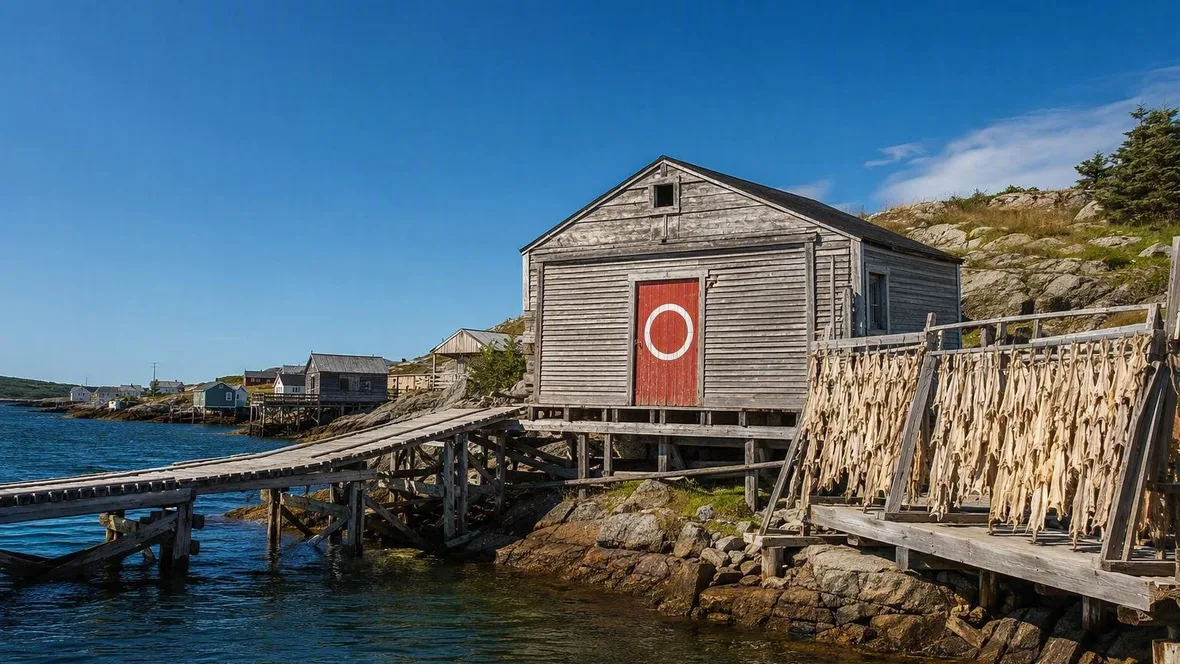
Fogo Island: Fishing Rooms, Punts and Work That Continues
In Fogo, stores, lofts and stages still run between the main street and the harbour. In Tilting, houses, gardens and fishing buildings gather around a smaller sheltered bay, on ground shaped by family plots and coastal work.
“Picturesque” is an easy word for Fogo Island. It leaves out the labour that gave the buildings their shape.
People landed fish here, cleaned and salted it, repaired nets, stored supplies and built boats close to the water. Fishing still provides work, while textile makers, woodworkers and other craftspeople use older skills and materials in new ways.
Fogo Harbour beside the fishing grounds
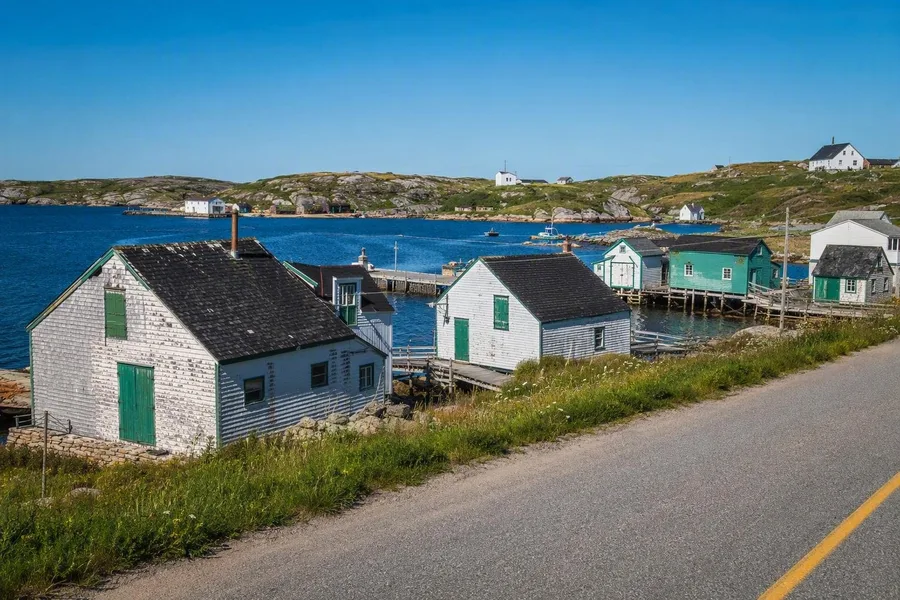 The Best Premises’ historic fishing buildings stand between the road and Fogo Harbour.
Fogo Island lies off Newfoundland’s northeast coast, close to the shallow Fogo Shelf, where cod and salmon were among the available fish stocks. Fogo Harbour served fishers from southwest England as a seasonal base in the 1680s. Permanent settlement followed in 1728. Houses, stores, boat work and fish handling therefore gathered at the harbour rather than inland.
The Best Premises makes that arrangement legible. Generations of the Best family built its 14 buildings from about 1840 to 1960, between the road and the harbour. The group includes dry-fish stores, a net loft that also served as a sail loft, maintenance buildings, crew accommodation and a stage at the water.
The buildings changed as work changed. A tilt became a store. A former house became a shop, then a credit union, then a twine loft. One fish store used rejected pine boards from a sawmill. Reuse and repair explain this harbour architecture more accurately than any romantic idea of weathered wood.
Best Premises has no confirmed museum access. View it from the public road unless an owner or operator explicitly permits entry; parts of the property may remain private or in use.
Fishing after cod
The 1992 northern cod moratorium changed the island’s fishery, but commercial fishing did not disappear. The local cooperative moved into species including crab, shrimp and halibut. Its history reaches back to 1967, when island residents formed the cooperative amid pressure to resettle elsewhere. It took over abandoned processing sites, developed facilities and found markets for catches.
Fish processing in Fogo remains a workplace, not an attraction. Public streets show the harbour and the scale of the present-day fishery, but production areas require the cooperative’s permission.
That boundary is worth keeping clear. Fishing here is not a performance of an old outport life; it remains organised work for fishers and processing workers.
Cloth, timber and a wooden punt
Textile work grew from practical reuse. Quilters cut old clothes, flour sacks and worn fabric into warm covers, and makers now turn discarded fishing nets into bags alongside knitted socks, hats and trigger mittens. The Winds and Waves Artisans Guild, in Tilting’s Heritage Centre, provides a public place to see textile work and try traditional techniques.
Boatbuilding connects craft most directly to the fishery. Builders made the small wooden punt around a keel, stem and curved frames, using a three-part mould to set the hull’s form. At the public Punt Premises in Joe Batt’s Arm, historical tools, models and organised activities explain that knowledge and its place in inshore fishing. Follow the programme there rather than treating nearby boats or fishing buildings as open to visitors.
In Barr’d Islands, Fogo Island Workshops works from the former Society of United Fishermen Hall, built in 1909. Local woodworkers and other makers work with visiting designers on furniture, textiles and useful objects; some projects reuse wooden barrels and worn cloth. Public tours enter the production floor. The upstairs design centre is accessible by appointment only.
The Punt Chair draws on construction knowledge from the small workboat. That is a concrete shift in use: timber skills once applied to hulls now also shape furniture.
Tilting around a sheltered harbour
Tilting sits on Fogo Island’s eastern side. French fishers used the area in the 17th century, and Irish settlers began building houses and fishing rooms around the harbour from about 1730. The protected water and rocky shore explain the village’s form. Houses, gardens, stores and stages sit around the harbour and Pigeon Island rather than along a planned grid.
Irish inheritance practices divided older plots among relatives. Family clusters of houses emerged around the harbour, with gardens close to homes, hay ground farther away and wooden fences marking working land. Root cellars, sheds, stages and homes belong to the same inhabited landscape.
Public roads, the harbour edge and marked paths provide access to that landscape. Houses, gardens, stages, bridges and working yards are often private property or active workspaces, and Tilting’s historic designation does not open every building to the public.
Several fishing structures repay a close look from outside. The red Edwin Broders Twine Store, built around 1870, held traps, nets, lines and salted fish; boatbuilders also made punts, skiffs and schooners in and around the building. Gus Foley’s Stage, visible near the road into Tilting, stored salted cod. Its restored cribwork, flakes and wooden bridge show how much maintenance these waterfront structures require. Neither site has confirmed public interior access.
The Squish Studio, near Tilting on a walking trail, is another useful lesson in access. It is a private studio for a resident artist and may be viewed from outside; the interior opens only during announced public programmes or monthly organised tours.
A short practical note
Vehicle and passenger ferries connect Farewell with Fogo Island; check the current timetable shortly before travel because schedules can change. A car makes it easier to reach Fogo, Tilting and trailheads across an island measuring roughly 25 by 14 kilometres. In Tilting, Dwyer Premises and Lane House operate as summer museums. Workshops, studios and design spaces require the advertised tour, class or appointment where specified.
The Rock at Tilting Harbour
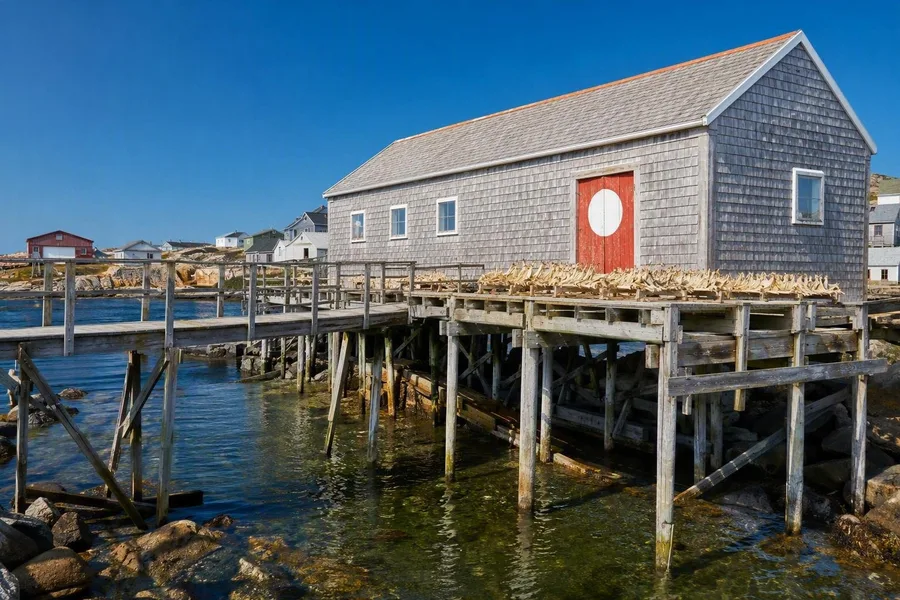 The Dwyer Premises stage stands above Tilting Harbour on The Rock.
Dwyer Premises stands on The Rock, a peninsula on the eastern side of Tilting Harbour. Its house, store, fish-drying flakes and original stage form one waterfront fishing room, and the seasonal museum is the island’s clearest public place to understand how that system worked.
Inside, a splitting table, barrels and hand tools place fish processing beside domestic space. An opening between the stage floors let two people operate a hand saw, one above and one below. A white circle on the red door gave returning crews a point of light in dim conditions.
The site stands at the edge of a low rocky plateau, with beach deposits of boulders and cobbles at the waterline. The stage’s loosely laid floor beams leave gaps for air and for waste from fish cleaning and salting to pass through. Long wooden bridges reach water deep enough for boats to berth, and some also served as drying flakes.
Keep exploring