
Africa’s national parks ranked: ten landscapes beyond the Big Five
Salt hardens across a vanished lake in Botswana. Atlantic surf meets rainforest in Gabon, while cliffs fall away from Ethiopia’s high plateau. These ten national parks show a continent far wider than the usual safari circuit.
This ranking weighs landscape most heavily at 30 percent, followed by biodiversity at 25 percent, distinctive character at 20 percent, conservation at 15 percent and realistic visiting opportunities at 10 percent. The same measure applies to every park. It favours ecosystems and landforms over a Big Five checklist, while the deliberately small access score stops remoteness from becoming an automatic disadvantage. The ten parks cover East, North, West, Central and Southern Africa, plus Madagascar, from mountain watersheds and forest clearings to a coast, a sand sea and an old lakebed.
10. Isalo National Park, Madagascar
Water and wind cut Isalo’s sandstone plateau into ravines, rock walls and isolated pillars. Dry, open ground lies above shaded canyon floors, where streams support dense vegetation and natural pools. Parts of the massif also serve as Bara burial grounds, giving the rock landscape a cultural role beyond its geology.
Isalo ranks tenth because its ecological scale and visitor access fall below those of the continental parks, not because the place lacks character. April to October brings drier walking conditions. A local guide is compulsory.
9. Makgadikgadi Pans National Park, Botswana
Makgadikgadi occupies the floor of a former inland lake in the lowest part of the Kalahari. Shifts in regional drainage gradually cut off its water supply, leaving broad flats of salt and clay beneath windblown sand and older lake deposits.
Seasonal change earns the park its place. Winter exposes a hard white crust; summer rain, seasonal rivers and occasional inflow from the Okavango system can turn parts of the pans into shallow water and fresh grassland. Visit from May to October for dry pans, or from December to April for rain-fed wetlands, flamingos and zebra movement. Both depend on the season’s rain.
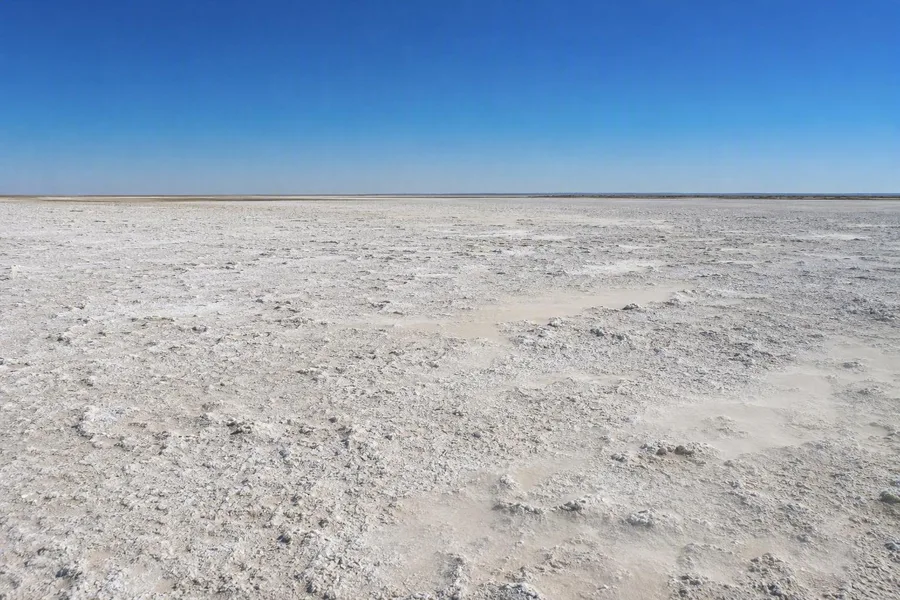 A hard white salt crust stretches across Makgadikgadi Pans National Park in Botswana.
8. Loango National Park, Gabon
Loango protects a rare meeting of rainforest and Atlantic coast. Beaches and coastal ridges hold back lagoons, with mangrove, marsh, savanna and forest extending inland; forest elephants and forest buffalo can reach the shore.
That overlap of coast, lagoon and forest is Loango’s main strength. Remote logistics and pressure from activities around the park lower its score. July and August provide the most useful all-round window, with drier conditions and passing humpback whales. January to May better suits visits focused on habituated gorilla groups.
7. Odzala-Kokoua National Park, Republic of the Congo
Odzala-Kokoua protects a Congo Basin mosaic of forest, swamp, savanna and rivers. More than 130 marshy clearings, known as bais, break through the trees; forest elephants use these mineral-rich sites to feed from soil and vegetation.
The bais make forest ecology visible in a landscape where much remains screened by dense vegetation. Odzala’s conservation value is substantial, but tightly managed and costly access keeps it below Niokolo-Koba. June to September is the main dry period, with January and February as a shorter alternative.
6. Niokolo-Koba National Park, Senegal
The Gambia, Sereko, Niokolo and Koulountou rivers feed gallery forest, pools, flooded grassland and dry woodland across this West African park. This water-and-savanna mosaic protects a large section of the Sudano-Guinean transition zone, rather than repeating the open grasslands of East Africa.
Poaching, fire, drying and livestock pressure still affect the park. Improved monitoring and anti-poaching work helped remove Niokolo-Koba from the List of World Heritage in Danger in 2024, though oversight of the area remains important. November to May generally brings firmer roads and easier travel.
5. Toubkal National Park, Morocco
Toubkal adds North Africa’s highest mountain landscape to the ranking. Jbel Toubkal reaches 4,167 metres among old volcanic rock, high plateaus and steep valleys, while rivers rising in the park irrigate farmland below the High Atlas.
Vegetation shifts from oak, thuja and juniper to alpine plant communities with altitude. Amazigh villages and terraced fields sit in the valleys, making Toubkal a lived-in watershed as well as a protected mountain park. April to October is the non-technical trekking season; snow and ice change the upper mountain from November to March.
4. Simien Mountains National Park, Ethiopia
Millions of years of erosion cut the edge of Ethiopia’s plateau into serrated peaks, deep gorges and long escarpments. Endemic Walia ibex, geladas and Ethiopian wolves give this highland biological weight to match its relief.
Simien remains below the top three because farming, grazing, fire and infrastructure place continued pressure on soils, vegetation and habitat. October to March offers the driest trekking conditions and green highlands after the rains.
3. Kidepo Valley National Park, Uganda
Kidepo looks unlike Uganda’s wetter western parks. The Narus and Kidepo valleys lie between distant mountain walls, with acacia, dry riverbeds, granite outcrops and rocky hills across semi-arid Karamoja.
Water gives the park its structure. During the dry season, rivers retreat to scattered pools, while the more reliable Narus Valley becomes a vital centre for wildlife. Kidepo takes third place for this clear ecological pattern, its broad biodiversity and its lightly developed wilderness character. December to March is the driest period.
2. Namib-Naukluft National Park, Namibia
Namib-Naukluft is the ranking’s strongest pure landscape. Atlantic fog supplies vital moisture, while shifting winds rebuild the Namib Sand Sea over older dunes and deposits. Dune ridges meet gravel plains, temporary rivers, isolated rock hills and the clay pan of Sossusvlei.
Life here rests on adaptation to severe dryness, rather than large concentrations of animals. Protection also means keeping vehicles off fragile gravel and lichen surfaces, where tyre marks can remain for centuries. May to October brings cooler, drier conditions for dunes and walks.
Planning access across the ten parks
Book Serengeti accommodation early for the dry-season peak. Namib-Naukluft permits are available at Sesriem or in advance, and some areas need separate permits. Kidepo is reached by road or charter flight. Simien requires an accredited scout, and Toubkal requires a licensed mountain guide; reserve the mountain refuge ahead. Niokolo-Koba uses ranger-guides and four-wheel-drive vehicles on interior tracks. Odzala and Loango require prearranged camps, guides and transfers, often by boat in Loango. Makgadikgadi usually calls for a guide, fly-in connection or four-wheel drive. Buy Isalo entry in Ranohira before setting out with a local guide.
1. Serengeti National Park, Tanzania
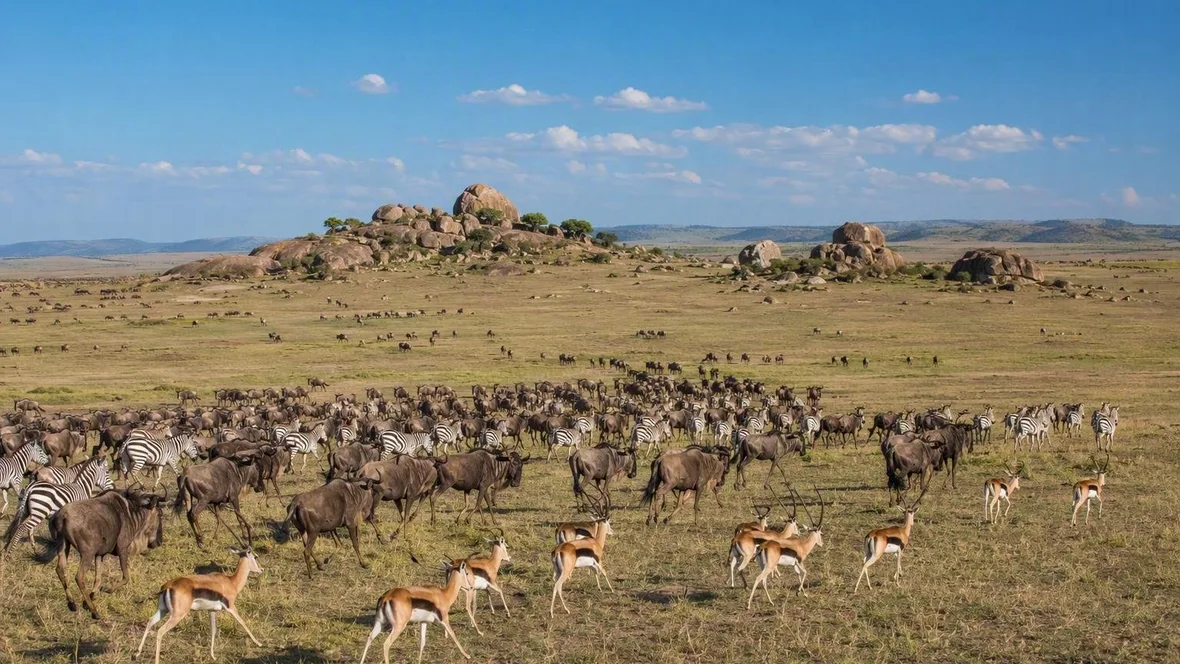
Serengeti takes first place because its scale, biodiversity and conservation value remain visible in the annual movement of grazers. Seasonal rain sends wildebeest, zebra and gazelles through an ecosystem that continues across the Kenyan border, sustaining powerful predator-prey relationships.
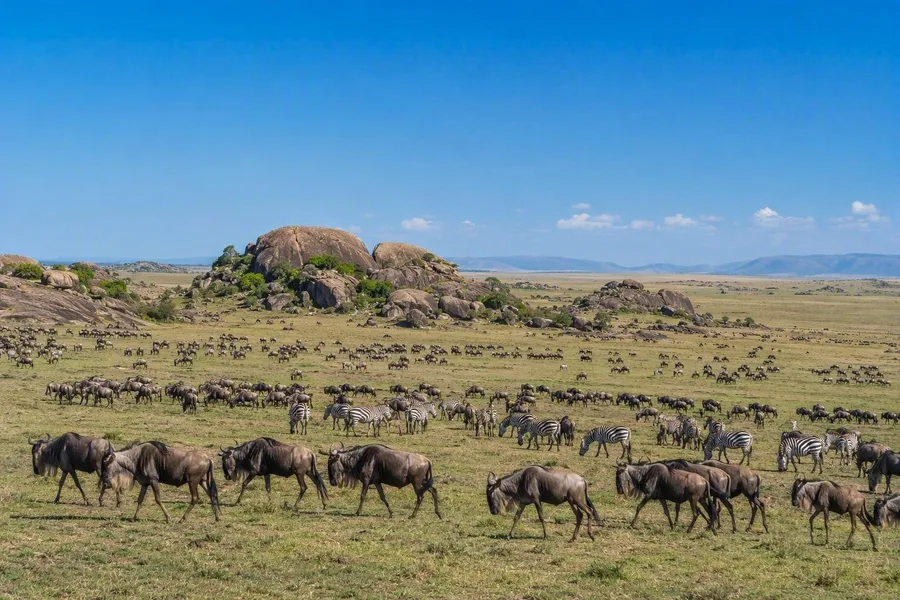 Wildebeest and zebra move across Serengeti’s southern short-grass plains beneath granite kopjes.
This is not one uniform plain. Mineral-rich volcanic ash feeds short grass in the east and south; longer grass, thorn scrub, riverine woodland and clay pans spread west and north. Choose January to February for calving on the southern plains, or June to October for the drier northern phase. No date guarantees a river crossing.
After rain reaches the short-grass plains, herds spread across new growth. Low granite kopjes rise above the moving animals, and winding riverbeds cut through the gently sloping savanna.